Lacking money and support, Trump’s Board of Peace stalls in Gaza
Seven months after the president announced his peace plan for Gaza, the plan is stalled and expected donations to the fund it created are nonexistent.
Seven months after President Donald Trump announced his peace plan for Gaza and more than four months since he convened his Board of Peace to implement and pay for it, the plan is stalled and expected donations to the fund it created are nonexistent.
Disarmament negotiations with Hamas, a crucial part of the plan, have remained deadlocked. The heavily armed militants still control Gaza’s 2 million people, now confined to less than half of what was, before the war, already one of the most densely populated places on earth.
Israel’s military has expanded its occupation of 60% of the enclave that has been cleared of Palestinians and says it intends to take more. Despite the ceasefire declared on Oct. 9, Israel’s near-daily strikes have killed more than 900 Palestinians since then, according to Gazan health authorities.
Security and reconstruction of the destroyed territory seem a distant dream. The glitzy proposal of apartment complexes, high-tech industries, and waterfront tourist resorts displayed by Jared Kushner, Trump’s son-in-law and Gaza negotiator, at the board’s February meeting has been shelved. For now, the most ambitious proposal is to build temporary housing for tens of thousands of Palestinians once still-unrealized governance and security plans are in place.
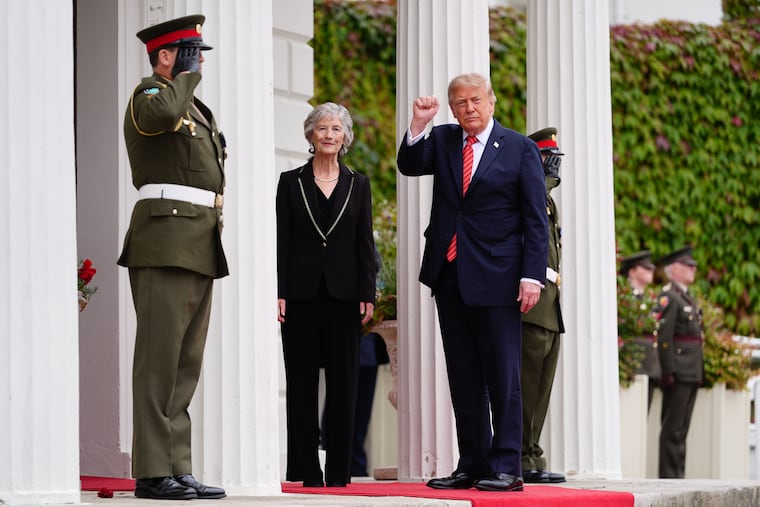
Trump, who declared the Gaza war “over” when the 29-member board of world leaders gathered in Washington on Feb. 19 for its first and only meeting, pledged, “We’re going to make Gaza an example of success and safety and unity.”
Less than 10 days later, the U.S. and Israel launched strikes against Iran. Trump has rarely mentioned Gaza since then.
While the board says that $17 billion has been pledged by its members toward Gaza reconstruction — out of an estimated $70 billion required — little of it has been collected, and virtually none has been spent. Humanitarian aid deliveries — food, fuel, water, medical care — have improved since the ceasefire but are still insufficient. “One in five families is eating only once a day,” the United Nations reported last month, “and mothers are skipping meals so their children can eat.”
Most of Gaza’s borders to the outside world, all of them controlled by Israel, remain closed.
Israel has been clearing rubble in the uninhabited area it controls, and there are board plans to build a logistics hub and operational base for the International Stabilization Force that is intended to provide security oversight during a transition period.
But the board has “no money and they’re not going to get any money,” said one person familiar with the reluctance of Arab governments to contribute funds while long-term peace and a credible path to a Palestinian state remain in doubt. The person spoke on the condition of anonymity about internal discussions.
Bradley Klapper, spokesperson for the board, to whom the White House referred requests for comment, emphasized the positive. “While the ambitions are great and much work remains, let’s put the progress achieved in this short time in perspective,” he said.
All Hamas-held hostages were released by mid-October. Israel Defense Forces attacks that killed an average of about 3,000 people a month in the two years before the ceasefire have been reduced “by 99%,” Klapper said.
Among the plan’s achievements, he said, is that a committee of Palestinian technocrats has been appointed to serve as interim government while Gaza is rebuilt; recruits are being vetted for a new, non-Hamas Gaza police force; and five countries have said they will commit troops to the ISF.
But none of these elements, to the extent they exist, have been deployed inside Gaza.
Instead, the National Committee for the Administration of Gaza, or NCAG, remains in Cairo and has yet to enter the enclave. The Board of Peace has sought approval from the Israeli government to allow the committee inside the IDF-controlled part of Gaza, according to an Israeli official, speaking on the condition of anonymity to discuss internal deliberation. But it is not clear if or when that will happen.
Although what Klapper called a “framework” for the ISF has been established and potential donor countries have been named, the force so far exists only on paper. The board has posted requests for bids on construction work — primarily a logistic site for the future ISF in Israeli-held territory, where some rubble has been cleared. But no contracts have been signed and no work has begun in the rest of Gaza.
In increasingly plaintive terms, Nickolay Mladenov, the Bulgarian diplomat who serves as high representative for the board, has called for movement.
“Seven months since the ceasefire, the door to the future of Gaza is still closed,” he told reporters in a news conference last month. “It is not what the Palestinians were promised.”
In a May 21 briefing to the U.N. Security Council, which has blessed the Trump plan, Mladenov said he would “not stand before this council and call this recovery, because there is no recovery. ... Around 85% of the buildings in Gaza are damaged or destroyed. Some 70 million tons of rubble lie where homes and schools and hospitals used to stand, much of it mixed with unexploded ordnance.”
“More than a million people ... are living, this morning, in tents and in the broken shells of buildings,” he said. “Roughly 80 out of every hundred working-age Palestinians in Gaza have no work. Water is scarce. The health and education systems have not been rebuilt. ... Civilians are still being killed. ... Families still live in fear and uncertainty. ... Restrictions and delays continue to obstruct humanitarian access and ordinary life.”
Other reports by the U.N. and aid organizations cite dangerous infestations of rats and other vermin and the spread of disease. Palestinians are prohibited from almost all of Gaza’s agricultural land, most of which lies behind the expanding lines drawn by Israel’s occupation.
“The people of Gaza are still in desperate need of everything,” said Sobheya Ayyas, 47, who now lives on a rooftop in Old Gaza City with her husband and five children after relocating four times since they abandoned their home at the beginning of the war.
While some goods are available in markets, she said on WhatsApp, they cannot afford meat, fresh fruit, or vegetables, nor replacements for the tattered clothes and blankets they have carried from place to place. Food aid packages largely consist of dried beans and flour, and there has been no electric power since the war began, she said.
“The situation has become unbearable, especially with the intensified airstrikes,” Ayyas said. “We no longer know where to go or what to do.”
The board and Mladenov cite Hamas’s refusal to disarm as the key sticking point, saying that a regular and adequate flow of aid, internal security, reconstruction, and Israeli withdrawal cannot begin without it.
Mladenov and Egyptian negotiators have sought for months to coax Hamas leaders into a framework agreement that would see its fighters turn in their arms in exchange for Israel beginning a phased withdrawal from Gaza.
Under the 15-point, detailed version of Trump’s original 20-point plan that forms the operating basis for Mladenov’s efforts, Hamas fighters would be granted amnesty and could be absorbed into the national police force or choose to go abroad. Hamas could also compete in national elections as long as it gives up its weapons and violent resistance.
“We are not asking Hamas to disappear as a political movement,” Mladenov told reporters recently in Jerusalem. “What is not negotiable, however, is that armed factions or militias with their own military command-and-control systems, with their arsenals or tunnel networks, can exist alongside a transitional Palestinian authority.”
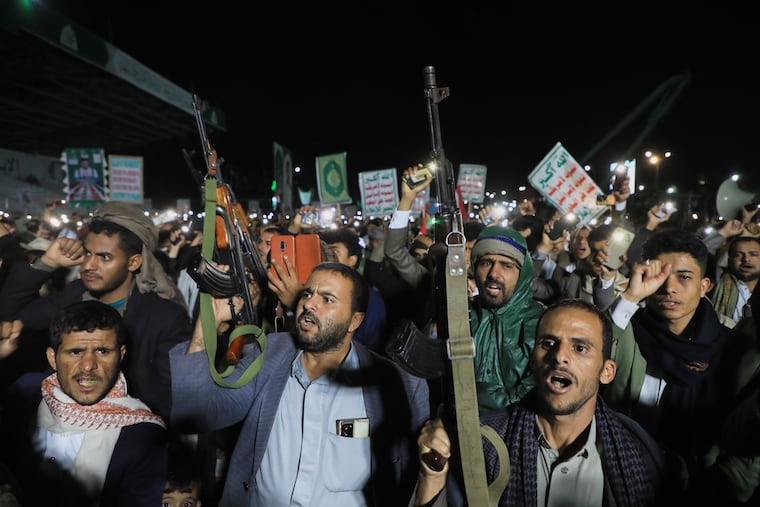
Hamas leaders have so far refused to sign on, in part, they say, because of Israel’s continued strikes and seizure of additional territory, all in apparent violation of the ceasefire.
Responding at a recent conference in Israel to a member of the audience who urged him to seize all of Gaza, Prime Minister Benjamin Netanyahu acknowledged that his latest directive to the army was to take 70% as a “start,” and possibly even more. That’s up from the 53% it initially controlled under terms set out in the peace plan, from which it eventually is supposed to fully withdraw.
In recent statements, Hamas accused Mladenov of absolving Israel’s “daily violations” of the agreement and said Israel was “deliberately sabotaging the mediators’ efforts” to carry out the plan and “flagrantly defying all agreed-upon understandings and guarantees.”
Netanyahu, who has his eye on approaching elections this year, has repeatedly said Israel will never accept the existence of a Palestinian state.
“The main problem for Israel is that although it is taking more and more territory and Israel kills more and more senior members of Hamas, I see no sign for flexibility from Hamas regarding disarmament,” said Michael Milstein, formerly the top analyst for Palestinian affairs in Israeli military intelligence.
“For Netanyahu,” Milstein said, “there is a big gap between all the big slogans and promises of total victory and the current situation, so you need to fill this gap with all kinds of alternative promises of taking more territory.”
Bishara Bahbah, a Palestinian American who has been a mediator between Hamas and the White House, said Hamas officials do not feel assured that their personal safety would be guaranteed after turning over their weapons, and that the U.S. was allowing Israel to get away with ceasefire violations and territorial gains in Gaza.
“We’re at a deadlock right now,” Bahbah said. “There’s going to be a point of explosion. ... If they feel further cornered, I wouldn’t be surprised if there’s renewed fighting in Gaza, and the last thing [Trump] will want to see is images of Israel butchering people in Gaza at a massive scale.”