The Gordie Howe Bridge opening between the U.S. and Canada was postponed. Here’s what to know
In February, Trump threatened to stop or delay the project in a rambling social media post, saying he wished to punish Canada for what he described as its exploitation of the United States.
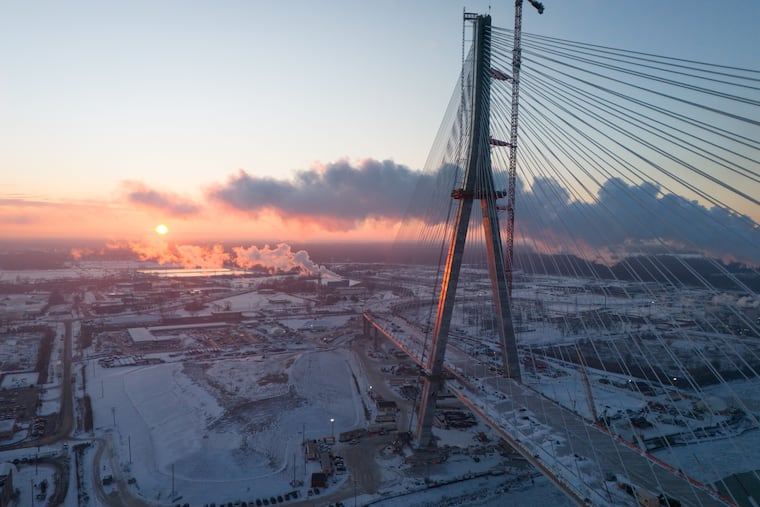
A day before a ribbon-cutting ceremony, the opening of a new bridge meant to ease congestion at the busiest trade corridor between Canada and the United States hit another roadblock, four months after President Donald Trump vowed to block it.
The authority that will operate the 6.4 billion-Canadian-dollar Gordie Howe International Bridge between Detroit and Windsor posted a notice online Thursday announcing that the opening, scheduled for late Friday morning, had been postponed.
“Canada and the United States have agreed to delay the opening of the bridge, taking the necessary time to resolve any outstanding issues,” Chuck Andary, acting CEO of the bridge authority, said in a statement. “We appreciate the efforts of workers on both sides of the border to get the bridge to its current state of readiness.”
The statement offered no details about those issues and gave no new opening date.
Invitations to a Friday opening ceremony had been sent to participants Tuesday.
In February, Trump threatened to stop or delay the project in a rambling social media post, saying he wished to punish Canada for what he described as its exploitation of the United States and its revival of trade ties with China, among other perceived transgressions.
He also demanded compensation for a wealthy Detroit-area family that owns a nearly century-old bridge upstream, which currently carries around $300 million a day in trade.
Matthew Moroun, a billionaire trucking industry scion in Detroit whose family has mounted legal challenges of the project for decades — one even reaching Canada’s Supreme Court — and aggressively lobbied governments on both sides of the border.
Trump had issued his post hours after Moroun met in Washington with Commerce Secretary Howard Lutnick, The New York Times reported in February. Lutnick then called Trump.
Less than one month before that meeting, Moroun donated $1 million to a super PAC devoted to Trump.
What’s being negotiated?
After Trump’s initial post, Canada’s prime minister, Mark Carney, said he called Trump and explained that although Canada paid for the bridge, it will share ownership with Michigan under a 2012 agreement between the two governments.
Canada is Michigan’s largest export market.
“This is a great example of cooperation between our countries,” Carney told reporters at the time. “I look forward to it opening.”
Carney said that Trump asked Pete Hoekstra, who is the U.S. ambassador to Canada and is from Michigan, to “play a role in smoothing the conversation” about the bridge.
In late May, Carney told reporters that there have been “discussions at the ambassadorial level around the bridge.” Neither Carney or officials in Canada or Michigan have offered any details about those talks.
The bridge opening delay comes as a July 1 review deadline for the United States-Mexico-Canada Agreement on trade looms. The Trump administration has been offering varying signals about its continuation in the pact.
On Wednesday, Trump said: “I don’t know that I’m going to renew it.”
The following morning at a conference in Toronto on relations between Canada and the United States, Hoekstra appeared more optimistic about the pact’s continuation.
He advised Canadians to “go into these negotiations very aggressively and say we know America has needs across the board and we’re here to partner with America.”
He added: “We’re open to offers, make your case.”
Why did Canada build a second bridge?
The catalyst for the new bridge was the closing of the border after the Sept. 11, 2001, terrorist attacks.
The enormous, miles-long traffic jams of trucks along roads in Ontario underscored the vulnerability created by relying on a single bridge for commercial traffic at North America’s busiest land crossing.
There is a tunnel for vehicles linking Windsor and Detroit, but tractor-trailers are too tall to fit.
The Ambassador Bridge, which opened in 1929, was also showing its age. Chunks of it regularly fell off, causing lane reductions on the bridge and street closings below in Windsor.
An expressway that runs across southern Ontario ends on the outskirts of Windsor, forcing trucks to make a slow journey to the bridge on a congested local road.
Investors and both governments floated several proposals, including a plan by the Moroun family to build a second crossing alongside the four-lane Ambassador Bridge.
Who is the Moroun family?
Manuel Moroun purchased the Ambassador Bridge in 1979 after building a fortune largely through the expansion of his father’s trucking company. Matthew Moroun, Manuel Moroun’s son, gradually took over as head of the family before the older Moroun’s death in 2020.
Manuel Moroun was known for being exceptionally litigious even with other members of his family. He also had a reputation for disregarding government and court orders.
The Moroun family bought properties on both sides of the border near its bridge and was known for leaving the buildings in those areas to decay, leading to disputes with both cities.
A former railway station in Detroit that became a widely known symbol of the city’s decay was among the family’s holdings. It was sold to Ford Motor Co. in 2018 and was restored.
Who paid for the new bridge?
After finding no interest among U.S. lawmakers, the Canadian government has entirely financed the bridge’s construction and even paid for the highway interchange on the American side. The United States paid for the bridge’s border inspection facility.
The project cost CA$6.4 billion, or $4.7 billion. The province of Ontario also completed a $1 billion highway expansion that opened a decade ago.
By alleviating traffic on streets in Windsor, the bridge, which has been built roughly six years behind schedule, will benefit both countries, said Dennis Darby, CEO of the Canadian Manufacturers and Exporters, an industry group.
“Fewer bottlenecks and fewer surprises mean more resilient, competitive supply chains,” Darby said in a statement.
This article originally appeared in The New York Times.