Muslim pilgrims perform Hajj rituals under intense heat as Eid al-Adha celebrations start
The Hajj, one of the Five Pillars of Islam, is required once in a lifetime of every Muslim who can afford it and is physically able.
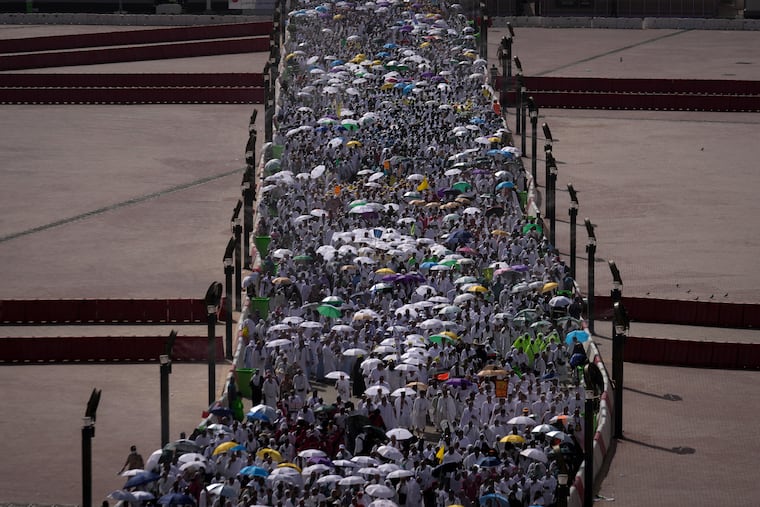
MINA, Saudi Arabia — Masses of pilgrims in Saudi Arabia threw pebbles at a large pillar in a symbolic ritual on Wednesday, one of the final days of the Hajj as Muslims around the world started celebrating the Islamic holiday of Eid al-Adha.
Pilgrims in Mina, Saudi Arabia, chanted “Allahu akbar” (“God is great”) while throwing pebbles in a ritual seen as a symbolic stoning of the devil. The act is also considered a symbol of rejecting evil and a commemoration of the prophet Ibrahim’s rejection of temptation when the devil tried to dissuade him from submitting to God’s will.
Large crowds of pilgrims moved through the sprawling Jamarat complex after arriving from Muzdalifah, where they collected pebbles overnight following a day of worship and prayer at Arafat on Tuesday.
Aamar Shakur, a pilgrim from Pakistan, said he saw the pebble throwing as a symbol of confronting personal struggles in which he was “throwing the stone to my own devil.”
The last days of the Hajj in Saudi Arabia coincide with Eid al-Adha, or “Feast of Sacrifice,” which marks the willingness of Ibrahim, known as Abraham to Christians and Jews, to sacrifice his son. During the holiday, Muslims typically slaughter sheep or cattle and distribute some of the meat to poor people.
The Hajj, one of the Five Pillars of Islam, is required once in a lifetime of every Muslim who can afford it and is physically able. Performed over several days, the Hajj can be a deeply moving spiritual experience and a chance to seek God’s forgiveness. Rituals on its final days also include circling the cube-shaped Kaaba.
A joyous occasion subdued for some
The physically demanding Hajj has been held this year in intense heat, which appeared to take a toll on some as they moved between holy sites. Medical teams stationed across Mina were seen treating several pilgrims.
Many poured water over their heads and faces to cool themselves under the scorching sun, while others carried umbrellas. Some pushed elderly relatives and loved ones in wheelchairs through the crowds toward the pillars so they could complete the ritual.
The Hajj brings together large numbers of Muslims of diverse races, ethnicities, languages, and socioeconomic classes, creating a sense of unity for many. More than 1.5 million pilgrims arrived from abroad, a Saudi official said Friday.
This year’s Hajj has taken place against the backdrop of a tenuous ceasefire in the Iran war and related uncertainty throughout the region.
Eid al-Adha is a typically a joyous occasion, marked with communal prayers, food, and festive gatherings with loved ones. In some places, though, conflicts and economic pressures are dampening festivities for many.
In Jakarta, Indonesia, Muslim worshipers have joined communal prayers in the mosques and streets.
Lebanon is observing Eid al-Adha amid an ongoing conflict between Israel and the Hezbollah armed group. Many of the displaced people in the country are sheltering in tented settlements or repurposed public schools, a far cry from the normalcy of spending the occasion among friends and family in their hometowns.
“There is no Eid for us. We are displaced, forced to leave our land, our homes, our livelihoods, while our memories are being destroyed,” said Rabee Khreis, who fled the village of Khiyam where intense fighting has taken place.
A U.S.-brokered ceasefire in the Israel-Hezbollah conflict appeared more nominal by the day, complicating efforts at a broader peace in the Iran war.
‘Only for the people who lost no one’
In the Gaza Strip, where the Israel-Hamas war that began in October 2023 has devastated the territory and its people, Palestinians are observing a subdued Eid al-Adha under a fragile ceasefire and amid rampant suffering and displacement.
“This is not Eid … we’re dead,” said Mahmoud Saqer, a displaced man from Khan Younis.
In Khan Younis and Gaza City, amid destroyed buildings, worshipers gathered for Eid prayers with few signs of celebration as the typical holiday joy eluded many.
“There’s no Eid. My children were killed,” said Ayda Al-Banna, a displaced woman from Gaza City, who prayed with her granddaughter. “Eid is only for the people who lost no one.”
Israel’s military offensive in Gaza has killed more than 72,803 Palestinians, according to the Gaza Health Ministry, caused widespread destruction, and displaced most of the territory’s residents. The ministry, part of the Hamas-led government, maintains detailed casualty records that are seen as generally reliable by U.N. agencies and independent experts. It does not give a breakdown of civilians and combatants.
Israel launched the offensive after Hamas-led fighters killed about 1,200 people, mostly civilians, and took 251 hostage in an attack on Israel on Oct. 7, 2023. While the heaviest fighting has mostly subsided since a fragile ceasefire took effect on Oct. 10, deadly Israeli strikes have repeatedly disrupted the truce. Hamas and Israel have accused each other of violating the ceasefire.