What we know about damages from Hurricane Lala in Hawaii
Hurricane Lala, which was a Category 1 hurricane, did not make landfall but moved close enough to do substantial damage, mostly on the Big Island.
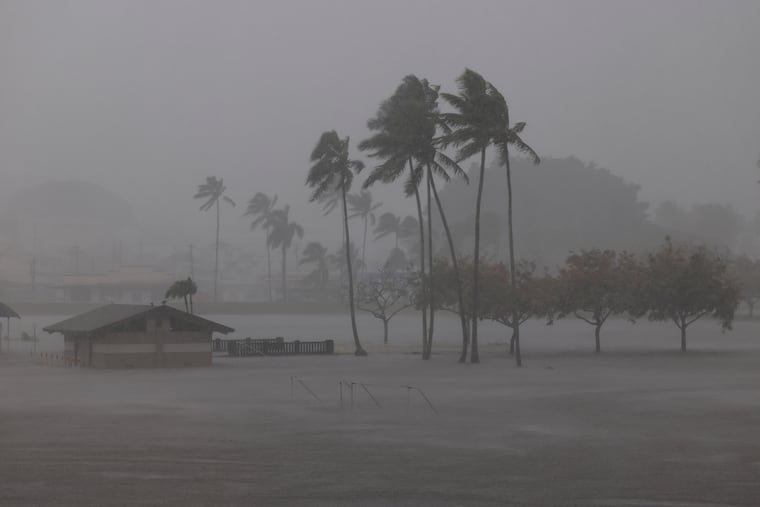
Hawaii residents faced extensive power outages, submerged bridges and roads, and damaged homes after Hurricane Lala brushed along the islands.
Hurricane Lala, which was a Category 1 hurricane, did not make landfall but moved close enough to wash out highways, wreck properties, and topple trees. Hurricanes are common in the Pacific Ocean, but landfall in Hawaii is rare because of its small size in relation to the expansive ocean. The eye of Lala did not cross over into land, but the outer bands still left significant destruction, primarily affecting people living along the southern and eastern edges of Hawaii’s Big Island.
On Sunday and Monday, residents and emergency crews continued to sift through damage. Here’s what we know:
The Big Island was drenched
Gov. Josh Green of Hawaii said that some areas received as much as 30 inches of rain and that there were several reported mudslides. More than 13 inches had fallen at Hilo International Airport as of Sunday night. About 35 inches of rain was recorded near Nene Cabin, a weather observation site on the southern tip of the Big Island. Laupahoehoe, on the Hamakua coastline in the northeast part of the island, measured more than 43 inches during the storm, with the majority of precipitation falling within 24 hours beginning Saturday afternoon.
Hilo, on the eastern edge of the Big Island, is one of the rainiest cities in the United States, and residents are used to frequent downpours. But many residents said they were surprised at the intensity of the storm.
Hurricane Lane in 2018 similarly passed south of Hawaii and produced comparable rainfall totals in the same locations. The difference with Lala is that it came dangerously close enough to produce damaging winds, including hurricane-force winds, on the Big Island.
Residents were spared the worst of the worst, which is found in the eyewall, but the more intense side of Lala (the right side in the direction the storm is traveling) hit the Big Island directly. One wind gust at the Mauna Kea Summit measured 140 mph, and another near sea level in Kona registered 78 mph. (Hurricane-force winds are 74 mph or greater.)
One person was killed, and about 100 homes were damaged on the Big Island.
On Saturday, when the storm passed through, a 45-year-old man was killed in a head-on car accident in the southern area of the Big Island. A 21-year-old woman was critically injured from the collision.
Two paramedics were also rescued in Naaleuh, in the southern region of the Big Island, after floodwaters trapped them in their vehicle.
About 100 homes had been damaged or washed away because of the storm, Green said.
Officials said some of the worst damage may have occurred in rural places in the southern edge of the Big Island but that fallen electrical lines have complicated efforts for people to get to the area.
The coastal town of Pahala, which has about 1,800 residents, was cut off from the rest of the island after floodwaters inundated roads and bridges — six were destroyed or severely damaged, officials said. Part of a major highway also collapsed, which blocked road access to Ka’u Hospital, the region’s only hospital.
County fire officials said they were prepared to use helicopters to move patients with medical emergencies.
“There’s a lot of damage that we’ll be working on,” Green said Sunday afternoon.
Hundreds of thousands remain without power
More than 114,000 homes and businesses remained without power in Hawaii on Monday, down from about 200,000 customers Sunday. That includes about 40% of the customers on the Big Island, which is largely rural.
People could face days or weeks without power because the storm downed transmission lines that connect power plants to homes and businesses. Because of widespread flooding and other challenges traveling along rural roads, officials said it could take weeks for the power to be fixed on the Big Island.
Green said that schools, state and county offices, and courts across the state would be closed Monday, as Hawaii recovered from the storm and worked on restoring power. All airports and harbors had reopened, according to the Hawaii Department of Transportation.
The damaged transmission lines include one that runs for 42 miles on the Big Island. In addition to knocking out power lines, the storm also damaged many of the large structures that carry the lines on the Big Island and Oahu.
This article originally appeared in the New York Times.