U.S. gave Tehran details on Iranian asylum seekers, lawsuit alleges
The suit claims U.S. officials had secret meetings to give Iran’s government confidential information about asylum applications for Iranians it planned to deport.
A lawsuit filed Tuesday in Washington alleges the Trump administration violated U.S. law by providing Iran’s government with confidential information detailing the asylum applications for Iranians it planned to deport.
The extraordinary claim, outlined in court papers submitted by the Iranian American Legal Defense Fund and Public Citizen Litigation Group, contends that the materials it alleges were shared with the Iranian government could jeopardize the lives of pro-democracy protesters along with members of religious minorities and the LGBTQ community and their families.
An annual State Department report on human rights in Iran, released last year under the Trump administration, called the situation in Iran “severe” and worsening, with political protest movements and religious minorities targeted by authorities. Previous U.S. administrations have reported that Iranian authorities have targeted LGBTQ people for prosecution and subjected them to humiliating treatment.
“The law couldn’t be more clear that information in asylum applications is protected,” said Michael Kirkpatrick, a Public Citizen attorney involved with the complaint. He called the case “potentially a matter of life and death” for Iranian asylum seekers who end up deported back to Iran.
Since returning to office last year, immigration hard-liners in the Trump administration have taken several steps that opponents say has eroded the United States’ established practice of allowing migrants who say they are fleeing persecution to seek asylum in the country. The administration and its allies have argued that the asylum system had become overwhelmed and, in some cases, abused by individuals making dubious claims.
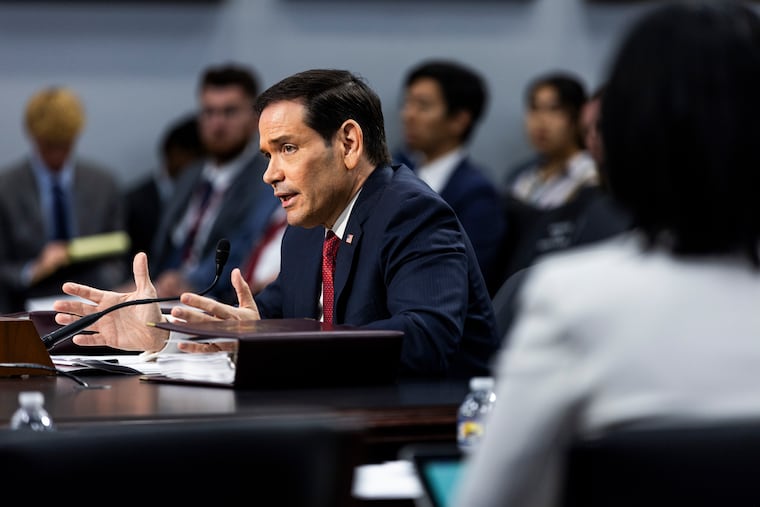
The lawsuit names as defendants Secretary of State Marco Rubio, Homeland Security Secretary Markwayne Mullin, and acting director of U.S. Immigration and Customs Enforcement (ICE) David Venturella, along with the agency each leads.
Spokespeople for the three agencies did not provide comment. The Iranian Mission to the United Nations did not respond to a request for comment.
The lawsuit seeks an end to the alleged practice and to require that the U.S. government notify anyone whose personal information was shared with the Iranian government without their consent. It is not immediately clear how the government might respond or whether the case would succeed.
Despite long-running tensions between the U.S. and Iranian governments, which escalated into all-out warfare in February, the Trump administration has deported more than 100 Iranians back to the country since President Donald Trump’s return to office in 2025, according to advocate groups that track deportations and reports in the Iranian news media.
Iranian officials said last year that they had reached an agreement with the Trump administration to accept approximately 400 Iranian deportees. More recently, the administration included at least one Iranian national among a group of people deported from the United States to the Central African Republic, lawyers for the group have said.
The lawsuit filed Tuesday in U.S. District Court in D.C. includes accounts of alleged secret meetings between officials from the Trump administration and representatives of the Iranian government dating to March 2025.
Because the United States does not have diplomatic relations with Iran, the government in Tehran is represented in Washington by the Iranian Interests Section at the Embassy of Pakistan.
Kirkpatrick told the Washington Post that the allegations contained in the lawsuit are based, in part, on the account of an Iranian government official who is assigned to the Pakistani Embassy and accounts from deportees who have said that Iranian officials knew details from their applications seeking asylum in the United States.
The lawsuit does not identify the Iranian government officials or the deportees to whom attorneys spoke. The Pakistani Embassy did not respond to a request for comment.
At the initial meeting in March 2025, the lawsuit alleges, State Department officials met with representatives of the Iranian Interests Section in Washington. The lawsuit alleges that the discussion encompassed the Trump administration’s desire to deport Iranians to Iran, with the administration officials handing over a list of roughly 150 names. The lawsuit does not identify by name any of the meeting’s participants.
After this encounter, the lawsuit alleges, it was agreed that officials from ICE and the Iranian government representatives would hold monthly meetings so that the administration could share information about Iranians in U.S. custody.
ICE falls under the Department of Homeland Security, which at that time was led by Kristi L. Noem. Mullin took over as secretary in March after Trump removed Noem from the post. Noem now serves as the special envoy to the Shield of the Americas, a State Department position. The State Department did not respond when asked if she wanted to comment.
The lawsuit also alleges that while in-person meetings between ICE officials and Iranian officials were halted after Feb. 28, when the U.S. and Israel started the war with Iran, ICE officials continued to send documentation to the Iranians.
Roughly 115 Iranian nationals are believed to have been sent back to Iran on three U.S. deportation flights, according to advocacy organizations that track the deportations. The most recent is said to have occurred Jan. 26, only weeks after anti-government protests there were met with a severe response that is estimated to have left thousands dead.
Trump had earlier this year expressed sympathy with the protesters, telling them on Jan. 13 that “help is on the way.”
It is not clear how many of those deported back to Iran had asylum claims pending before the U.S. government. Lawyers for some of the deported Iranians have said that people from at-risk groups were among those deported on the flights.