Pentagon seeks more than $200 billion in budget request for Iran war
The Pentagon has asked the White House to approve a more than $200 billion request to Congress to fund the war in Iran, according to a senior administration official, in an enormous new ask that is almost certain to run into resistance from lawmakers opposed to the conflict.
The Pentagon has asked the White House to approve a more than $200 billion request to Congress to fund the war in Iran, according to a senior administration official, in an enormous new ask that is almost certain to run into resistance from lawmakers opposed to the conflict.
That number would far surpass the costs of the administration’s massive airstrike campaign to date and instead seek to urgently increase production of critical weaponry expended as U.S. and Israeli forces have struck thousands of targets over the last three weeks, according to three other people familiar with the matter, who confirmed that the Defense Department is seeking packages of that size.
Like some others for this article, the people spoke on the condition of anonymity to describe the administration’s sensitive planning.
It remains unclear how much the White House will ultimately ask congressional lawmakers to approve. Some White House officials do not think the Pentagon’s request has a realistic shot of being approved in Congress, the senior administration official said. The Pentagon has floated several different proposed funding requests over the last two weeks, according to the official and three other people familiar with the matter.
Asked about the $200 billion figure at a news conference Thursday, Defense Secretary Pete Hegseth did not directly confirm the amount, saying it could change.
“It takes money to kill bad guys,” Hegseth said.
But he said: “We’re going back to Congress and our folks there to ensure that we’re properly funded.”
The funding request is likely to stage a major political battle in Congress, as public support for the effort remains tepid and Democrats have been sharply critical. Republicans have signaled support for the forthcoming supplemental request but have not committed to a legislative strategy or found a clear path to surpass the Senate’s 60-vote threshold.
President Donald Trump said the administration is asking for the money for reasons beyond Iran.
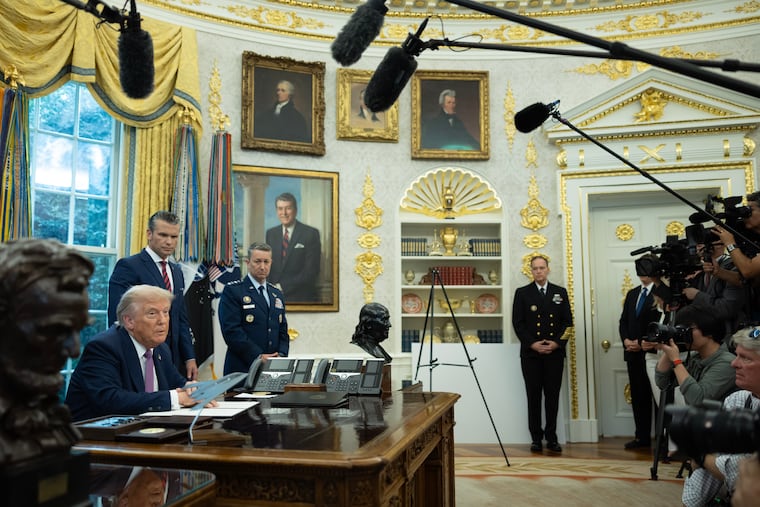
“This is a very volatile world,” the president said from the Oval Office. He said the emergency spending would be a “very small price to pay” to ensure the nation’s military stays in top shape.
Trump campaigned on ending American adventurism abroad and frequently hammered the Biden administration for the amount of money approved to finance the war in Ukraine. By December, Congress had approved roughly $188 billion in spending for the war in Ukraine, according to the U.S. special inspector general for Operation Atlantic Resolve.
The cost of the war in Iran has rapidly grown, exceeding $11 billion in the first week alone, according to multiple officials. Shortly after the joint U.S.-Israeli campaign began late last month, the Trump administration started preparing an additional funding request to help cover the costs, a process often required to ensure the military can maintain its readiness to defend against threats around the world even during wartime.
Inside the Pentagon, the effort was led by Deputy Defense Secretary Steven Feinberg, who has focused for the last year on the American defense industry and increasing production of precision munitions, which have been rapidly depleted by the war, according to two people.
Feinberg’s office put together a range of packages in a bid to quickly address the Pentagon’s munitions shortage and jolt the country’s at-times-sluggish defense industry, one of the people said.
Even before the war in Iran, Trump had called for a $1.5 trillion defense budget, a more than 50% increase from the previous year. It remains unclear how, and whether, the supplemental may count toward that total. The White House Office of Management and Budget objected to that total in internal discussions, suggesting it was too large.
Sen. Tom Cotton (R., Ark.), chairman of the Senate Intelligence Committee, has also pushed for the administration to include additional funding for the intelligence community in its final package.
Experts say the coming fight over the Pentagon’s funding request is likely to be a test of the war’s popularity, as critics are expected to try to defeat the measure as a signal of their opposition to U.S. involvement in the conflict.
“We have made some cost estimates of the costs of the war based on the limited data available, but there’s tremendous uncertainty, and Congress wants to know what the bill is,” said Mark Cancian, a senior adviser at the Center for Strategic and International Studies, a Washington think tank. “If the administration asks for more money, there will be a big political fight because all the anti-war sentiment will focus on that request.”
Rep. Rosa DeLauro (D., Conn.), the ranking Democrat on the House Appropriations Committee, said of the $200 billion price tag: “It’s outrageous.”
To muscle a package to passage, Republican leaders could either try to go it alone through an arduous budget process or cut deals with Democrats on other priorities that would likely balloon the overall price tag.
House Majority Leader Steve Scalise (R., La.) signaled the negotiations ahead.
“Ultimately, we’re going to have negotiations with the White House on an exact amount,” Scalise said. “We’re not at that point yet.”
An additional problem with any request will be the limitations on how quickly the U.S. defense industry will be able to increase production, a time frame limited by the number of available workers, production facilities, and critical materials required to build the military’s most exquisite weaponry, experts said.
“Just throwing lots of money into the industrial base doesn’t necessarily get you things sooner, but you’re definitely not going to get it sooner if you don’t,” said Elaine McCusker, the Pentagon’s former acting comptroller who now analyzes the defense budget at the American Enterprise Institute.
This article contains information from the Associated Press.