First round of U.S.-Iran talks ends with high hopes and big challenges
Mediators from Pakistan and Qatar said early Monday that Vice President JD Vance and his Iranian counterparts had made “encouraging progress”
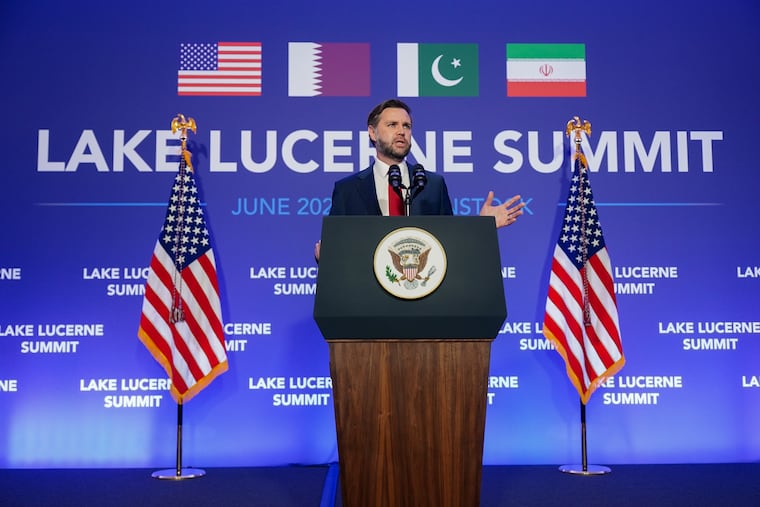
ZURICH — The morning after the first overnight session of renewed talks between the United States and Iran, aimed at turning an incomplete truce into a lasting peace deal, the vibes were as warm as the heat wave currently washing over Switzerland.
Mediators from Pakistan and Qatar said early Monday that Vice President JD Vance and his Iranian counterparts had made “encouraging progress” toward the goal of cementing a final peace agreement within 60 days. Swiss officials called the outcome “constructive.”
“Yesterday was a very, very good day,” Vance told reporters Monday afternoon. “We made a lot of good progress. We did exactly what we wanted to do.”
He added that Iran had promised to readmit nuclear inspectors from the International Atomic Energy Agency, a U.N. watchdog, though Iran did not immediately confirm that.
But other details that emerged from the luxury Bürgenstock Resort Lake Lucerne suggested that the discussions over the next two months could still prove difficult and that efforts to reach a deal could proceed in fits and starts.
Iran’s delegation, headed by the speaker of parliament, Mohammad Bagher Qalibaf, walked away from the table Sunday to protest a social media post from President Donald Trump that threatened to resume U.S. attacks on Iran if a deal did not come together. They eventually returned.
Perhaps more important were the still-unresolved topics that appear to have dominated much of the conversation.
The 60-day window, which was established by the initial memorandum of understanding that Trump and Iran’s president signed last week, was meant to be a period for Iran and the United States to solve crucial issues left out of that first-step deal. Most notably, that includes Iran’s nuclear ambitions. The memorandum says that Iran will dilute its existing stockpile of near-weapons-grade nuclear material but does not clarify how that will happen or whether the country will be barred from producing such material in the future.
Those issues were not center stage, aside from Vance’s mention of the IAEA inspectors, whose return would still be far from a solution to the nuclear question.
Instead, the first talks focused largely on two topics that were supposed to be settled: How to enforce a ceasefire between Israel and Hezbollah in Lebanon, and how to ensure shipping traffic, including oil tankers, flows freely again through the Strait of Hormuz.
Israel launched the war on Iran alongside the United States in February and was not party to last week’s initial deal. Despite the deal’s call for a ceasefire, both Israel and Hezbollah have continued to carry out attacks on each other. Iran protested Israel’s attacks over the weekend by saying that it had closed the Strait of Hormuz — which has been clogged throughout the war, sending global oil prices skyward — though U.S. officials said that ships were still passing through.
Mediators from Qatar and Pakistan, who joined Iranian and U.S. officials at Lake Lucerne, said Monday morning that discussions would continue through this week.
Some analysts warned Monday against an overly optimistic takeaway.
Financial markets had reacted to Trump’s initial agreement with Iran “with a classic show of irrational exuberance,” Carl B. Weinberg, the chief economist for High Frequency Economics, an American analysis firm, wrote in a research note Monday morning. “This week should bring a reality check,” he noted.
Weinberg added that he believed Iran was likely to string out the talks for much longer than 60 days — all the way until January 2029, when the next U.S. president will take office.
The stop-start nature of the negotiations has heightened the uncertainty.
Vance had been scheduled to fly to Switzerland on Thursday night, but canceled the trip at the last minute after Iran pulled out in protest, diplomats said, at continuing Israeli attacks in Lebanon.
Nothing in the statements from the mediators, or from Iranian officials, suggested that the negotiations were barreling toward the sort of quick capitulation that Trump has intimated would be the endgame for the talks. For example, Qalibaf wrote on social media that Iran’s “armed forces are prepared to respond” if Trump attacked Iran again — raising the possibility of more war.
Still, the releases from the mediators and hosts conveyed, at the very least, a sense that the talks had succeeded in starting the gears of a more traditional diplomatic process.
Qatar and Pakistan said that the discussions had led to “the creation of a mechanism for further technical talks.” Swiss authorities said that the parties had agreed to “a road map aimed at reaching a final agreement within 60 days.”
“Our aim,” Swiss officials wrote, “is that our diplomacy contributes to de-escalation, stability and peace.”
This article originally appeared in the New York Times.