Trump-Xi summit likely delayed as president pushes China to help open Hormuz
The Iran war could throw into question a long-planned effort to reset relations between the world’s two largest economies.
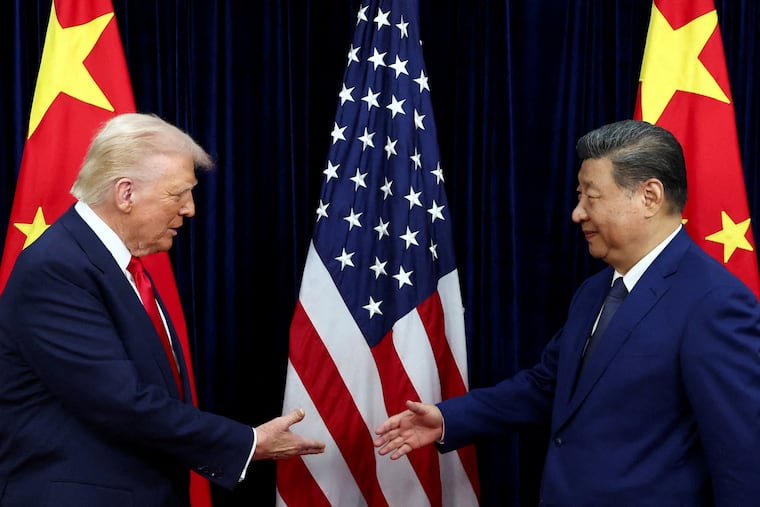
President Donald Trump is likely to delay a planned trip to China this month as he pressures Beijing and NATO allies to send warships to help the United States reopen the Strait of Hormuz, throwing into question a long-planned effort to reset relations between the world’s two largest economies.
The U.S. campaign in Iran, now in its third week, has unsettled global energy markets and injected a note of uncertainty into Washington’s broader foreign policy agenda, as Trump called on allies and rivals alike to help reopen the strait — a vital artery for global oil and gas supplies — in an apparent acknowledgment that the task cannot be managed by the U.S. military alone.
In an interview with the Financial Times on Sunday, the president acknowledged he “may delay” the China trip and said he would “like to know” Beijing’s position on helping police the strait before traveling. On Monday, White House press secretary Karoline Leavitt confirmed the summit dates could be moved.
“The president looks forward to visiting China. The dates may be moved. As commander in chief, it’s his number one priority right now to ensure continued success of the operation, Epic Fury,” she said, referring to the name the Pentagon has given to massive military action against Iran.
The Associated Press reported on Monday that Trump said he’s asked to push off the meeting by a “month or so” because of the war.
“I want to be here,” Trump said at the White House. “I have to be here, I feel.
“I think it’s important that I be here. And so it could be that we delay it a little bit” Trump said.
The Chinese Embassy in Washington did not immediately respond to a request for comment Monday. One Chinese official familiar with the preparations told the Washington Post they believed a delay was likely and that a new date had not been set. The official spoke on the condition of anonymity due to the sensitive diplomacy surrounding the summit.
Beijing — unlike the White House — had not publicly confirmed the March 31-April 2 visit, a common practice in Chinese diplomatic planning given the potential for last-minute changes.
U.S. Treasury Secretary Scott Bessent, a key figure in negotiations before the China trip, on Monday morning denied a connection between the Iran operation and Trump’s meeting with Chinese leader Xi Jinping, saying that any potential delay would be due to “logistics.”
“If the meetings are delayed, it wouldn’t be delayed because the president demanded that China police the Strait of Hormuz,” Bessent told CNBC’s Brian Sullivan.
Trump has hoped to secure a political win ahead of the midterm elections by striking a deal with China on agricultural purchases, while both sides seek to extend a fragile trade truce after a tumultuous year marked by tensions over Trump’s tariff campaign and Beijing’s restrictions on rare-earth exports. Last month, the president said he hoped the trip would be “biggest display you’ve ever had in the history of China.”
However, the widening fallout from the U.S.-Israeli war in Iran has rapidly subsumed Washington’s foreign policy agenda.
“Hopefully China, France, Japan, South Korea, the UK, and others that are affected by this artificial constraint will send ships to the area so that the Hormuz Strait will no longer be a threat,” Trump said in a post on Truth Social on Saturday.
On Sunday, he warned that NATO allies would face a “very bad future” if they failed to help the United States in Iran.