As war reshaped the World Cup, Iran’s team found an unlikely home in Mexico
When the Iranian national team needed a new World Cup home, the Mexican border city — and its small contingent of Iranian expats — welcomed them.
TIJUANA, Mexico — The three SUVs pulled into the gas station parking lot, one after the other, Iranian flags taped onto the hoods and fluttering from the windows.
It was barely 4 a.m. The city’s nightclubs were closing, and the streets were dark. But this caravan had hatched a plan to stake out a national soccer team they never imagined they would see in person, and especially not here. So 4 a.m. at the gas station it was.
Like so many in Tijuana, the Iranian national soccer team was never supposed to end up here. They originally had planned to spend the month across the border, in Tucson, preparing to play their World Cup matches in Los Angeles and Seattle.
But for the first time in World Cup history, a host country is at war with one of the tournament’s contenders. FIFA, global soccer’s governing body, with tensions high and uncertainty about whether the team would even be allowed into the U.S., sought an alternative.
Co-host Mexico agreed to house them, with President Claudia Sheinbaum telling reporters that FIFA had asked for help because the “United States does not want the Iranian team staying overnight in the country.” Organizers opted for Tijuana, a border city close enough to the U.S. matches, with a stadium where the team could practice and a local government eager to welcome them.
Now Sadegh Galavi and his relatives were piled into these SUVs, hoping to welcome their national team to the city that adopted his family. They knew what the world thinks of Tijuana, the dangerous, gritty border city from the movies, a hub for drug smugglers, and a cheap destination for Americans seeking parties and sex.
But they knew Tijuana as something different: a transient, multicultural city that embraces migrants and misfits, offering creole schools for Haitian children whose families are stranded there, and welcoming Sadegh and his wife four years ago when they knew no Spanish and not much more English.
It was just the place for a global soccer tournament, they thought, an unlikely but ideal refuge for their home team.
Sadegh and his friends spent the past two weeks working to convince the Iranian Embassy and team that Tijuana is safe. Now the team was minutes away from landing at Tijuana International Airport.
He had slept barely an hour, anxiously tracking the team’s flight, worried he might miss his chance to greet them. The jerseys ordered on Amazon hadn’t arrived on time, but the Iranian Embassy sent replacements at the last minute. The ambassador asked Sadegh’s wife, Maryam Asidi, to take photos and videos of the fans at the airport, to show Iranians back home that Tijuana isn’t as dangerous as they might fear.
“Hi brother, yes, please,” Sadegh said, answering his phone as he pulled into the airport. Military and police forces surrounded the airport’s entrances. The players must be landing soon, he thought.
He pulled over, hopped out of the car and power-walked toward the flight arrivals, waving his small Iranian flag.
A divisive team
Known affectionately as Team Melli, Iran’s national team was near-universally loved in Iran for decades.
“There was absolute mania around Team Melli,” said Arash Azizi, an Iranian author and historian who recalled celebrations breaking out in the streets in Iran after the team qualified for the 1998 World Cup. “It was one of the most trusted, beloved institutions in Iran across political differences,” he said.
But after years of government mismanagement and repeated, brutal crackdowns on civilian protesters, many Iranians began to see even their national soccer team as an extension of the country’s leadership.
During the 2022 World Cup, in Qatar, Iran was engulfed by nationwide “Women, Life, Freedom” protests, and its men’s national team faced criticism for not vocally supporting the protesters. The team stood silently during Iran’s national anthem, but some fans were unsatisfied. Social media videos showed Iranians honking horns and setting off fireworks after their team’s 1-0 loss to the United States, which they viewed as a symbolic defeat for the regime.
Then, this March, the Iranian women’s team came under criticism from pro-government media outlets for standing silently during the national anthem, after reports that Iranian security forces had killed thousands of people in a violent January crackdown on protests.
Australia granted six players and a staff member humanitarian visas, citing concerns they would be persecuted for failing to sing along. Eventually, five of the team members withdrew their claims and were welcomed back to Iran with an elaborate ceremony.
Then came the war, which threw the men’s team’s season into chaos. Most play in domestic Iranian leagues whose games were suspended Feb. 28. A friendly, scheduled to be played in Arizona, was canceled. President Donald Trump, in a Truth Social post, said the Iranian team was “welcome” to play in the World Cup but advised them against it “for their own life and safety.”
Just days before the team was scheduled to travel to Mexico, it still hadn’t received its U.S. visas. Earlier this month, the players learned their visas had been approved, but visa applications for 15 members of the team’s support staff had been rejected.
In an interview with the Washington Post in Tijuana, Iran’s ambassador to Mexico said the 15 people included trainers, managers, a media director, a security leader and a delegate from the Foreign Ministry. He accused the United States of failing to follow FIFA rules.
On Tuesday, Iran’s soccer federation said the ticket allocation for Iranian fans had been revoked, in an “unexpected move.” FIFA requires that participating federations be allocated 8% of ticket capacity, so fans can purchase entry to their team’s games.
“From my perspective, politics needs to be separate from sports,” Abolfazl Pasandideh, the Iranian ambassador, said through his translator in Tijuana. “And if in this case they want to mix the two, it has to be the other way around. Politics must be at the service of sports.”
But to some in Tijuana’s small Iranian community — the ambassador puts it at 20 or so, in a city of over 2 million people — politics are inherent to Iranian soccer.
“For the team to come here while the country is grieving … I don’t think that celebrating the football team right now is appropriate,” said Pedram Maymand, 31, who moved to Tijuana from Fresno, Calif., when his student visa expired after graduation about five years ago. “They’re representing the government that is killing our people."
If he could meet the players, he would want to send them a message, he said: “Have you any shame?”
Sadegh understands the complex feelings. But to him, Team Melli is still a symbol of national pride, of a country he chose to leave but that remains a core part of who he is.
How Tijuana became home
Sadegh’s family’s path to Tijuana, like the stories of many in this city, began with a romance across borders and cultures.
About 50 years ago, Maryam said, her father visited San Diego as part of the Iranian military. He fell in love with a Mexican woman, who eventually gave birth to their son.
Maryam grew up hearing about the half brother she had never met, who lived in the faraway city of Tijuana. But she didn’t believe the story until her half brother came to visit Iran for the first time when he was in his 20s, and she was 13.
Many years later, after marrying Sadegh, Maryam decided to visit her brother’s city, not knowing anything about Tijuana’s reputation. Within two weeks, they had decided to stay.
“Here, you never feel you are from another country,” Maryam said. “This country makes you feel good. … And as a woman, you are more free.”
She shed her hijab, a head covering that is mandatory for women in Iran. Within weeks of leaving the Islamic republic, where drinking is banned, Sadegh tried mezcal for the first time. The music coursing through Tijuana’s streets on Friday and Saturday nights made Maryam feel alive.
They longed for their family and for home, but they soon began finding the other Iranians. One day Sadegh saw a car parked on the side of a road with vanity plates: “Tehran.” He left a note on the windshield with his phone number; the car‘s owner is now his friend and boss, at a car-restoration business in town.
Sadegh and Maryam gave birth to a Mexican son, Sepehr, whose middle name, Mayahuel, was a reference to an Aztec god. “We want him to feel he’s from here,” Maryam said.
When her mother died unexpectedly of a heart attack last year, Maryam fell into a deep depression and returned to Iran for a long visit with her 9-month-old son. The trip coincided with the U.S.-backed Israeli attacks on Iran, and she had to flee the country by land. As soon as she landed back in Mexico, she was moved by the strangers who offered to help carry her suitcase.
She worried her grief would taint the city for her. Instead, Tijuana pulled her out of it. This was the place where she wanted to raise her son, she decided. The couple bought a house in Tijuana and began applying for Mexican citizenship.
Then, with the World Cup on the horizon and the war raging, rumors started circulating: Their country’s team needed a home.
‘I am in my country’
Late last month, FIFA announced the team was heading to Tijuana.
Sadegh could hardly believe it. When Iranian news outlets raised concerns about security, he began messaging the players directly on Instagram to tell them about the city he loves and assure them they would be safe. He knew he would never get a response but kept typing anyway.
His boss and friend, Dara Makoipour, met with the Iranian ambassador and showed him around the city — to the stadium, to the restaurant known as the origin of the Caesar salad. Local tourism and Chamber of Commerce officials were eager to use this as a chance to change Tijuana’s reputation and put it on a global stage.
Sadegh started a WhatsApp group with his small circle of Iranian and Iranian Mexican family and friends in Tijuana, and they came up with a plan to welcome them at the airport for their 1:30 a.m. arrival. When the flight was delayed to 5 a.m., some in the group pulled out.
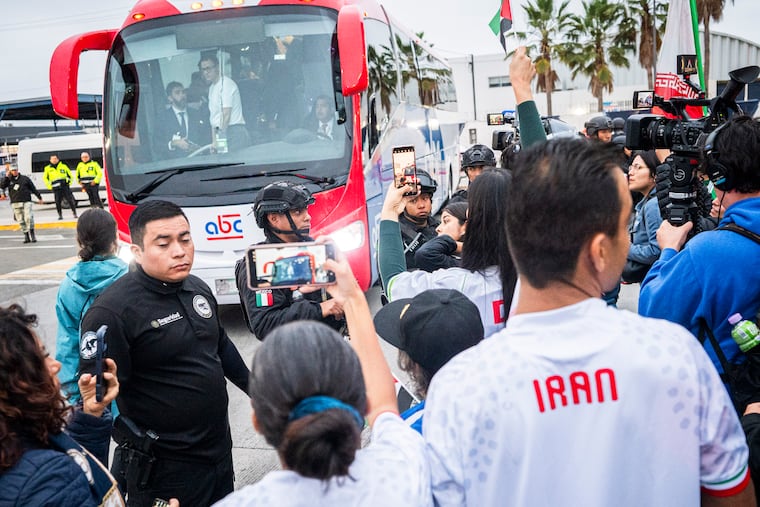
But his small family caravan had powered through, and now they were gathered in international arrivals, surrounded by heavily armed Mexican national guard troops, trying to scope out where they might be able to catch the team.
They walked around a security roadblock to a group of reporters and a handful of other fans from across the San Diego area.
Suddenly the team bus approached with a military escort. The small crowd cheered, raising their flags and chanting the name of one of the players. A team representative briefly rolled down the window and waved straight toward Sadegh.
“Merci,” the Iranian representative said with a smile.
Sadegh, his heart racing, accidentally spoke to them in English, calling out, “welcome!” He had forgotten he could speak to them in Farsi.
“Bienvenidos!” his Mexican relatives shouted.
Reporters surrounded the couple to ask them how they felt. Maryam beamed.
“I think now I am in my country,” she said.
The team later circulated a photo, taken from the bus on their arrival that morning, of Sadegh waving his flag. He proudly shared it on Instagram, writing in English and Farsi that “the Iranian national team belongs to all Iranians,” regardless of their beliefs, religion or political stance.
“Welcome to Tijuana,” he wrote.