As Christians are attacked in Israel, government shows little concern
In the predominantly Christian town of Taybeh, 10 extended families have emigrated because of pressure and attacks by Israeli settlers.
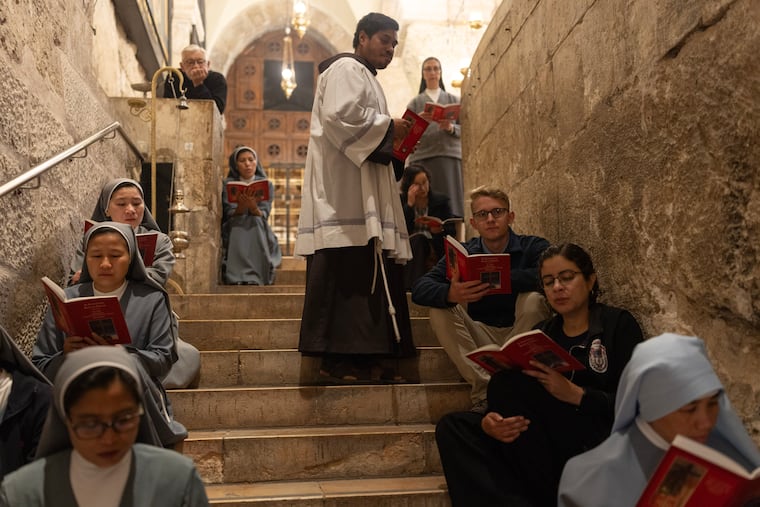
JERUSALEM — The stone footpath begins at the tomb of King David, revered by Jews, and curves past the room where Christians believe Jesus held the Last Supper. Nearby, the Dormition Abbey towers over a site where many believe Mary slept before being taken to heaven.
Steeped in history and faith, this quiet alleyway in Jerusalem’s Mount Zion was the site of a brazen attack in April, when a Jewish Israeli man from the occupied West Bank shoved a French Catholic nun to the ground and kicked her out of “religious hostility,” according to Israeli police.
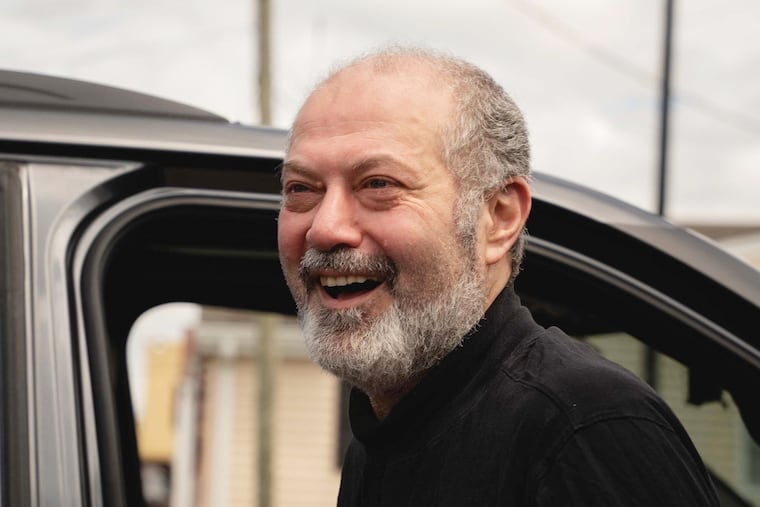
The assault, recorded by surveillance cameras in broad daylight, shocked many. But not Nikodemus Schnabel, abbot of the Dormition Abbey, which the nun had visited before she was attacked.
Christians today are “hit, spit at, beaten,” said Schnabel, who has experienced it all — and worse. “There was a video in this case, but you can be sure there are so, so many undocumented things.”
“Believe me,” he sighed, “this is not the case of one lost soul.”
Across the Holy Land, Christians are being targeted by a tide of hostility and violence — attacks that risk drawing the ire of Christians in the United States, including evangelicals who are traditionally among Israel’s most ardent American supporters.
In Jerusalem, Christians say they are routinely harassed by ultra-Orthodox Jews and huddle in fear when Religious Zionists rampage through the Old City, destroying property during their processions.
Twenty miles away, in the West Bank’s only predominantly Christian town, Taybeh, the population is dwindling after years of unrelenting attacks and economic pressure from armed Jewish settlers.
U.S. Ambassador Mike Huckabee, an evangelical pastor who has often spoken in Israel’s defense, visited Taybeh last year after settlers allegedly set fire to its most famous landmark, the 1,500-year-old Church of St. George, and denounced what he called “an act of terror,” though he later retracted that statement.
Meanwhile, a string of social media posts from neighboring Lebanon, where Israeli soldiers have recorded themselves smashing Christian icons and defacing churches despite calls for discipline from military commanders, have reinforced a sense that animosity toward Christians is being normalized under Prime Minister Benjamin Netanyahu’s government, the most right-wing in Israel’s history.
For decades, Christian monastics and pilgrims, easily identifiable with their robes and crosses, faced harassment in Jerusalem. But the number of incidents nearly doubled from 2023 to 2025 and is on track to reach a new high this year, according to the Rossing Center, an interreligious organization in the city.
At different times in the past 18 months, the two joint-chief rabbis of Israel, David Yosef and Kalman Ber, have issued statements condemning attacks on Christians as antithetical to Jewish values and as a “severe phenomenon” that “must be eradicated.”
But local and national political leaders have often kept their silence.
After the attack on the nun on April 28, which drew condemnation from the French Consulate, the Israeli Foreign Ministry was one of the few official voices that issued a statement, calling the assault a “shameless act” that contradicted Israel’s founding values of “respect, coexistence, and freedom of religion.”
Netanyahu’s office did not comment at the time of the assault but in a statement to the Washington Post said: “We have made it clear that any acts of violence and vandalism of this type will not be tolerated. Those who commit such acts will be prosecuted to the fullest extent of the law.”
When an earlier wave of harassment targeting Christians made headlines in 2017, Itamar Ben Gvir, then a settler activist and lawyer, gave a radio interview to defend spitting at Christian monks and churches as “an ancient Jewish tradition.”
“I don’t think this represents any violation,” said Ben Gvir, who today leads Israeli law enforcement as minister of national security, a post he was given despite having been convicted of supporting a Jewish terrorist organization and inciting racism. “Why do we turn this into a criminal matter?”
A spokesperson for Ben Gvir did not respond to requests seeking comment.
Francesco Ielpo, the custodian of the Holy Land and a senior Vatican official in Jerusalem, said he feared the growing influence of Israel’s far right will push Christians in Israel and the Palestinian territories to leave, accelerating a pattern of emigration among a prosperous and well-educated minority group.
Although Israel’s Central Bureau of Statistics says the population of Christians in Israel and Jerusalem has ticked up about 1% annually to 184,200 at the end of 2025, or 1.9% of Israel’s population, Christian leaders say the official data does not reflect that many Christians included in the census mostly live abroad.
In the West Bank, the Christian population has hovered between 40,000 and 50,000 for years, as emigration balances out births.
“The general atmosphere is this: Many people are afraid,” Ielpo said. “I can give good works and health assistance. I can give good schools. But all this is not enough. You need hope to remain.”
Christian village under siege
From a vantage point an hour north of Jerusalem’s Old City, Suleiman Khouriyeh pointed in every direction to explain how the residents of Taybeh — a village that, according to the Gospels, once gave refuge to Jesus and his disciples — now cannot find relief themselves.
Khouriyeh, the mayor, was blocked from harvesting his 4-acre olive grove after settlers closed in from the west, seized his land and built a fence. Across the valley, a local business owner, Hanna Massis, was building a multistory hotel but halted construction because of settler attacks.
Bashir Marouf, the owner of a house on a street where settlers often arrive at night to set up roadblocks to disrupt the local traffic, had long fled.
To the south was Roland Bassir’s cement factory, its office windows shattered and its machinery destroyed from a recent attack. Initially, in late 2023, settlers set up a single tent on a nearby hilltop. One tent became a few trailers, then a small farm.
Over the next two years, settlers from the outpost began taking their cattle to graze inside the factory premises and forcing Bassir’s workers to leave in the middle of the day, according to Bassir and videos his employees recorded.
They lofted an Israeli flag, vandalized cars, and smashed equipment. During two attacks, on Sept. 14 and March 14, they shot in the air with rifles, Bassir said. Struggling to keep the factory running, Bassir has laid off nearly all of his 45 employees.
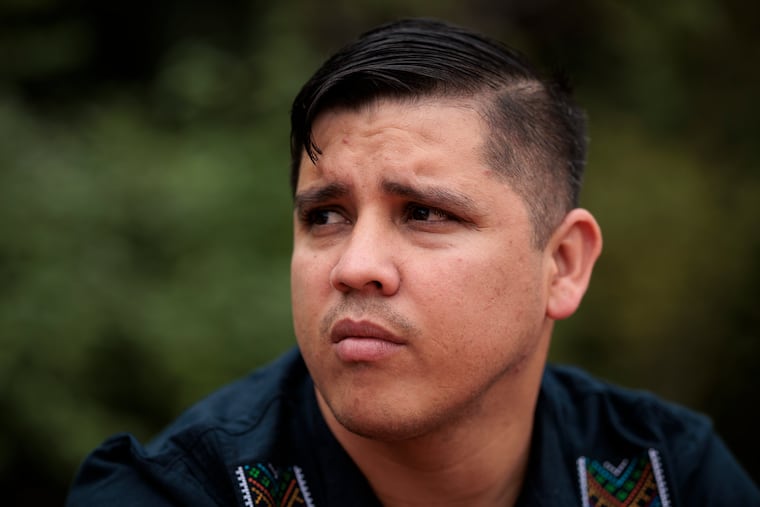
After sinking more than $100,000 into the business, Bassir was ready to abandon it, he said. He has already applied for a U.S. visa. “If I get it, I will leave tomorrow,” Bassir said. “There is no future. Every day I think it might be my last day here, because I might be killed.”
In the past 10 years, 10 extended families have left Taybeh for the United States, Latin America, and Spain - a significant exodus for a town of 1,500 residents, Khouriyeh said.
“They can’t handle living here,” Khouriyeh said. “It’s really hard, especially for young men who don’t have jobs and are forced to leave. What we see is Israelis taking the whole area.”
On a recent afternoon, Khouriyeh sat in his office with municipal employees, venting about the Western governments that they believed should do more to protect them — if not as Palestinians, then at least as Christians.
In 2024, many Taybeh residents celebrated when Donald Trump was reelected as president, believing he was the “peace president,” recalled Khouriyeh and the acting mayor during the recent election period, Khaldoun Hanna.
The following year, the village felt relieved when Huckabee, Trump’s new ambassador to Israel, visited.
But their appreciation turned to fury when Huckabee retracted his statement after Israeli police denied finding clear evidence of an arson attack.
Months later, villagers found clips of Huckabee telling Tucker Carlson in an interview that Israel had the divine right to claim as its own the Palestinian territories and parts of Egypt, Lebanon, Syria, and Iraq.
“Someone ask Huckabee, is he America First or Israel First,” a young municipal employee, Jeries Taye’e, angrily demanded.
“He’s Israel First,” Hanna snorted.
Mayor Khouriyeh raised his hands, then posed a question: Without a change in policy in Israel — and in Washington — what will happen to the Christian population here?
“We have the oldest holy sites: the Church of the Holy Sepulchre, the Church of the Nativity,” Khouriyeh said. “But what is the value of an empty church without Christians?
International dimensions
At a time when Israel already faces international isolation and criticism over its actions in Gaza, particularly from the Islamic world, tensions with Christians could further undermine a crucial pillar of support, some Israeli analysts warn.
In America, Christian conservatives — who traditionally leaned pro-Israel — have questioned Vice President JD Vance at public events about Israel’s treatment of Christians, noted Avishay Ben Sasson-Gordis, an expert on U.S.-Israel relations at the Institute for National Security Studies, a Tel Aviv think tank that advises the government. Christian nationalist commentators who are influential on the American right, like Carlson and Candace Owens, also frequently cite reports of attacks and harassment against Christians when they lambaste Israel, Ben Sasson-Gordis said.
“The violence against Christians and the [Israeli] political figures who encourage it are bad enough that something needs to be done about them,” he said. “But it’s also important to pay attention to the way it alienates Israel’s friends and provides tools for Israel’s detractors.”
These days, the slew of headlines suggests that anti-Christian sentiment has grown particularly quickly among Israeli youths, said Yisca Harani, the founder of the Religious Freedom Data Center, a Jewish Israeli group that operates a hotline for reporting attacks against Christians in Jerusalem.
Harani now organizes a group of about 100 Jewish volunteers to walk alongside Christian nuns whenever they leave their homes, and since the May attack, nuns have called Harani every day requesting a protective presence. The problem begins with education, said Harani, an observant Jewish Israeli who has pushed Jewish religious schools to teach more about the history of Christians in the Holy Land.
“Half of Israel is greatly affected by the rhetoric of Jewish supremacy and Jewish exclusivity,” Harani said. “What can only be the outcome if in school they say: ‘All gentiles want your annihilation, remember what the Christians did, remember what Hamas did.’ People therefore look at the world through glasses of fear, estrangement, and, finally, animosity.”
For Nikodemus, the Dormition Abbey abbot, the change in atmosphere is more easily explained.
When he first traveled to Israel in 2003, he saw advertisements at the Tel Aviv airport showcasing the country as the home of Christian holy sites. The minister of tourism at the time held receptions where the young Benedictine monk was welcomed. But over the years, the occasional curses that Schnabel encountered in dark alleys became spitting and open confrontations in broad daylight.
“That’s the difference between then and now,” Schnabel said. “The government.”
One major shock for Schnabel came in 2015, when Jewish extremists set fire to the Church of the Multiplication, where it is said Jesus performed the miracle of feeding 5,000 people with two fish and five loaves.
A decade later, one memory from the arson trial has stuck with Schnabel: the attorney delivering a fiery courtroom argument in defense of the young Jews accused of terrorism.
That lawyer was Itamar Ben Gvir, now the minister of national security.