A diocese tries to protect its 29-foot Jesus from Trump’s border wall
The diocese's chancellor says,"Our symbol was there first. The wall is an in-your-face insult.”
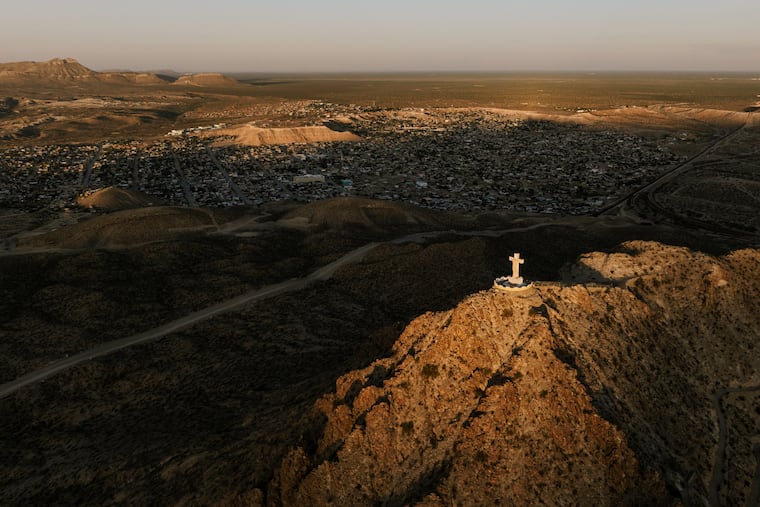
LAS CRUCES, N.M. — At sunrise, when the day’s first golden glow washes over the 29-foot-tall limestone Jesus atop Mount Cristo Rey, Lourdes Castañon feels the presence of the divine. “The rays catch it,” he said, “and, oh man, I think I’m touching the face of God.”
Countless pilgrims from around the world journey to the sacred site just on New Mexico’s side of the southwestern border, but Castañon fears for its future. At the mountain’s base, President Donald Trump wants to build his border wall, and the small Catholic diocese that owns the land is trying to stop it.
The Department of Homeland Security is attempting to use eminent domain to seize 14 acres of desert from the diocese, based in Las Cruces, N.M., so it can raise about 1.5 miles of new wall. The church claims a towering steel barrier would desecrate a holy landmark and violate the religious liberties of those who wish to worship there.
“It will look like a scar on Mother Earth,” said Castañon, 74, a volunteer with the Mount Cristo Rey Restoration Committee, an independent group that works to keep the site clean and accessible.
Homeland Security sued to wrest control of the land from the diocese last month, offering about $180,000 as compensation. The diocese, which had pleaded with the Trump administration to consider alternatives to a wall, countered in court, arguing that the lawsuit flouted the First Amendment and laws to further protect religious freedom.
“The wall is a physical manifestation of this government’s attitude toward migrants,” the diocese said Friday in a legal brief that detailed its arguments and included testimony from local bishops and others. “Nothing could be less Catholic.”
The ongoing federal case is the latest example of opposition to a border wall Trump wants to extend across the entire southern frontier. Since Trump’s first term, aggrieved landowners, environmentalists, and Native American tribes have fought the president’s barrier-building, tying up government lawyers in court.
The Trump administration has claimed broad authority over wall construction, but opponents have secured a few tentative wins, including this year in Texas’ Big Bend National Park, where U.S. Customs and Border Protection had to change plans after a bipartisan outcry.
Now, an administration that holds itself up as a defender of the devout is facing off with Catholics asserting their freedom of religion.
“This is not a battle between the church and the government; it’s a battle between symbols,” said Deacon Jim Winder, the chancellor of the diocese. “One is a 29-foot statue of Christ the King, which is meant to symbolize unity and hope, and the other is a 30-foot iron monstrosity that symbolizes exclusion and division. Our symbol was there first. The wall is an in-your-face insult.”
Customs and Border Protection has acknowledged Mount Cristo Rey’s significance, but the agency has argued that the site is also popular for drug smugglers and human traffickers. The mountain is the only stretch of land in the area not fortified with tall fencing — Cristo Rey was long considered a natural barrier — and the federal government now sees the gap as a security problem.
Part of the new segment will be built on federal land and the rest “will have no adverse impact” on Mount Cristo Rey, the government has said, because it won’t block the trail leading up to the Christ sculpture. Construction will occur several hundred feet below the statue.
“Anyone who spent 30 seconds examining a map of Mount Cristo Rey and the southern border would realize how ludicrous these claims are,” John B. Mennell, an agency spokesperson, said in a statement, referring to the church’s arguments.
Mount Cristo Rey, known also as Sierra de Cristo Rey, near El Paso, Texas, and the suburbs of Mexico’s Ciudad Juárez, saw its first pilgrim in the early 1930s, after a local priest, Father Lourdes Costa, gazed out his window at the distant peak and envisioned a soaring crucifix at its summit.
Costa made the challenging trek and shared his premonition with the Diocese of El Paso, which purchased the land from the state of New Mexico. In the nearly 90 years since the sculpture was completed, hundreds of thousands of faithful have traveled to the top, some on their knees and others barefoot, over rough ground studded with yucca and creosote.
It also attracted those looking to cross into the United States illegally. As migrant apprehensions soared, members of the restoration committee, among the mountain’s most frequent visitors, noticed an uptick in vandalism and crime at the site.
Not all of Mount Cristo Rey’s devotees oppose the wall. Ruben Escandon, whose parents and grandparents preceded him as Cristo Rey caretakers, worried that border-related safety concerns have held the site back from being considered one of the world’s premier Catholic attractions, like the statue of Christ the Redeemer in Rio de Janeiro.
He is opposed to Trump’s immigration agenda, he said, but the surrounding segments of the border wall are funneling migrants onto his cherished mountain. The barrier needs to be completed, he said.
“It has nothing to do with immigration policies; it has to do with keeping Mount Cristo Rey safe,” said Escandon, a former police officer who specializes in performing cross-border marriages. “Hopefully it will allow the traditional visitor to come without fear.”
But environmental and migrant rights groups say the new wall would disrupt a fragile desert ecosystem and make an already dangerous journey over the border more deadly.
The diocese said it respects the Trump administration’s authority to secure the area. When Border Patrol officials asked in recent years to carve a roadway through Cristo Rey property, the diocese agreed and charged the government nothing. The church has not objected to the agency’s use of sensors and cameras around the mountain.
But a wall is too far, Winder said.
Barrier construction elsewhere has threatened or destroyed other cultural sites, including a 1,000-year-old Native American etching that federal contractors mistakenly bulldozed in Arizona this year. And the blasting involved in building near Cristo Rey could damage the statue, he said.
Lawyers for the Justice Department have been pushing to accelerate the case, filing motions to condemn the property and take possession of it in quick succession. “Time is of the essence,” they argued, because the government has already contracted with construction companies and could be fined if the project is delayed.
“We’re just getting run over,” Winder said.
A Justice Department spokesperson, Natalie Baldassarre, said “the taking is authorized by law” and that it “will not impact activity or use of the shrine.”
Kathryn Brack Morrow, an attorney for the diocese, said the government’s urgency was not justified.
“This is a self-inflicted emergency,” Morrow said. “The diocese has raised weighty religious liberty concerns that warrant deliberate consideration.”
Contractors have already begun working at the base of Cristo Rey. On a recent morning, 15-year-old Fernanda Vazquez hiked up the winding trail with her family and looked down at the ribbon of dirt where the wall may soon be built.
“It just breaks my heart,” she said. “It just doesn’t seem right.”
This article originally appeared in the New York Times.