Colts owner Jim Irsay secretly relapsed and got ketamine from a private doctor before his death
The Post’s investigation is based on interviews with five people with direct knowledge of Irsay’s relapse, all of whom spoke on the condition of anonymity out of fear of retaliation from the Colts.
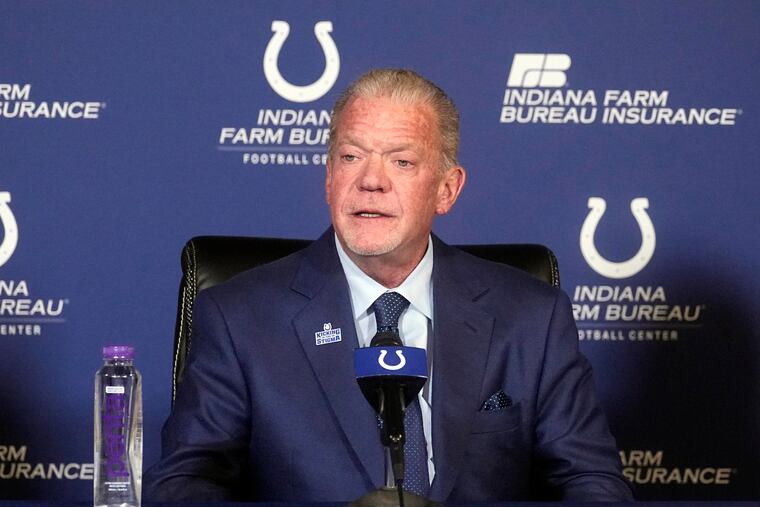
In the final years of his life, Jim Irsay, the owner and chief executive of the NFL’s Indianapolis Colts, spoke proudly about how he confronted his lifelong substance abuse battle with honesty and transparency, even launching a charity to promote openness around mental illness and addiction. He called it Kicking the Stigma.
But behind the scenes, Irsay, who died in May at 65, spent the last two years of his life in the throes of a relapse that he and Colts executives repeatedly hid from the public, a Washington Post investigation found.
» READ MORE: From May: Indianapolis Colts owner Jim Irsay dies at age 65
This relapse, and his death, came as he was under the care of a “luxury” recovery doctor prescribing Irsay opioids — and, eventually, ketamine — at amounts that worried people close to him, The Post found. This doctor signed Irsay’s death certificate, stating the cause was cardiac arrest, and no autopsy or toxicology testing was performed.
The Post’s investigation is based on interviews with five people with direct knowledge of Irsay’s relapse, all of whom spoke on the condition of anonymity out of fear of retaliation from the Colts, who are now owned by Irsay’s three daughters. All five said they witnessed Irsay consuming opioid pills. Four said they witnessed Irsay receiving ketamine injections.
Post reporters also interviewed several other people close to Irsay and obtained previously unreported prescription records, flight data and law enforcement records from California, Indiana and Florida.
The account of Irsay’s relapse that emerges from The Post’s reporting is at odds with public explanations that Irsay and the Colts gave for his rapidly declining health, and raises questions about how authorities investigated his death.
The Post found evidence that Irsay suffered three overdoses in the last five years of his life: in February 2020 in Turks and Caicos; in December 2023 at his home in suburban Indianapolis; and then again 12 days later at a beachfront resort near Miami.
Two days before the Florida overdose, Irsay fired one of his nurses and asked police to escort her away because she tried to hide his pills, concerned he was taking them too fast, a police report shows. This overdose left him hospitalized for nearly four months.
And while Irsay and the Colts publicly touted the importance of transparency in addressing addiction, he and team executives repeatedly misled the public about his relapse, The Post found.
When Irsay overdosed at his home in 2023, a Colts executive who called 911 said nothing to the dispatcher about pills or drug use, stating only that Irsay may have been suffering from heart failure. When news outlets uncovered this incident, Irsay disputed the police description of it as an overdose.
And when the public learned of Irsay’s lengthy hospitalization in 2024, the team claimed he was being treated for a “severe respiratory illness,” while Irsay later said he had been recovering from back surgery.
Irsay’s daughters, Carlie Irsay-Gordon, Casey Foyt and Kalen Jackson, declined to be interviewed. In response to an email summarizing the contents of this story, they provided a statement asking for privacy.
“Our Dad was open about his battles with addiction and mental health. He never claimed to be perfect,” the Colts co-owners wrote. “The media is not the place to address inquiries about information which is disputed, lacks essential context, or involves private medical matters.”
» READ MORE: What is a ketamine therapy session like? A Philly-based therapist explains her process.
The people with knowledge of Irsay’s relapse said they agreed to speak to The Post because they were concerned about the treatment he received from Harry Haroutunian, a prominent addiction specialist based in California.
Over the last two years of Irsay’s life, Haroutunian regularly supplied Irsay with the opioid pills that fueled his addiction, these people said. Images of pill bottles reviewed by The Post show Haroutunian prescribed Irsay more than 200 opioid pills in the days before his two overdoses in December 2023.
In Irsay’s final months, these people said, Haroutunian began treating him with ketamine, the powerful anesthetic that contributed to the 2023 death of Hollywood actor Matthew Perry. Nurses working under Haroutunian’s direction were frequently seen by these people injecting Irsay with ketamine, which experts said is risky to administer to patients with substance abuse disorders and heart conditions.
Irsay had a heart condition, these people said, in addition to his publicly admitted addiction struggles.
In a phone interview, Haroutunian briefly discussed his treatment of Irsay before declining further comment, citing medical privacy laws.
“I dedicated 18 months of my life to try to care for him … as a brother,” he said. “We did everything we could to make him as comfortable as possible.”
Haroutunian did not respond to multiple emails sent later summarizing The Post’s reporting, including concerns raised by others about opioids and ketamine he provided Irsay.
When Irsay died in May at the Beverly Hills Hotel, Haroutunian was also staying there and overseeing Irsay’s care, according to statements from police. He signed the death certificate, listing the cause as cardiac arrest due to pneumonia and heart issues.
The Los Angeles County Department of Medical Examiner declined to investigate Irsay’s case or conduct an autopsy, a spokeswoman said, because it did not consider his death sudden, violent or unexpected.
Beverly Hills police closed their investigation into Irsay’s death several days later, according to a department spokesman. Officers who responded to the hotel where Irsay died saw no signs of an overdose or drug use, this spokesman said, and Haroutunian assured them the cause of death was natural.
But without an autopsy and toxicological testing, according to three experts in death investigations, there is no way to know whether pneumonia caused Irsay’s heart to stop.
Irsay’s daughters, in their statement to The Post, did not directly address the concerns raised by others about Haroutunian’s treatment of their father.
“Our focus remains on honoring our Dad’s legacy, his decades of philanthropy, his loyalty to the Colts and its fans, and his passion for mental health advocacy, music, and second chances,” Irsay’s daughters wrote.
A powerful figure
Irsay has been synonymous with the Colts since 1984, when his father, Robert Irsay, moved the team out of Baltimore under the cover of night and made his 24-year-old son the youngest general manager in NFL history.
When Robert, who struggled with alcoholism, died at 73 in 1997, Jim inherited the team, becoming one of the youngest owners in league history at 37. Far from a figurehead, Irsay also ran the team as its chief executive and was active and influential in NFL matters, including serving on the league’s finance committee. He became a beloved figure around Indianapolis, a testament perhaps as much to his charisma, generosity and quirkiness as it was to the team’s success, which peaked with a Super Bowl championship following the 2006 season.
Among NFL owners, who can be stiff and reserved, Irsay stood out. He powerlifted competitively, collected expensive artifacts of rock music and American culture, and socialized with an eclectic group of friends that included musician John Mellencamp and countercultural writer Hunter S. Thompson.
He also regularly made multimillion-dollar donations in the Indianapolis community and, on occasion, tossed $100 bills to fans at practice.
But beneath the rock star persona, he nursed addictions to match.
Irsay’s substance abuse problems burst into public view in 2002, when news outlets in Indianapolis uncovered his involvement with a plastic surgeon under investigation by federal law enforcement. In one 24-day period, the Indianapolis Star reported, the surgeon had given Irsay prescriptions for 400 pills of the opioid painkiller OxyContin.
Indianapolis’s NBC affiliate then found concerns about Irsay’s addiction dating to 1995. That year, an Indianapolis police detective told both the NFL and the Colts that she believed Irsay, then the team’s 35-year-old general manager, needed treatment, after she found him involved with another doctor suspected of running a pill mill.
Amid the media attention in 2002, Irsay publicly acknowledged an addiction and said he had recently sought treatment.
“I took care of it,” Irsay told the Star in 2005. “Some people aren’t as lucky to pull through this.”
In 2012, Irsay told ESPN he had been sober from both pills and alcohol since 2002 and acknowledged recovery was a lifelong battle.
“I don’t care how tough you are. This disease is 5 trillion and 0 — technical knockout every time,” he said then.
Two years later, Irsay, then 54, suffered a public relapse when police pulled him over for driving erratically and found dozens of pills and thousands of dollars in cash strewn about his car. He pleaded guilty to driving while intoxicated and admitted to being under the influence of opioid pills and the antianxiety medication Xanax.
For the first time, Irsay’s substance abuse drew punishment from the NFL, which suspended him for six games and fined him $500,000 for violating the league’s expansive personal conduct policy. Irsay-Gordon, the eldest of his three daughters, ran the team in his absence.
When Irsay returned after his suspension, he said he hoped his public struggles would reduce the shame around addiction.
“Any way I can take away from the stigma is good,” Irsay said. “I’ve had many, many years of continual recovery. What’s really important is that you can be honest.
‘Share your story’
In the years after Irsay’s 2014 intoxicated driving conviction, from all outward signs, he kept his addiction under control.
But around the Colts’ front office, according to several former employees, it was common knowledge that Irsay periodically suffered relapses that team executives worked to keep from public disclosure, out of concern the league office or fellow NFL owners would ask him to step aside as chief executive or pressure him to sell the team. The NFL declined to comment or answer questions about its knowledge of Irsay’s relapses.
While the NFL’s conduct policy grants the league office authority to punish team owners for actions considered detrimental to the league, in practice, Commissioner Roger Goodell has only moved against owners on rare occasions due to public pressure or calls from other owners.
Irsay himself played a lead role in one such situation, publicly calling in 2022 for the league to consider removing Daniel Snyder as owner of the Washington Commanders, a year before Snyder decided to sell.
The Colts executives who helped keep Irsay’s relapses under cover, former employees said, included two longtime team employees: chief operating officer Pete Ward, who was worked for the team since 1981, and general counsel Dan Emerson, who started with the team in 1984.
Ward declined an interview request.
“I’ve always approached my responsibilities with the utmost professionalism and care,” he wrote in an email to The Post. “Out of respect for everyone, I don’t believe it’s appropriate to comment on anyone’s private health matters, whether living or deceased.”
In a brief phone interview, Emerson declined to answer questions but defended the team’s handling of Irsay’s substance abuse struggles.
“We handled everything in an appropriate, professional, ethical and moral fashion,” he said. “... I really wish everybody would let my friend rest in peace.”
Around Irsay, former employees said, these executives took steps to keep his continued struggles with pain pills secret. Colts employees who worked close to Irsay were made to sign strict confidentiality agreements, as were his personal employees at his home, including his cooks and nurses, and even his girlfriends.
When Irsay suffered overdoses, these people said, he was taken to Ascension St. Vincent Hospital, about 10 minutes from his home, where staff agreed to admit and treat him in private, to help escape public detection.
The hospital’s financial reports over the years routinely list the Colts and Irsay as donors, and the team eventually forged an official partnership with the hospital. Ascension St. Vincent declined to comment, citing medical privacy laws.
By 2020, it had been six years since Irsay had publicly acknowledged a relapse. But that year, he sought treatment at the Coleman Institute for Addiction Medicine in Richmond, according to people with knowledge of his treatment. The Coleman Institute declined to comment.
Flight records for Irsay’s private jets obtained from JetSpy, an aviation data platform, show several trips between Indianapolis and Richmond between Jan. 19 and Feb. 3 of that year.
A few weeks later, however, came another low: While vacationing in Turks and Caicos, according to people with knowledge, Irsay overdosed. An air ambulance transported him off the island, these people said, and he was hospitalized for a few days before reappearing at the team’s headquarters in late February.
Irsay’s absence from team leadership was brief and went unnoticed by the public, these people said, and the Colts never publicly acknowledged this overdose.
After the scare of that overdose, according to people close to him then, Irsay recommitted himself to sobriety. And Irsay’s daughters, all longtime Colts executives, approached him with an idea to launch a charitable drive focused on mental health issues, including substance abuse disorders.
In interviews promoting Kicking the Stigma, Jackson, Irsay’s daughter who oversees the Colts’ philanthropic efforts, said the drive was inspired by her father’s addiction battles, which his daughters had avoided speaking about publicly until then.
“For the first time we’re telling the story, instead of the story being told about us,” Jackson told the Indianapolis Star in 2022. “It’s been a healing process. Being able to share your story with others is a big part of healing.”
Kicking the Stigma grew into a significant part of the Colts’ public brand. Irsay bought national public service announcements supporting it, and the team enlisted legendary Colts quarterback Peyton Manning and recording artist Snoop Dogg to appear in promotional videos.
“We can either be an example through death, or an example through living. … Kicking the Stigma has given me an avenue to discuss this,” Irsay told the Indianapolis Star in 2022.
When not focused on the Colts, Irsay threw himself into expanding his collection of rock and Americana memorabilia, which he began touring across the country. Each stop featured a performance by the Jim Irsay Band, an all-star cover group with a rotating cast of famous musicians including Mellencamp, John Fogerty and the guitarist Kenny Wayne Shepherd.
In a 2022 interview with the New York Times, Irsay said the tour helped him stay sober.
“Many a man has tried to manage the opiates … whether it’s Jerry Garcia or Tom Petty or Prince or Elvis,” Irsay said then. “It’s really a thrill in life as we get older to try to have more experience and know what’s always the light and not the dark, because sometimes the shadows can fool you.”
But in March 2023, Irsay went in for shoulder surgery and came out with a new prescription for pain pills, according to people with knowledge. Not long after, Irsay began consulting a California addiction doctor he had known for years. He went by “Dr. Harry.”
Calling on ‘Dr. Harry’
From his public profile, Harry Haroutunian seemed like the ideal doctor to help a billionaire NFL owner get sober.
A former family physician who ran a medical clinic at the base of a Vermont ski mountain, Haroutunian battled alcoholism himself until he sought treatment at the world-renowned Betty Ford Center in Southern California, according to his first book: “Being Sober: A Step-by-Step Guide to Getting to, Getting Through, and Living in Recovery.”
After becoming an addiction specialist, Haroutunian came to work at Betty Ford, serving as physician director and a national spokesperson, and treating famous patients including Aerosmith lead singer Steven Tyler.
In a 2014 news release announcing an award for Haroutunian, the president of another addiction treatment center said his “dedication to helping addicts regain their lives is truly an inspiration.
“He has literally helped thousands of individuals with their recovery,” said David Likens, then the president of ABC Recovery Center in Indio, California.
The next year, Haroutunian opened his own boutique practice near Palm Springs, California, according to his website, focused on “luxury” addiction treatment.
Irsay had consulted many addiction specialists over the years, people close to him said, and it’s not clear when he first was treated by Haroutunian. In his interview with The Post, Haroutunian said only that he had known Irsay for more than 20 years. He has been licensed to practice in Indiana since 2018, state records show, and a review of records there and in California show no complaints or lawsuits for malpractice.
In recent years, people familiar with Irsay’s recovery said, they grew concerned about Haroutunian’s willingness to prescribe Irsay opioid pills containing hydrocodone and oxycodone rather than safer, slower-acting alternatives typically preferred in addiction treatment: methadone and buprenorphine.
When Irsay’s pain prescriptions ran out after his shoulder surgery in 2023, these people said, he again turned to Haroutunian. By June, Irsay was regularly getting small prescriptions for pills containing hydrocodone from Haroutunian, usually from Indianapolis-area pharmacies. As months passed, people around Irsay began growing concerned that he was in the midst of a relapse, taking beyond what he needed to manage pain and at times appearing intoxicated.
That September, Irsay agreed to spend time with Andrea Kremer, a veteran broadcast reporter covering the NFL for HBO. The interview featured perhaps Irsay’s most expansive comments about the origins of his addictions, including childhood trauma he believed set him up for substance abuse. Both his father and grandfather were alcoholics, he said. His sister died in a car crash when Irsay was 12, and his brother was born with severe mental disabilities.
Irsay acknowledged in the interview many more absences from team leadership than the Colts had ever disclosed — “at least 15” stints in rehab, he said, and one overdose. He did not specify when the overdose occurred.
But he also voiced a new perspective on his 2014 intoxicated driving conviction that people close to him believe was affected by his pill consumption. Irsay recanted his admission of guilt and claimed he had failed field sobriety tests that night not because of opioids but because a hip surgery made it difficult to walk. Then he accused the officers who pulled him over of racial profiling.
“I am prejudiced against because I’m a rich, White billionaire,” he said.
Around this time, larger amounts of pills from Haroutunian began arriving directly at Irsay’s house in Indiana, people close to him said, from a pharmacy in Beverly Hills.
Images of three pill bottles from this time frame, reviewed by The Post, show Haroutunian as the prescriber. The prescriptions, all for opioids, were written over the span of nine days in late 2023: 120 hydrocodone-acetaminophen pills on Nov. 27, followed by 60 more on Dec. 4 and then 40 oxycodone-acetaminophen pills the next day.
Three experts in addiction and pharmacology consulted by The Post said they couldn’t make authoritative assessments on these prescriptions without knowing Haroutunian’s entire treatment plan for Irsay. But they agreed it was risky to prescribe such a high number of pills over a short period of time.
“Those are high doses, particularly if taken concurrently,” said Nora Volkow, director of the National Institute on Drug Abuse.
Three days after the last prescription was filled, Colts chief operating officer Ward made a 911 call from Irsay’s home, in the early morning of Dec. 8.
“We have a gentleman who is unresponsive,” Ward told dispatchers. “He is breathing, but he’s bluish in color and we believe that he may be having congestive heart failure.” Ward made no mention of pills or Irsay’s history of overdoses.
When officers arrived, however, they acted is if they believed a different health crisis had occurred, according to reports that were later made public. Officers gave Irsay naloxone, a nasal medication spray that reverses opioid overdoses.
Irsay had overdosed, according to people with direct knowledge, and police in Carmel, Indiana, later classified it in their reports as an overdose. Paramedics put Irsay on oxygen in his driveway, these people said, and he was hospitalized for a few days.
Eight days later, Irsay was seen at the team’s home game against the Steelers. The next day, one of his jets flew to Miami, flight data shows.
The morning after Irsay landed in Miami, security at the St. Regis resort in Bal Harbour, just outside Miami Beach, called police at his request. He had fired one of his nurses and wanted her taken away, according to a report from Bal Harbour police.
When Irsay woke up that morning, he told police, he noticed his orange pill vial had been removed from his nightstand. He asked one of his nurses where his pills were, according to the report, and she refused to tell him.
When officers interviewed the nurse, she told them she took away Irsay’s pills because she had observed him “taking his medication too frequently.”
“Mr. Irsay became upset and demanded that she return his medication to him or leave … she advised Mr. Irsay that she would be leaving because she could not in good faith return his medication,” the report states.
Before the nurse left, she told officers where she had put Irsay’s pills: in a lockbox in his room. The officers then told Irsay where he could find his pills, the report states. Bal Harbour police did not reply to multiple voice messages and emails seeking comment.
Two days later, paramedics rushed an unconscious Irsay from the resort to a nearby hospital, according to a police report. He had overdosed for the second time in 12 days, people close to him said.
Flight data for Irsay’s private jets shows a flurry of activity in the following days. Three of the planes shuttled back and forth between Miami and Indianapolis. Irsay-Gordon and Ward flew to Florida to learn what had happened, a person familiar with these flights said.
Irsay was flown back to Indianapolis, where he was taken to Ascension St. Vincent Hospital, according to people with knowledge. He would spend nearly four months recovering from the overdose, these people said.
This time, Irsay’s disappearance did not go unnoticed. The Colts were fighting for a playoff spot, and their famous owner suddenly stopped appearing at games. Reporters asked about Irsay, but team officials declined to comment.
A looming public appearance forced the team to address Irsay’s health. The Jim Irsay Band was scheduled to perform on Jan. 11 in Los Angeles. When the concert was abruptly canceled, the Colts released a statement, claiming Irsay was being treated for “a severe respiratory illness.”
The team stood by this statement weeks later, even after TMZ and news outlets including The Post found public records relating to the incident at his home that police had classified as an overdose.
In March, with Irsay still recovering, his daughter Jackson represented the team at the NFL owners meetings in Orlando. In an appearance on “The Pat McAfee Show,” the host, a former Colts punter, asked about Irsay.
“I heard it was not good. Is that accurate? Your dad’s a tough dude,” McAfee said.
“He is a tough dude,” Jackson answered. “I’m not going into specifics about his medical condition, he can answer those questions for himself, but it’s going to be a long road for him. …. He’s getting better every day.”
A few weeks later, Irsay told a reporter for Fox 59 in Indianapolis, in a phone interview, that he had been hospitalized because of “surgery to address a back/leg issue.”
He also disputed the police description of the incident at his home, which he claimed had been for a leg injury.
“It wasn’t an overdose,’’ Irsay said. “I don’t know why when you have your name in the paper in the past, people throw that out there quickly. … I don’t think it’s fair.’’
Introduction of ketamine
When Irsay returned home in the spring of 2024, according to people close to him then, it appeared the overdose in Florida, and the subsequent hospitalization, had inflicted severe damage. He had lost weight, looked frail and was unable to walk.
“He came home from the hospital looking like a skeleton,” Haroutunian told The Post, without addressing what sent Irsay to the hospital.
But according to people familiar with Irsay’s recovery, Haroutunian continued prescribing Irsay opioid painkillers even after the two overdoses, worrying those around him.
Haroutunian declined to say, in his phone interview, whether he gave Irsay opioids. But he suggested any medication he did prescribe was necessary after Irsay’s hospitalization, citing the common medical practice of weaning.
“They gave him a lot of medication,” he said. “You can’t just stop certain medications abruptly, so sometimes they have to be tapered off over long periods of time, sometimes a year or longer.”
Later in 2024, people with knowledge of Irsay’s treatment said, Haroutunian added a new drug to Irsay’s treatment regimen that is far from commonplace or accepted in addiction therapy: ketamine.
Traditionally, ketamine has been administered in hospitals for its one FDA-approved use: as a general anesthetic. But in recent years, experts said, research has suggested ketamine shows promise as an alternative treatment for depression. Doctors can legally prescribe ketamine “off label,” meaning not for its FDA-approved purpose, and it can be administered intravenously, in consumable forms like lozenges or via injections.
But the use of ketamine with substance abuse patients is more controversial. Experts in ketamine use told The Post it should only be used when treating addicts under strict conditions with patients closely monitored, because the drug itself can also be addictive.
“In general, the use of ketamine in people with substance use disorders is questionable,” said Gerard Sanacora, a psychiatrist and professor at Yale medical school. “It really should be reserved for the most extreme cases and done under the most stringent protocol and follow-up.”
Ketamine can also be dangerous for patients with heart conditions, experts said, because it can cause both blood pressure and heart rate to surge, increasing the risk of heart attacks or cardiac arrest. Irsay suffered from atrial fibrillation, a condition marked by an irregular heartbeat, and needed regular treatments known as cardioversion therapy, according to people with knowledge of his condition.
Despite these apparent risk factors, Haroutunian prescribed Irsay ketamine administered through injections, often done by concierge nurses acting under his direction, people who witnessed the treatment said. Nurses typically injected the ketamine into Irsay’s thigh, these people said, sometimes as often as 10 to 14 times per day, eventually leaving Irsay with black bruising and scabbing on the thigh.
Haroutunian repeatedly declined to discuss specific drugs he provided Irsay, citing medical privacy laws. He and his attorney did not reply to emails asking about his treatment of Irsay with ketamine.
Haroutunian often delivered the ketamine personally, these people said, after flights from Palm Springs to Indianapolis on one of Irsay’s private jets. Palm Springs was a regular destination for Irsay’s jets, flight data shows. In the last 18 months of Irsay’s life, his jets flew to Palm Springs 44 times, or about once every 12 days. Irsay’s jets occasionally stayed overnight in Palm Springs, flight data shows, but often stayed for less than an hour, including once when a jet was on the ground for just 33 minutes.
As the 2024 Colts season approached, Irsay took a noticeable step back from team leadership. He appeared, briefly, at one training camp practice, in a golf cart. And after the last game of the season, Irsay spoke to the team from the locker room, as he sat, propped up, on a walker.
During the NFL draft in April, Irsay was absent from Colts headquarters, where he traditionally sat next to General Manager Chris Ballard and called to congratulate the team’s draft picks. Instead, two of his daughters, Irsay-Gordon and Jackson, joined Ballard and front-office staff, according to photos and videos the team released.
And in May, as NFL owner’s meetings began in Minneapolis, Irsay-Gordon represented the Colts.
Her father, meanwhile, was about 2,000 miles away, settling into another stay with a small entourage, including Haroutunian, at the Beverly Hills Hotel.
No autopsy
Deep within a lush maze of tropical vegetation, along a narrow path trafficked by white-coated servers wheeling room service trays back and forth, stood one of Irsay’s favorite homes away from Indiana: Bungalow 23A at the Beverly Hills Hotel.
Irsay visited often and sometimes spent weeks in the bungalow, which can cost $25,000 per night, according to several hotel staffers who spoke on the condition of anonymity because they were not authorized to talk publicly about guests.
These staffers knew Irsay as a gregarious and generous regular who usually rented out a portion of the hotel, covering the tab for his entourage. In recent years, they said, that included a doctor they knew as Harry.
But when Irsay arrived this year, these staffers said, he seemed frail and moved slower, as if he had aged considerably.
Then, at 11:19 a.m. on May 21, someone in Bungalow 23A called 911.
“He is not breathing and he is ice-cold. … I’m one of his personal assistants,” said the caller, whose name was redacted from public records.
“Is there anything that you can do to help him?” the dispatcher asked.
“We’ve started CPR but … like I said, he’s cold and really stiff.”
Beverly Hills police sent a detective and a supervisor to investigate. They found Irsay dead in a “hospital-bed” type setup, according to Lt. Chris Coulter, a department spokesman. Haroutunian told the officers Irsay had been battling several chronic health issues, Coulter said.
“There was no evidence that our detectives saw that made them suspicious that it was an overdose,” Coulter said.
After officers described the scene to the Los Angeles County Department of Medical Examiner, Coulter said, that office decided no autopsy was needed.
On the death certificate, Haroutunian wrote that Irsay had died of cardiac arrest caused by acute pneumonia, with two heart conditions, chronic atrial fibrillation and cardiac arrhythmia, as contributing factors.
Three experts in death investigations, after reviewing the publicly available details of Irsay’s death, told The Post it is common for medical examiners to not perform an autopsy or toxicology testing in a case like Irsay’s, where a doctor at the scene asserts the cause was natural and is willing to sign the death certificate.
But there is no external evidence that would prove Irsay’s heart stopped because of pneumonia and not another cause, these experts said.
Irsay’s daughters could have requested an autopsy under California law, and the medical examiner would have had to perform one. But after Irsay-Gordon flew in to take possession of her father’s body, the medical examiner did not perform one, according to the death certificate, and Irsay’s body was sent back to Indianapolis.
The Colts announced Irsay’s death through a statement attributed to Ward, the longtime chief operating officer, that contained few details, saying only he died “peacefully in his sleep.”
Irsay was buried several days later in Indianapolis, after a private memorial service. Mellencamp performed next to the casket.
Among the eulogists was Jackson, Irsay’s youngest daughter, who said she had been preparing some version of this speech since middle school, according to people who attended.
In June, the Colts held a news conference introducing Irsay’s three daughters as co-owners, with Irsay-Gordon assuming her father’s role as chief executive.
“We’ve spent decades in our family business, learning every aspect of our organization, under our dad’s leadership,” Irsay-Gordon said. “It was sometimes trial by fire, and I’m forever grateful for the invaluable experience that I’ve gained.”
In July, Kicking the Stigma earned the Colts the 2025 Sports Humanitarian Team of the Year award from ESPN. In five years, Kicking the Stigma has pledged more than $30 million to causes relating to mental health research and resources for those in need, according to promotional material circulated by the Colts. As a charitable drive operated by the team’s foundation, Kicking the Stigma does not file publicly available financial reports with the IRS.
In interviews after the award was announced, Irsay’s daughter Jackson again highlighted her father’s candor about his substance abuse disorder.
“A huge part of why people don’t speak about their struggles … is because of that stigma,” Jackson said in an appearance on the NFL Network. “Stepping into that space was such an inspiring moment for me, my dad, our whole family, to really own our story.”
The Colts’ media guide for this season, released in late July, features a photo on the cover of Irsay gripping a football, and the message “FOR THE BOSS.”
It opens with Irsay’s obituary, which states that, in his later years, Irsay “took the brave and monumental step of publicly sharing his own personal journey in hopes of ending the stigma surrounding mental health and inspiring others to seek help.”
“While many hide challenges they have experienced,” the obituary states, “Jim declared himself ‘an open book’ and sought to empower others by courageously sharing his own story.”