U.S. military drone strike kills two Islamic State members; evacuations continue with days left
Two officials said the Afghan death toll in Thursday’s bombing rose to 169, and the United States said it was the deadliest day for American forces in Afghanistan since August 2011.
KABUL, Afghanistan — American forces working under heightened security and threats of another attack pressed ahead in the closing days of the U.S.-led evacuation from Afghanistan after a devastating suicide bombing, and U.S. officials said they had killed two members of the extremist group that the United States believes responsible for it.
Acting swiftly on President Joe Biden’s promise to retaliate for the deadly suicide bombing at Kabul airport, the U.S. military said it killed two members of the Islamic State group’s Afghanistan affiliate with a drone strike in the group’s eastern stronghold. It was not immediately clear whether the targeted IS members were directly involved in Thursday’s airport attack. The U.S. military initially said one person was killed.
The attack Saturday local time came amid what the White House called indications that IS planned to strike again as the U.S.-led evacuation from Kabul airport moved into its final days. Biden has set Tuesday, August 31 as his deadline for completing the exit.
“It was a single mission to get these targets and as the assessments and information flowed over time, we were able to recognize that another was killed as well and one wounded,” Pentagon spokesman John Kirby said at a Defense Department briefing Saturday.
“They were ISIS-K planners and facilitators and that’s enough reason there alone. I won’t speak to the details of these individuals and what their specific roles might be,” Kirby said. He added: “We have the ability and the means to carry over the horizon counterterrorism capabilities and we’re going to defend ourselves.’’
He declined to identify those killed but said the United States knew who they were.
The airstrike was launched from beyond Afghanistan less than 48 hours after the devastating Kabul attack that killed 13 Americans and at least 169 Afghans with just days left in a final U.S. withdrawal after 20 years of war. U.S. Central Command said it believed its drone strike killed no civilians.
The next few days “will be our most dangerous period to date” in the evacuation, White House press secretary Jen Psaki said, hours before the U.S. issued a security alert for four of the airport gates.
Thursday’s bombing marked one of the most lethal attacks the country has seen. The U.S. said it was the deadliest day for American forces in Afghanistan since 2011.
As the call to prayer echoed Friday through Kabul along with the roar of departing planes, the anxious crowds thronging the airport in hope of escaping Taliban rule appeared as large as ever, despite the scenes of victims lying closely packed together in the aftermath of the bombing.
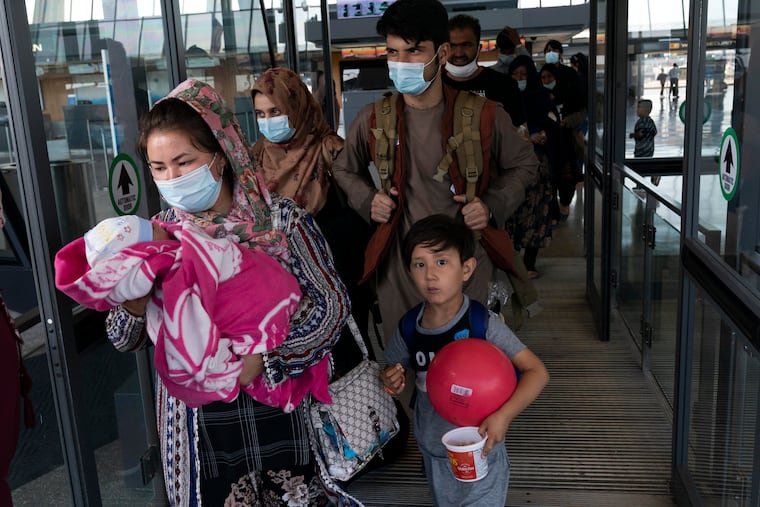
Around the world, newly arriving Afghan evacuees, many clutching babies and bare handfuls of belongings in plastic bags, stepped off evacuation flights in the United States, in Albania, in Belgium and beyond. In Kabul on Friday, Afghan families looked for loved ones among bodies, placed along a hospital sidewalk for identification, of bombing victims who died pleading for a seat on the U.S.-run airlifts.
Afghans, American citizens and other foreigners were all acutely aware the window was closing to get out via the airlift.
Jamshad went to the airport Friday with his wife and three small children. He clutched an invitation to a Western country he didn’t want to identify.
“After the explosion I decided I would try. Because I am afraid now there will be more attacks, and I think now I have to leave,” said Jamshad, who like many Afghans uses only one name.
The Pentagon said Friday that there was just one suicide bomber — at the airport gate — not two, as U.S. officials initially said. A U.S. official said that the bomber carried a heavier-than-usual load of about 25 pounds of explosives, loaded with shrapnel.
The U.S. official spoke on condition of anonymity to discuss preliminary assessments of the attack. The officials who gave the Afghan death toll also spoke on condition of anonymity because they were not authorized to talk to the media.
The Afghan victims ranged from a hard-working young journalist to an impoverished father, driven to to the airport by hopes of a better life.
The American dead were 11 Marines, a Navy sailor and an Army soldier. Many had been tiny children when U.S. forces first entered Afghanistan in 2001.
One, Marine Lance Cpl. Kareem Mae’lee Grant Nikoui, sent a video to a family friend in the United States just hours before he was killed, showing himself smiling and greeting Afghan children.
“Want to take a video together, buddy?” Nikoui asked young boy, leaning in to be in the picture with him. “All right, we’re heroes now, man.”
» READ MORE: With hundreds of Afghan evacuees expected to arrive, Philadelphia-area officials promise a ‘safe haven’
British officials said two of the country’s citizens and the child of another Briton were among those killed.
On the morning after the attack, the Taliban used a pickup truck full of fighters and three captured Humvees to set up a barrier 500 meters (1,600 feet) from the airport, holding the crowds farther back from the U.S. troops than before.
U.S. military officials said that some gates were closed and other security measures put in place. They said there were tighter restrictions at Taliban checkpoints and fewer people around the gates.
U.S. officials said evacuees with proper credentials still were being allowed through the gates. Inside, about 5,400 evacuees awaited flights.
U.S. commanders had briefed Biden Friday on developing plans to strike back at the Islamic State and make good on the president’s vow to the attackers to “hunt you down and make you pay.”
Biden pronounced the U.S. effort to evacuate Americans, Afghan allies and others most at risk from the Taliban a “worthy mission.”
“And we will complete the mission,” he said.
» READ MORE: What to know about the N.J. military base set to shelter thousands of Afghan refugees
The Taliban have wrested back control of Afghanistan two decades after they were ousted in a U.S.-led invasion following the 9/11 attacks. Their return to power has terrified many Afghans, who have rushed to flee the country ahead of the American withdrawal.
More than 100,000 people have been safely evacuated through the Kabul airport, according to the U.S., but thousands more are struggling to leave.
The White House said Friday afternoon that U.S. military aircraft had flown out 2,100 evacuees in the previous 24 hours. Another 2,100 people left on other coalition flights.
The number was a fraction of the 12,700 people carried out by U.S. military aircraft during a brief period when the airlift reached maximum capacity.
France ended its own evacuation effort and pulled up stakes on a temporary French embassy at the airport, leaving Taliban-ruled Afghanistan.
Britain ended evacuation flights from Kabul airport on Saturday and began bringing troops home, even as the U.K.’s top military officer acknowledged “we haven’t been able to bring everybody out.” Britain says it has evacuated more than 14,500 people from Kabul in the past two weeks but that as many as 1,100 Afghans who were entitled to come to the U.K. have been left behind.
Britain’s defense ministry said the final flight for Afghan citizens had left Kabul and further flights over the weekend will bring home British troops and diplomats, though they may also carry a few remaining U.K. or Afghan civilians.
U.S. allies and others have ended or are ending their airlifts, in part to give the U.S. time to wrap up its own operations.
The Taliban have said they will allow Afghans to leave via commercial flights after the U.S. withdrawal, but it is unclear which airlines would return to an airport controlled by the militants.
Gannon reported from Islamabad and Anna from Nairobi, Kenya. Darlene Superville in Washington and Rahim Faiez in Turkey and Elaine Ganley in Paris contributed along with Robert Burns, Aamer Madhani, Nomaan Merchant, and other Associated Press writers around the world.