A look at the rare historic documents heading to the Lincoln Memorial
When the 15,000-square-foot exhibition area in the memorial's undercroft opens June 25, signed copies of the Emancipation Proclamation and the 13th Amendment will be on display.
The workers brought the copies of the Emancipation Proclamation and the 13th Amendment to the Constitution into the warehouse display room and carefully placed them on a table covered with blue blankets.
Both documents, which date to the 1860s, bear the original signature of President Abraham Lincoln. Both are treasured milestones in the nation’s bloody struggle to eradicate slavery, and are worth millions.
And both are now being loaned for public display in a new exhibit area under the Lincoln Memorial, which is due to open June 25 to honor the nation’s 250th birthday.
The Washington Post was given an up-close look at the historic documents in a private storage facility, before they were to be sent to the memorial.
The copy of the 1863 proclamation, which freed enslaved people in the rebellious states, also bears the faded signatures of Secretary of State William H. Seward and Lincoln’s private secretary, John Nicolay. The 1865 copy of the 13th Amendment, which outlawed slavery in the United States, is handwritten on lined parchment.
The National Park Foundation said that the documents are being loaned by hedge fund billionaire, collector, and philanthropist Kenneth C. Griffin, who bought them last year at auction for a reported $18 million. (The originals are in the National Archives.)
The foundation, the nonprofit fundraising partner of the National Park Service, said the artifacts will be on loan through June 2027. The documents will be part of a new, state-of-the-art exhibit space in the rarely seen area beneath the Lincoln Memorial called the undercroft.
The 15,000-square-foot space will allow visitors to see through floor-to-ceiling glass the massive concrete foundations that support the memorial — and view part of 50,000-square-foot undercroft itself.
“Everyone who’s been there just raves about it,” said Jeff Reinbold, president and CEO of the foundation. “We’ve talked about this for so long and now can actually see that vision come to life.”
“It will be one of the hottest tickets in D.C.,” he said. “Talk about powerful. You have a chance to see these documents under the memorial for the president who signed them.”
Griffin said in a statement: “The Emancipation Proclamation and the 13th Amendment marked a profound step forward, abolishing the scourge of slavery and moving the country closer to its founding ideals.”
The foundation said the copy of the Emancipation Proclamation is one of 27 known remaining copies from the limited number printed for a large patriotic fundraising fair in Philadelphia in 1864. The proclamation, issued on Jan. 1, 1863, in the midst of the Civil War, freed enslaved people in the states or parts of states still in rebellion, and allowed Black men to join the Army and Navy, according to the National Archives.
The copy that will be on display at the Lincoln Memorial was one of 48 signed by Lincoln to raise money for hospitals, injured Union soldiers, and the families of soldiers killed in the war, said Selby Kiffer, international senior specialist for books and manuscripts at Sotheby’s, where the documents were sold.
Each copy was sold for $10 — roughly $200 today. They did not sell out.
The 13th Amendment, ratified by the states in 1865, ended slavery in the United States.
The rare copy of the amendment on loan to the memorial dates to 1865, and is one of only 15 known copies like it.
In addition to Lincoln’s signature, it has those of other notable political figures of the era — Sen. Charles Sumner, Rep. Thaddeus Stevens, and Vice President Hannibal Hamlin, among others.
“It was such a big moment that many legislators wanted to sort of capture it for themselves,” Kiffer said in a video interview.
So various members of Congress hired clerks to write out special copies of the amendment.
Then, “a little bit like a high school yearbook, you would take it around and get everyone who had worked on this monumental piece of legislation and amendment to the Constitution to sign it,” Kiffer said.
“They were really mementos,” he said. “They were all individual, unique creations.”
The Griffin copy “is one of the most complete, with the signatures of the senators and congressmen who voted in favor of the amendment,” he said. (Not all members of Congress voted for the amendment.)
It is signed by 37 senators and 114 members of the House. They were among the legislators who voted to send the amendment to the states for ratification, he said.
The exhibit area where the documents will be displayed will also tell the story of how the Lincoln Memorial was built and examine its role in American history and civil rights, the foundation said.
The project includes new restrooms, a larger bookstore, and new elevators, the Park Service said. It will also feature an immersive theater presentation that projects images of historic events onto the memorial foundations.
The undertaking is believed to be the most extensive of its kind at the memorial since it was dedicated in 1922, the Park Service said.
The undercroft, essentially the memorial’s basement, is the huge area beneath the 38,000-ton structure, which sits on a platform supported by 122 concrete pillars. The undercroft is so large that the entire memorial, flipped upside down, would fit in it, officials have said.
The project opening the area to visitors has been in the works since 2016, when another billionaire, David Rubenstein, donated $18.5 million to the effort. But major work did not get underway until 2023, the National Park Service has said.
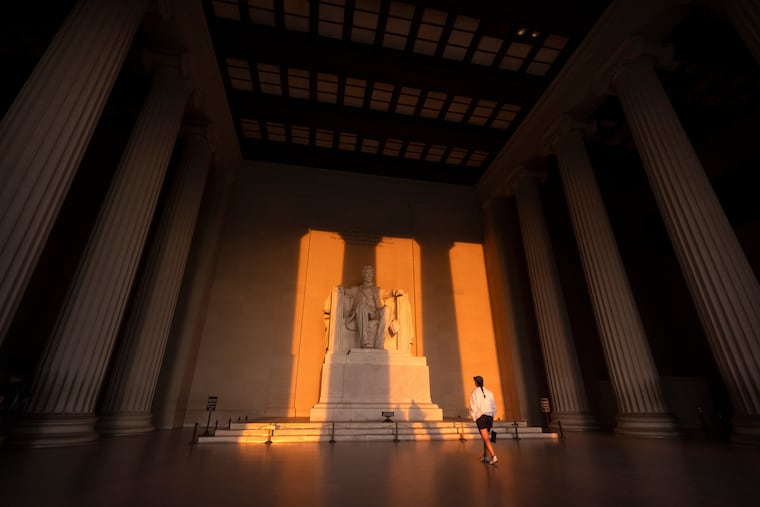
The memorial, which includes the 175-ton marble sculpture of Lincoln, was built on a spot called Kidwell Flats, a tract on the Potomac River that had been reclaimed with mud dredged from the river.
Ground was broken in 1914. The statue of the seated Lincoln was made from 28 blocks of Georgia marble carved by sculptor Daniel Chester French in the New York studio of the Piccirilli brothers, a team of renowned Italian stonecutters.
The blocks were then shipped to Washington and assembled inside the memorial in 1919.
The memorial was dedicated in 1922 in the presence of Lincoln’s son, Robert, then 78. About 50,000 people attended. African Americans, as was the cruel custom in then-segregated Washington, were shunted off to the rear.
On Easter Sunday in 1939, the African American opera star Marian Anderson elevated the significance of the memorial when she sang there after being barred from performing at whites-only Constitution Hall seven blocks away.
Twenty-four years after Anderson’s performance, the Rev. Martin Luther King Jr. gave his “I Have a Dream” speech there before 250,000 people.
And 50 years later, President Barack Obama, the country’s first Black president, spoke there on the anniversary of King’s speech.