World War II POW from Wilmington, Delaware, positively IDed from remains, U.S. says
U.S. Army Lt. Col. Louis E. Roemer was taken prisoner in the Philippines when the Japanese in May 1942 captured the island fortress of Corregidor, after American forces lost the Bataan Peninsula.
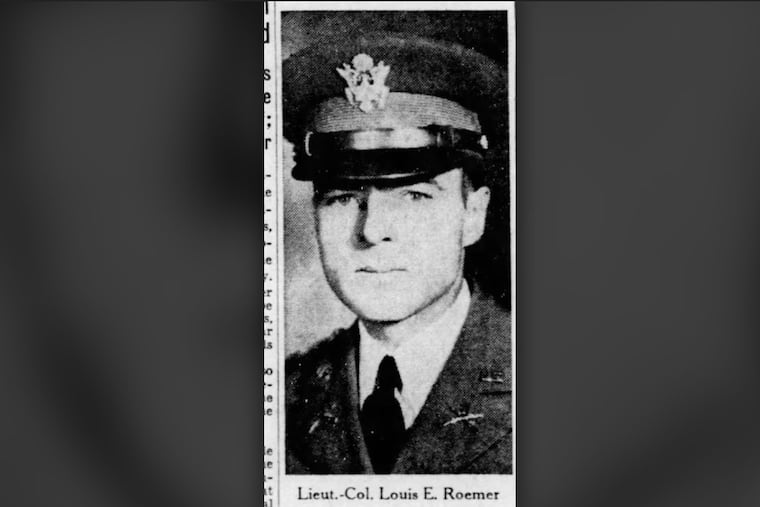
A Wilmington native who died while being held as a prisoner by Japanese forces during World War II has been positively identified through analysis of his remains, U.S. military officials said this week.
Army Lt. Col. Louis E. Roemer was taken prisoner in the Philippines when the Japanese captured the island fortress of Corregidor in May 1942 after American forces lost the Bataan Peninsula, according to historical news accounts.
He remained a POW in the Philippines until late 1944, when the Japanese began to move prisoners as an American invasion force retook the occupied territory.
Roemer may have survived transport on two Japanese “hell ships” — which had reputations for inhumane conditions and cruel treatment — that were both attacked by Allied forces, only to die afterward of an illness, reportedly on Jan. 22, 1945. He was 43.
He had been loaded in Manila onto the transport ship Oryoku Maru, destined for Japan. However, U.S. carrier-borne aircraft attacked the Oryoku Maru, and it eventually sank in Subic Bay on Dec. 15, 1944.
Roemer was then transported to Formosa, now known as Taiwan, aboard the Enoura Maru. While that ship was docked at the Port of Takao in Formosa and still loaded with prisoners of war, it was hit by Allied aircraft on Jan. 9, 1945. Approximately 400 Allied POWs were killed.
According to the Defense POW/MIA Accounting Agency, the Japanese reported that after the Enoura Maru was attacked, Roemer was placed aboard the Brazil Maru, bound for Moji, Fukuoka Prefecture, Japan. Roemer reportedly died of acute colitis during the last stage of transport, the Japanese reported.
“However, since historical and contemporary evidence indicate that the Japanese government-reported Brazil Maru casualties list contains errors, he conceivably could have died at any point during this December 1944 to January 1945 POW transport, including the Jan. 9 attack on the Enoura Maru,” the Defense POW/MIA Accounting Agency said.
In 1946, a U.S. military search-and-recovery team exhumed a mass grave on a beach at Takao in Formosa and recovered 311 bodies. Attempts to identify the remains were unsuccessful, and they were buried in the National Memorial Cemetery of the Pacific, known as the Punchbowl, in Honolulu.
In 2022 and 2023, remains linked to the Enoura Maru were disinterred from the Punchbowl for analysis. Scientists used dental and anthropological analysis, as well as circumstantial evidence, the Defense POW/MIA Accounting Agency said. Scientists also used mitochondrial, Y-chromosome, and autosomal DNA analysis.
Roemer was officially accounted for on July 28, 2025, the agency said Wednesday. The announcement was made after Roemer’s family received a briefing on his identification.
Roemer will be buried in Pittsburgh, the agency said.
According to historical news accounts, Roemer was one of three brothers who served as high-ranking military officers during World War II. He was born in Wilmington and graduated from the University of Delaware in 1922 with a chemical engineering degree. He was inducted into the Army through the ROTC.
Before the war, he was assigned to the Chemical Warfare Service on the Bataan Peninsula in the Philippines under Maj. Gen. Jonathan M. Wainwright.
Japan attacked the Philippines just hours after Pearl Harbor. On April 9, 1942, American and Filipino forces surrendered on the Bataan Peninsula, and Corregidor fell about a month later.
Roemer was subjected to the notorious Bataan Death March, which led to the death of thousands of POWs.
His family did not know what had happened to him until December 1942, when they were notified by the U.S. War Department that he was a prisoner of war in the Philippines.
Roemer was able to send a couple of postcards to his family through a system facilitated by the International Red Cross, and on one occasion a freed POW was able to communicate a message to Roemer’s family he had heard through a POW “grapevine.”
Col. Louis D. Hutson wrote to Roemer’s wife, Mary, and said Roemer “was in very good health and quite cheerful and he asked in case I were returned to the States before he returned that I write you and send you and his boys and his mother all his love,” the Wilmington News Journal reported on March 30, 1945.
At that point, Roemer had already been dead for at least two months.
His family did not learn about his death for about five more months.
Roemer was posthumously awarded a Bronze Star Medal with V device and the Legion of Merit award.
“Colonel Roemer saved hundreds of lives during the famed Bataan Death March, but it was for his service before the surrender of American troops that he was decorated,” a 1947 News Journal article said.
Another news story relayed an account by Sgt. Alfred Torrisi, who said that during the Bataan Death March, Roemer “often slipped out of camp at night into the jungle to get wood for charcoal, from which he made the only soothing medicine available for the sick men.”
Torrisi said Roemer was in charge of hospital service at the Cabanatuan prison camp, where “practically everyone was a patient.”