With limited avenues to health care, uninsured immigrant patients may face ‘medical deportation’
Advocates say hospitals sometimes repatriate uninsured noncitizen patients without full consent. Experts worry cases could increase under the Trump administration.

ALLENTOWN — The headaches and vomiting had grown unbearable.
It was December 2022. Junior Clase’s wife, Solibel Olaverria, had left the Dominican Republic five months earlier to join him in the U.S. They were uninsured and unfamiliar with the American healthcare system. But Clase knew she needed help, so they headed for the ER.
Olaverria was diagnosed with a brain aneurysm. During surgery, she suffered a stroke and was induced into a coma. Not long after, Clase said, hospital administrators suggested transporting his still-comatose wife to a facility in the Dominican Republic — an option he refused.
“They told me that they could send her back to my country,” he said — even without his consent. “At that moment, she was missing a piece of her skull. … If they put her in an airplane or a helicopter, it was possible that she would die.”
Though only the federal government has the jurisdiction to remove people from the U.S., hospitals across the nation sometimes return uninsured noncitizen patients in need of long-term care to their countries of origin.
Immigration advocates call this “medical deportation.” Hospitals and medical transport companies refer to it as “medical repatriation.” By either name, the practice exists in ethical and legal gray areas without specific federal regulations, widespread public knowledge or a national tracking system.
Lori Nessel, a professor at Seton Hall University who supervised a 2012 report about medical repatriation, said the practice amounts to “private deportation … but outside of the legal process for deportation, because there was no immigration court involved.”
Experts believe medical deportation happens more than any tracking efforts account for. Some worry the practice could now increase, given that it sits at the intersection of health care and immigration — two systems undergoing drastic change during the second administration of President Donald Trump.
Since 2020, the Philadelphia-based Free Migration Project has tracked 19 cases of patients facing medical deportation. Six of those came in the first six months of 2025, from cities in Pennsylvania, Florida, New Jersey and New York, according to Adrianna Torres-García, deputy director of the organization.
“We’ve had a higher volume of cases in the same span of time than any other given year,” Torres-García said. “It’s also more complex cases.”
Under federal law, Medicare-participating hospitals must provide stabilizing care to anyone with an emergency condition, regardless of ability to pay or immigration status. Hospitals can then file for reimbursement through Emergency Medicaid. This program initially allowed Olaverria to receive treatment.
But the tax and spending cut bill Trump signed in July significantly reduces federal contributions to Emergency Medicaid, shifting the costs to states and hospitals. The law also makes some legally present immigrants, including refugees and asylees, ineligible for traditional Medicaid and Medicare.
Immigrants without legal status have long been ineligible for these programs, and even green card holders have to wait five years before they are eligible for Medicaid.
While the legal requirement to treat anyone with an emergency condition won’t go away, experts say the changes will leave more immigrants uninsured and provide less federal funding for emergency care if they need it.
“If immigrants are unable to get as much coverage, then they’re not going to be able to get as much care,” said Andrew Cohen, an attorney with Health Law Advocates, a Boston-based public interest law firm. “That’s where medical deportations could really grow.”
Medical transport companies can charge hospitals tens of thousands of dollars to repatriate a patient — but that may still be cheaper than long-term care.
“Unfortunately, it becomes a financial burden to the hospital,” said Craig Poliner, president of MedEscort, an Allentown-based medical air transport company that facilitates repatriations.
“The patients really do better in their own countries, in their own culture,” he said. “We’re not forcing anybody back. We convince them why we think it’s better. If we have the right approach, it usually resolves itself.”
However, advocates note that immigration status, a lack of insurance, the injury or illness itself, unfamiliarity with the healthcare system and language barriers can hinder someone’s ability to give informed consent.
In 2013, John Sullivan, a social worker based in Tempe, Arizona, traveled to Mexico to study medical repatriation as part of a Fulbright scholarship. He interviewed patients who had been sent back, along with family members, health workers and Mexican officials.
Sullivan said the circumstances surrounding consent in some of those cases were “unclear.” “It was almost like migrants would describe feeling like they had no other choice,” he said.
In early March 2023, Clase said, hospital administrators gave him an ultimatum: find care for his wife elsewhere or she’d be transferred to the Dominican Republic.
Clase didn’t believe Olaverria would survive the flight, and if she did, he didn’t trust the Dominican hospital she’d be transferred to. But he also couldn’t care for her at home or pay for another facility in the U.S.
The Free Migration Project organized protests against Olaverria’s repatriation. Ultimately, hospital administrators agreed to hold off on the transfer. The hospital did not respond to requests for comment.
Media coverage of Olaverria’s case helped bolster interest in a bill before the Philadelphia City Council to stop nonconsensual medical repatriations. In December 2023, it became the nation’s first law banning the practice.
The law requires Philadelphia hospitals to obtain patients’ written consent before repatriation. Hospitals must also offer information about patients’ rights and options for care.
In May 2023, Olaverria was transferred from the hospital into a long-term care facility in Allentown. Two months later, she woke up from the coma. She still cannot walk or use the bathroom on her own, and she can speak only a few words.
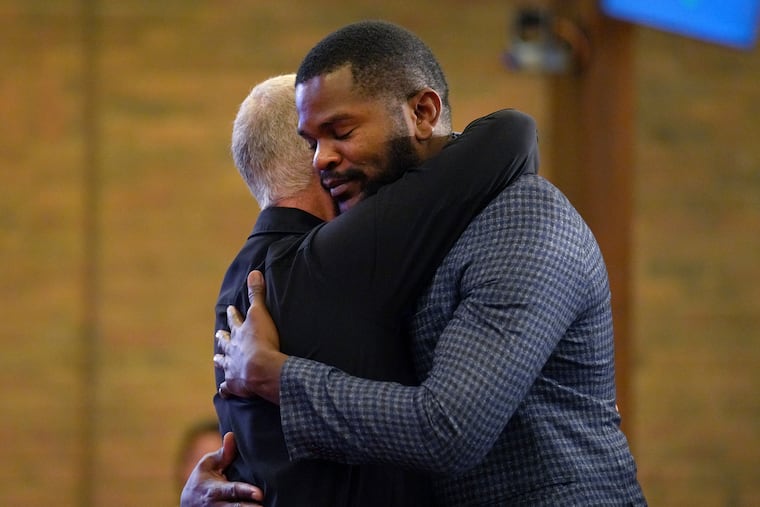
Between working two jobs and attending church services three times a week, Clase visits his wife every day. He wipes her mouth, adjusts her neck and massages her curled-in hands.
Life outside this routine is virtually nonexistent. When he gets home each night, he sleeps and occasionally cries.
“This country consumes you,” he said.
Clase and Olaverria currently have medical deferred action, which allows them to temporarily remain in the country. They are working to apply for a visa that would allow them to stay longer. But Olaverria’s ability to continue in long-term care is uncertain.
Despite this, Clase carries forward, focused on the familiar paths of his daily routine, all of which lead to Olaverria.
“The majority of my time,” he said, “I dedicate it to my wife.”
This report is part of “Upheaval Across America,” an examination of immigration enforcement under the second Trump administration produced by Carnegie-Knight News21. For more stories, visit https://upheaval.news21.com/.