Fatal shooting by police sets off protest in Minneapolis, the city’s first police-involved death since George Floyd
Scores of protesters quickly descended on the scene of the shooting in a gas station parking lot in South Minneapolis.
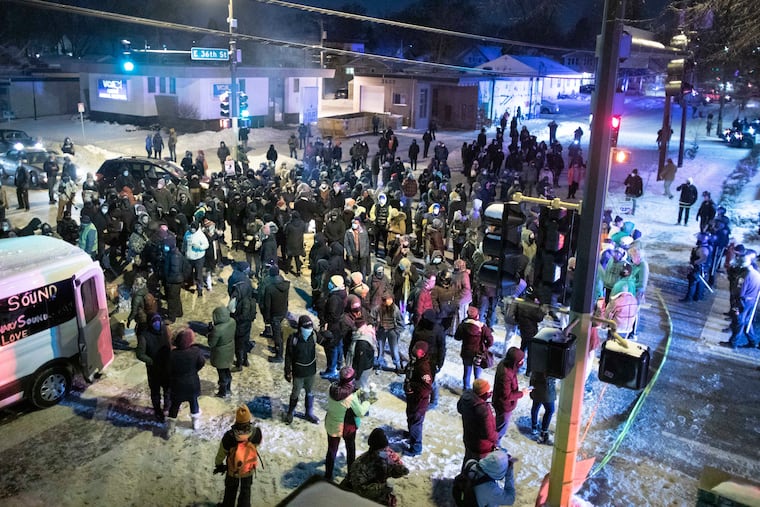
MINNEAPOLIS - A Minneapolis police officer shot and killed a man they say opened fire on officers during a traffic stop Wednesday night, sparking new tensions in a city still deeply on edge since the police killing of George Floyd last May and the fiery unrest that followed.
Scores of protesters quickly descended on the scene of the shooting in a gas station parking lot in South Minneapolis, about a mile from the intersection where Floyd was killed, facing off in below-freezing temperatures with police officers clad in riot gear, some clutching batons and cans of pepper spray.
The tense scene, reminiscent of clashes between police and demonstrators in the aftermath of Floyd's death, continued into the early morning hours Thursday and prompted calls for peace from Minneapolis officials anxious to avoid a repeat of the May unrest that left parts of the city burned and destroyed.
In a late-night news conference, Minneapolis police chief Medaria Arradondo announced he would release body camera footage of the shooting on Thursday in an effort to calm tensions and increase transparency about the incident. He said his department would protect the public's right to "freely assemble and demonstrate" but said he would not tolerate "destructive criminal behavior."
"Our city has gone through too much," Arradondo said.
The shooting occurred around 6:15 p.m. on Wednesday at a Holiday gas station at 36th and Cedar Avenue in South Minneapolis, where officers pulled over what police officials described as a "felony suspect." Arradondo said witnesses at the scene told police the suspect fired first and officers "exchanged gunfire" with the man, who was hit and killed. It was not clear if officers had verbally engaged the suspect before the shooting occurred or how many shots were fired.
Arradondo declined to discuss why police were looking for the man, but noted that the officers involved are members of a community response team, which typically deals with cases including narcotics and gun investigations.
An officer at the scene immediately radioed for help, the sound of gunfire crackling over the police radio.
"We have two people inside the vehicle," the unidentified officer told dispatch. "One male is down. We still have one female in the car with her hands up."
Police did not identify the suspect or say how many times he had been shot. He was expected to be named by the Hennepin County Medical Examiner on Thursday. Police also did not identify the race of the suspect or the officers involved. The female in the car was not wounded nor were any officers at the scene, according to police.
It was the first killing by police since Floyd's Memorial Day death. The 46-year-old Black man died after being handcuffed and restrained face down on a South Minneapolis street by police responding to a 911 call about a counterfeit $20 bill that had been passed at a local convenience store. Following a struggle, then-Officer Derek Chauvin pressed his knee into Floyd's neck for more than nine minutes as the man repeatedly complained of struggling to breathe.
Chauvin, who was with the department for 19 years, has been charged with murder, and three other officers at the scene - J. Alexander Kueng, Thomas K. Lane and Tou Thao - have been charged with aiding and abetting. All four were fired from the police department and are scheduled to go on trial in March.
Word of the Wednesday's shooting quickly spread on social media, including rumors about the race of the suspect and how many times he had been shot and where. Within hours, a crowd began to gather, including many who had walked over from 38th and Chicago, the site where Floyd was killed.
Both Mayor Jacob Frey, a Democrat, and Arradondo asked the protesters to wait for the results of the investigation. The Minnesota Bureau of Criminal Apprehension will investigate the shooting, the chief said, and a police union representative told the Star Tribune that the officers involved were waiting to be interviewed by state investigators.
"Events of this past year have marked some of the darkest days in our city. We know that a life has been cut short and that trust between communities of color and law enforcement is fragile," Frey said in a statement. "We must all be committed to getting the facts, pursuing justice, and keeping the peace."
But the scene after the shooting quickly grew tense, exposing the lingering hostility and mutual distrust between police officers and a community that has been engaged in a deeply contentious debate about the future of policing in the city.
The Minneapolis City Council recently voted to strip $8 million out of the city's police budget, redirecting those funds to other city services as part of an effort to "transform" public safety. The vote came as the police department has confronted an unprecedented wave of violence across the city - with 82 people killed and at least 550 people shot this year - and scores of officer departures in recent months.
On Wednesday, many of these tensions were on display - as officers complained to dispatch about the lack of manpower on the ground and pushed for an aggressive response to a crowd that was hostile but not violent.
As protesters shouted anti-police chants and expletives at the officers, a police supervisor issued an order over the radio for all responding officers to turn on the body cameras and "keep them on."
Soon, officers were complaining they felt under siege by demonstrators. One officer asked for permission to fire 40 mm launchers at the protesters who were pelting them with snowballs. A supervisor declined the request.
"These are not to be used on the crowd in general. These are be used to stop imminent physical harm to officers," the supervisor replied. "That understood?"
Another officer asked for authorization to use "chemical irritants." The request that was initially denied but later approved to stop what a supervisor described as "assaultive conduct" - though it was unclear if any pepper spray was actually used.
The back and forth reflected a change in Minneapolis policy in the aftermath of the Floyd demonstrations, when police were accused of freely firing tear gas and projectiles at peaceful protesters and members of the press. Under new rules approved this summer, the police chief is now required to personally sign off on the use of "crowd-control weapons."
Several times, police officers at Wednesday's scene seemed irritated by limits being placed on them, according to radio dispatch traffic. One demanded more officers. Another complained they were about to be overrun.
"This crowd is extremely close and hostile towards police," one officer said over the radio. "If they choose to storm past us, we do not have the resources to hold this crowd back currently."
But on the other side of the yellow caution tape, it was demonstrators who were accusing police of escalating tensions by donning riot gear and arriving at the scene with tear gas and batons.
"They are the ones out here ready for war. Not us," one demonstrator shouted at police. "They are the only ones who've got on the helmets. They are the only ones who've got the mace out and the billy clubs and the sticks."
The clash came on one of the coldest nights of the Minnesota winter so far - with temperatures dipping to 10 degrees. Many on the scene wore heavy coats and winter boots as they stood in a street partially covered with ice and snow from storms in recent days. As city officials appealed for peace, the only fire that erupted was a bonfire in the middle of the street built to keep demonstrators warm.