MIT president blames federal policy shifts for big drop in research on campus
Research programs have dropped by about 20% over last year.
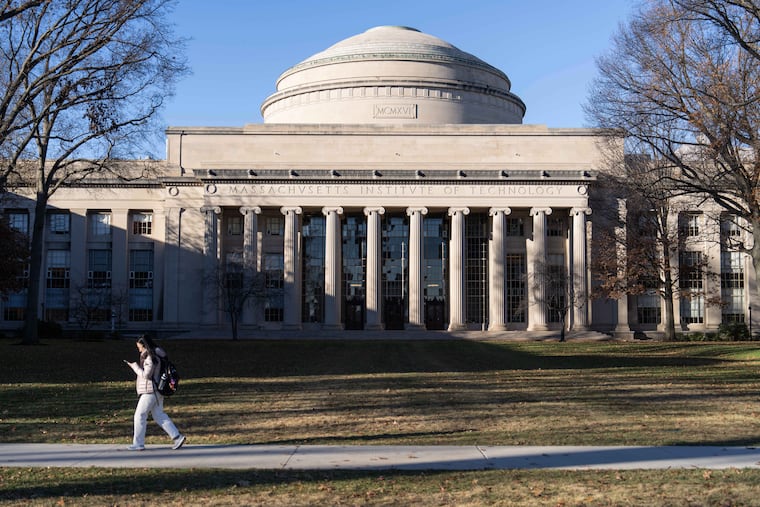
MIT is doing less research and enrolling fewer graduate students as a result of federal actions, the university president warned Thursday.
Federally funded research on campus is down more than 20% compared to this time last year, MIT’s president, Sally Kornbluth, told the campus community in a video message, and the number of new federal research awards is also down more than 20%.
"That is a striking loss for one of the most influential and productive research communities in the world," Kornbluth said.
Graduate student enrollment will also decline significantly in the coming academic year, she said; outside of two programs that are still in the midst of admissions, the number of grad students will be 20% less than it was in 2024 — about 500 fewer students.
MIT’s loss is emblematic of the shrinking of American science caused by Trump administration actions that are affecting labs across the country.
Ted Mitchell, president of the American Council on Education, said he expects to hear similar assessments coming from other leading research universities. “This is the first of many of these kinds of alarms that will be ringing," he said.
But at MIT, the reduction in research funding is exacerbated by the impact of a sharply increased tax on its endowment returns. Most colleges and universities are exempt from taxes because of their nonprofit status and educational mission.
MIT expects to pay about $240 million a year for that tax, which was increased to 8% this year by Congress and applied to only a handful of elite schools.
The school had already been making painful cuts for over a year, Kornbluth said.
MIT is one of the leading scientific institutions in the world, said Brendan Cantwell, a professor of higher education at Michigan State University, so if it is scaling back how it does research, that means universities across the country should be thinking about scaling back and adjusting. That’s happening at the same time that China continues to invest in research, particularly in the sort of research that MIT is good at, he said.
A lot of the attention to changes in higher education has focused on cultural issues, he said, such as debates over free speech. “But there’s also a real economic and geopolitical dimension to what’s happening, in terms of the shifting away from the scientific enterprise and the leading global role that the United States has played for decades.”
Federal funding isn’t flowing to MIT as it typically has, Kornbluth said. Some federal agencies are talking about taking geography — not just scientific merit — into account when allocating money, distributing funding to more parts of the country. Some grants are not getting renewed as expected. And fewer new grant proposals are getting funded.
The decline in research dollars has affected scientists at every stage of their careers, not just the youngest scientists trying to establish their labs. Senior faculty members with long track records of winning significant grants are having to cut graduate students, postdoctoral fellows and entire lines of research.
Graduate student enrollment is dropping because of the funding uncertainty. But there are also signs, Kornbluth said, that policy changes affecting international students and scholars are discouraging talented people from applying.
Changes to immigration policies and research funding have been damaging for graduate students, said Eric Lu, a third-year PhD student in the biological engineering department who engineers stem cells and bacteria, with applications for human health and for national defense.
“It’s a pretty unfavorable environment for students who see themselves — or saw themselves — as doing research in the U.S.,” he said. Graduate students are a relatively mobile group who are trying to figure out where they can be most helpful and where they will spend their careers. Compared to other places that are intensifying their science and research development, he said, the United States is becoming less appealing.
MIT was able to find other sources of funding for some labs, and is working to tap into others, especially in industry and philanthropy. But overall, taking into account both federal and nonfederal funding, research on campus is down 10%.
"The fact is that we’re looking at a real drop in research being done by the people of MIT," Kornbluth said. “When you shrink the pipeline of basic discovery research, you choke off the flow of future solutions, innovations, and cures — and you shrink the supply of future scientists.”