NASA’s newest telescope blasts off to answer universe’s big questions
Named for NASA’s first chief astronomer, the Nancy Grace Roman is a survey telescope, designed to look far and wide into cosmic time and the universe.
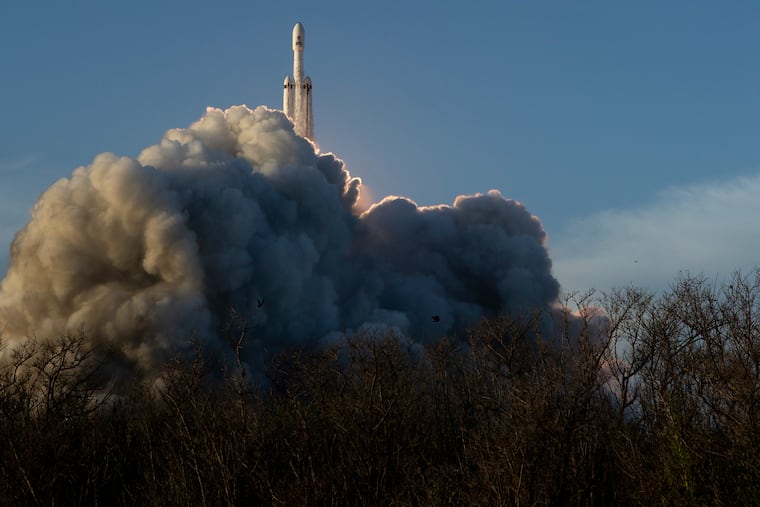
NASA’s Nancy Grace Roman telescope blasted off from near Cape Canaveral, Fla., on Sunday, sending a $4.3 billion project into space with the hope of answering some of the most profound questions in the universe.
It was NASA’s most ambitious telescope launch since the James Webb Space Telescope, which took off from Earth in 2021 after years of delays.
But in contrast to its predecessor, Roman ran relatively on budget and ahead of schedule, even after funding pressures and the pandemic threatened to throw a wrench in the project.
Named for NASA’s first chief astronomer, the Roman is a survey telescope, designed to look far and wide into cosmic time and the universe. Its field of view is big — about 100 times that of the Hubble Space Telescope. Among other observations, scientists hope it will help shed light on the unexplained force called dark energy that is responsible for the universe’s accelerating expansion and its ultimate fate.
At the launch, the major stages were all “nominal,” as NASA’s announcers put it — agency-speak for going as planned.
Down at the Kennedy Space Center, scientists, engineers, and other space enthusiasts gathered on a partly sunny morning to watch a SpaceX rocket rumble off the launchpad, carrying the telescope. It’ll take about three months to reach its distant orbit, 1 million miles out from Earth in the direction of Mars. (Hubble lives in a low Earth orbit about 350 miles up.) NASA hopes the first images could come at the beginning of 2027.
Roman will look for a phenomenon called cosmological redshift. As the universe expands, light wavelengths are stretched out as they travel long distances. (The same does not happen to objects with mass, like galaxies, because they’re being held together by gravity.) The longer the distance, the greater the stretching, which corresponds to the red and infrared end of the light spectrum.
Redshift carries important information when looking at distant cosmic objects. Light isn’t instantaneous; it has a finite speed, so the rays from a star in the sky visible today from Earth might have been emitted millions of years ago. When looking at the redshift of a galaxy or an exploding star even farther from Earth, Roman’s crisp infrared view should help scientists discern how far away it is — in effect dating how far back the telescope is peering in time.
“We will expect exquisite dark-energy measurements from Roman,” said Yun Wang, a researcher at the Infrared Processing and Analysis Center from the California Institute of Technology who worked on Roman and two of its predecessor projects. “It’s very exciting.”
The telescope will also hunt for traces of exoplanets, distant worlds that live outside our solar system. There are only about 6,500 known exoplanets, according to NASA’s data. But Roman could help spot as many as 100,000 new ones by picking up on faint signals, like a blip in a star’s brightness as a planet passes in front of it.
Scientists hope its wide field of view will also pick up on a rare event called microlensing that they hope will indicate the existence of small planets like Earth — maybe even ones that are potentially habitable.
Roman the astronomer was one of the agency’s first female executives and played a key role in securing funding for space projects such as Hubble — which made the observations that led to the discovery of dark energy in the first place.
Over the course of and after construction of the Roman telescope, engineers put it through a battery of tests to make sure it would survive various challenges of the launch and space. They shook it, simulating the vibrations of the launch, and blasted it with loud noise. They stuck it in a cold vacuum chamber for more than 60 days. And on Sunday, they counted down and let it go, to scan the skies for at least five years.
“In some ways, I could never believe that this moment would actually happen,” said Dominic Benford, the telescope’s program scientist, on the launch live stream. “And it is here, and far more beautiful than I could’ve anticipated.”