U.S. pursuing third tanker off Venezuelan coast, official says
The seizures of the ships is part of the Trump administration's pressure campaign against Nicolas Maduro.
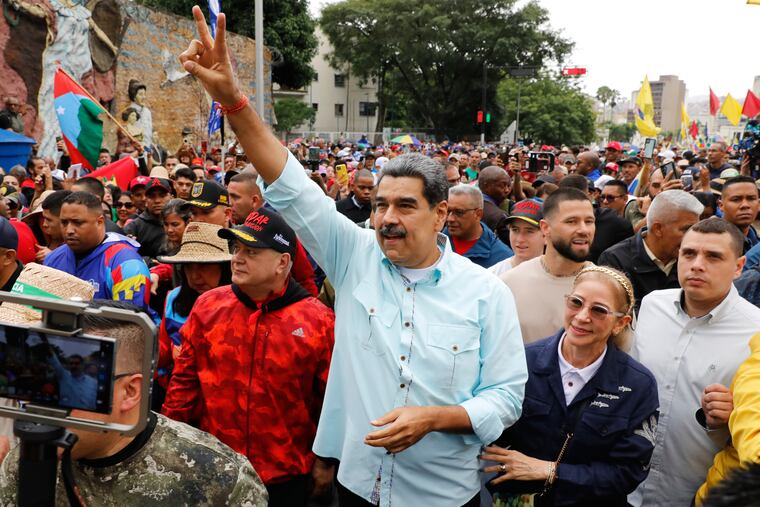
The United States Coast Guard is pursuing a tanker off the coast of Venezuela, a U.S. official said Sunday, in what would mark the third interception of a tanker in the waters off that country this month.
The official described that tanker as “a sanctioned dark fleet vessel that is part of Venezuela’s illegal sanctions evasion. It is flying a false flag and under a judicial seizure order.” The official shared the statement on the condition of anonymity under ground rules set by the administration.
President Donald Trump on Tuesday ordered a “total and complete blockade” on all oil tankers under sanctions entering or leaving Venezuela. He called the Venezuelan regime a foreign terrorist organization and said it was using oil to finance “drug terrorism.”
If intercepted, this would be the second tanker the U.S. stopped this weekend after seizing the oil tanker Skipper off Venezuela’s coast on Dec. 10. The U.S. attorney’s office for the District of Columbia issued the seizure warrant for the Skipper, alleging it was used in an “oil shipping network” supporting the Lebanese militant group Hezbollah and Iran’s Islamic Revolutionary Guard Corps-Qods Force.
Venezuela’s government has called the actions “theft” and “hijacking.”
Early Saturday, U.S. forces boarded a different commercial vessel, the Panamanian-flagged Centuries owned by Centuries Shipping in Hong Kong, off Venezuela. Homeland Security Secretary Kristi L. Noem posted a video on X showing service members rappelling down from military helicopters onto the vessel, which her department said was suspected of carrying oil subject to U.S. sanctions.
The U.S. has not imposed sanctions on Venezuelan oil. And neither the Centuries nor its company is under any sanctions, according to the International Maritime Organization, a U.N. agency.
These actions come as part of the United States’ monthslong pressure campaign against the government of President Nicolás Maduro, whom the administration wants to force from office. The tanker blockade could impact Venezuela’s already struggling economy, which heavily depends on overseas oil sales.
The U.S. has launched more than two dozen military strikes on boats it claimed had crews who were smuggling drugs into the United States. Officials have said that more than 100 people connected to drug cartels have been killed.
Sen. Rand Paul (R., Ky.) said on ABC’s This Week that he considers the seizing of the second oil tanker a “provocation” and “prelude to war.”
“Look, at any point in time, there are 20, 30 governments around the world that we don’t like, that are either socialist or communist, or have human rights violations … but it isn’t the job of the American soldier to be the policeman of the world,” Paul said.
By contrast, Sen. Lindsey Graham (R., S.C.) said on Meet the Press on Sunday, “I am all in the camp for regime change. … Maduro’s days are numbered.”
Jim Foggo, a retired U.S. Navy admiral, said the administration’s plan for Venezuela appears to constitute a “targeted blockade” or “embargo” operation, in which certain ships are stopped and others are allowed through.
“If you want to pick something to go after — an Achilles’ heel — of the Venezuelan regime, it’s oil exports,” Foggo said.
Venezuela has the world’s largest proven oil reserves. Output has plummeted amid sanctions, poor infrastructure, and mismanagement, but oil still represents the vast majority of the country’s exports. “So this is really going to hurt, and Maduro is going to have to do some serious thinking,” Foggo said.
Foggo, dean of the Center for Maritime Strategy outside Washington, said boarding operations can be unpredictable and dangerous for U.S. troops involved, citing a boarding operation in the Arabian Sea in January 2024 in which two Navy SEALs drowned.
“This is serious business,” Foggo said, noting that Maduro has said that Venezuelan naval forces will accompany vessels. “The danger is that it could go kinetic and someone could get hurt, but we seem to be willing to take that risk.”