Trump aides struggle with how to spend $500 billion more on military
The president approved the 50% increase in the Pentagon's budget, but details on how it would be spent aren't clear.
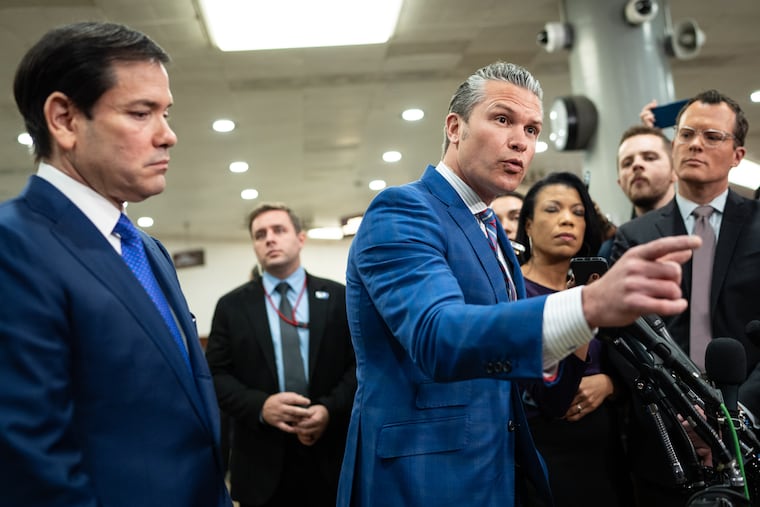
Trump administration officials have struggled to figure out how to increase U.S. military spending by a whopping $500 billion in their forthcoming budget, slowing the overall White House spending plan, four people familiar with the matter said.
President Donald Trump last month agreed to a roughly 50% funding boost sought by Pete Hegseth, the defense secretary, in the White House’s annual budget proposal. The idea ran into internal criticism from several other officials, including White House budget chief Russell Vought, who warned about its potential impact on the widening federal deficit, said the people, who spoke on the condition of anonymity to reflect internal deliberations.
Since Trump agreed to the higher number, White House aides and defense officials have run into logistical challenges surrounding where to put the money, because the amount is so large, the people said. The White House is more than two weeks behind its statutory deadline to send its budget proposal to Congress, in part because it is unclear how precisely to spend the additional $500 billion, according to the people familiar with the matter.
Senior Pentagon officials have consulted with former senior defense officials as they grapple with the challenge, said one person familiar with the matter. Part of the discussion centers on how much emphasis should go into buying weapons the military already uses versus investing in high-end technologies, such as artificial intelligence, that the Pentagon envisions as part of its future.
The roughly $900 billion defense budget approved last year was the largest in U.S. history. While other nations have also increased their military spending, the United States already spends more on defense than the next nine countries combined, according to 2023 data from the Peter G. Peterson Foundation, a nonpartisan think tank.
“I’m not surprised they’re having difficulty doing that,” said G. William Hoagland, senior vice president at the Bipartisan Policy Center, a nonpartisan think tank. “That’s an awful lot of money in one year.”
Spokespeople for the White House and the Defense Department declined to comment.
Trump, Hegseth, and many congressional Republicans have defended the proposed increase in the military budget as necessary to pay for an array of new priorities and confront foreign adversaries. Hegseth has said that the money would be spent “wisely” and that the larger budget would send “a message to the world.”
The forthcoming White House budget for fiscal 2027 will spell out the administration’s proposed spending levels across the government. It requires congressional approval to be enacted and faces long odds.
“This will allow us to build the ‘Dream Military’ that we have long been entitled to and, more importantly, that will keep us SAFE and SECURE, regardless of foe,” Trump said in a Truth Social post this month confirming his support for the $1.5 trillion budget number.
The Pentagon has been grappling with how to rapidly replenish expensive munitions that it has relied on heavily, including Tomahawk cruise missiles, Patriot missile-defense interceptors, and ship-launched munitions known as Standard Missile-6s, or SM-6s.
It also is wrestling with how to upgrade its Cold War-era nuclear weapons program with expensive next-generation systems like the B-21 bomber and the Columbia-class submarine. The aircraft, with an estimated cost of about $700 million each, is expected to replace the Air Force’s fleet of B-1 and B-2 bombers. The Columbia-class submarines are expected to cost at least $9 billion each.
Hegseth, upon taking office, directed each military service to look for budget reductions of 8%; the money could then be invested in other Pentagon priorities better aligned with Trump’s agenda. Hegseth bristled at the suggestion that such reprogramming should be considered cuts, saying he would be “reorienting” about $50 billion in defense spending that the Biden administration had planned.
More recently, Hegseth has called for “supercharging” the U.S. industrial base, seeking to speed up how quickly the military can field new weapons and other capabilities, in part by not relying as heavily on traditional defense contractors.
With such a significant jump in spending planned, it now appears that the Pentagon budget is detached from a new national defense strategy that Hegseth’s team released in January, said Mark Cancian, a retired Marine Corps colonel and senior adviser with the Center for Strategic and International Studies. That strategy calls for the Pentagon to focus first on defense in the Western Hemisphere, with less emphasis on Europe, Africa, and the Middle East.
It’s a “head-scratcher” that the Pentagon wants to spend so much money while also cutting back in those areas, Cancian said.
“If you’ve got a 50% budget increase, you don’t have to do any of that,” he said. “You’d be talking about all the new places you’d be making investments.”
The federal deficit, or the gap between what the government spent and what it collected in tax revenue, was $1.8 trillion last year. That number was down from the surges of red ink during the COVID years but up significantly from the standard deficit before the pandemic.
Vought, a deficit hawk, has long called for reducing federal spending while also supporting Trump’s general goal of rebuilding the American military. He was instrumental in securing additional funding for the military last year in the GOP’s tax bill, which bypassed the typical bipartisan process for setting military spending.
The increase in military spending alone would amount to one of the biggest federal programs. One Democratic plan to expand Medicare to cover dental, vision, and hearing benefits would cost $350 billion over the next decade, by comparison. If Congress were to spend an additional $500 billion every year on the military, the cost would be $5 trillion over the next decade. It is unclear if the Trump administration’s proposal is for an additional $500 billion just for next year, or $500 billion each year for a decade.
“I’m sure there are very difficult conversations happening right now. Obviously, it would have a huge impact,” said Charles Kieffer, who spent several decades across administrations in the White House Office of Management and Budget and working for Democrats on the Senate Appropriations Committee. “A 50% increase requires a completely different formulation for your priorities.”
Some experts in military spending panned the proposed increase as likely to increase fraud and waste. Julia Gledhill, a research analyst for the national security reform program at the nonpartisan Stimson Center, pointed to failed audits at the Pentagon and a lack of clear guardrails on much of the new military spending approved last year in the GOP’s One Big Beautiful Bill, which she said has been used like a “slush fund.”
“We don’t know what we’re already spending money on. We don’t have details on how the Pentagon is using its trillion-dollar budget,” Gledhill said. “How are you supposed to make educated, informed decisions about the military budget if you don’t know where it’s already going?”