After Mormon lawmakers object, Pentagon revises Christian religious categories
The Defense Department on Monday edited its new pared-down list of religious codes for service members so that no group is labeled “Christian”
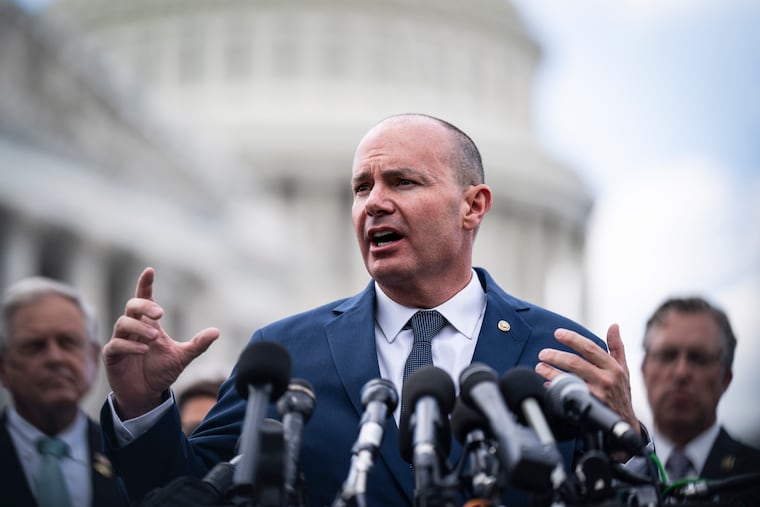
The Defense Department on Monday edited its new list of religious “codes” for service members so that no group is labeled “Christian” — drawing praise from Mormon lawmakers who were angered last week when their faith was categorized as outside of Christianity.
On Friday, the Pentagon released a new, dramatically pared-down list of religious groups. It classified groups including Catholic, evangelical, and Methodist, among others, with the tag: “Christian.” The Church of Jesus Christ of Latter-day Saints was listed without the tag.
After the outcry from several leaders who are members of the Mormon Church, the revised list simply states religious groups, without adding the tag “Christian” to any.
U.S. Sen. Mike Lee (R., Utah), who is Mormon and had spoken out multiple times over the weekend on social media against the list, posted on X on Monday that he was “grateful” to Defense Secretary Pete Hegseth for the change.
A spokesperson for Lee said he had spoken to President Donald Trump and Hegseth about the issue “and they assured him that the classification will be fixed.”
The Defense Department on Monday declined to comment on whether it changed the list because of Lee’s campaign. The White House did not respond immediately to a request for comment.
The Defense Department said last week that it removed 180 faith groups from its coding list — going from 211 to 31 — because the list was too large and “unmanageable.”
“This decrease in religious affiliation codes is not designed to make any claims on the legitimacy of any faith or religious belief, nor is it intended to provide a list of ‘officially approved’ religions,” the statement said. “Rather, it is designed to allow chaplains to quickly look at the religious composition of their units and determine how they structure resources to best provide for warfighters of all faith groups.”
In speaking earlier this year about his plan to trim down the code list, and to scrap the Army’s spiritual fitness guide, Hegseth has talked about his own view of faith, saying military religious services should be more focused on “truth” and less on self-care.
The former Fox News host‘s handling of religion within the Defense Department has repeatedly been questioned. He has urged chaplains to speak more about scripture than psychology, and hosts monthly evangelical worship services that legal experts say are unprecedented. His social media profile and public comments routinely espouse his understanding of Christianity, which says that the faith is a defining aspect of American life, and casts those who disagree with him as God’s enemies. Hegseth has brought clergy from his small Christian denomination to preach at the Pentagon, including a prominent pastor who says women shouldn’t have the right to vote.
The military has made many changes over time in how it recognizes different faiths, but experts say it had shifted in a more inclusive direction in recent decades. When the list of religious codes was expanded under the first Trump Administration, in 2017, the Defense Department said the broader list was needed to understand the military’s religious demographics and to “enable better planning for religious support.”
The Defense Department press office Monday declined to comment on who was consulted as the department built its latest coding list.
Among the dozens of faith groups no longer named in the codes are Wicca, atheists, and humanists. Also removed were Unitarian Universalists, the faith group with which multiple Founding Fathers were associated, including John Adams and Thomas Jefferson.
Retired Maj. Gen William D. Razz Waff, the executive director of the Military Chaplains Association, predicted that the removal of religious and spiritual specifics will significantly complicate chaplains’ ability to do their job.
Within the broad groupings of, for example, “Baptist” or “Jewish,” he said, are major differences — for the enlisted and for the chaplains themselves. For example, he wondered how marriage retreats that chaplains organize will work if it’s not clear how the participating soldiers or the chaplains themselves feel about topics like same-sex marriage.
“As we used to say, ‘this breathes well,’ it looks good on paper, but wow, is the execution is going to be a mess,” Waff said.
Lee, in his social media posts, mostly focused on arguing that his own denomination should be recognized as Christian, but also addressed the role of the government in making such decisions.
“I’m not talking about what individual Christians might think. I’m talking about the U.S. government,” he wrote on X on Sunday. “I can say confidently that the U.S. government has no business recognizing the Christianity of literally every other religious sect that worships Jesus Christ — with one exception.”
Whether Mormons are considered Christian has come up often in recent years, especially with the high-profile presidential campaigns of church member Mitt Romney. Concern about the issue prompted the group a few years ago to formally change all its marketing material to remove the word “Mormon” and replace it with the full name, which includes the words “Jesus Christ.”
In a 2022 Pew Research poll, Mormons received the lowest favorability rate among Americans of the seven religious groups included. Among Christian denominations, evangelicals — a group that includes Hegseth and a large part of Trump’s base — are particularly skeptical of the Church of Jesus Christ of Latter-day Saints.
Sen, John Curtis (R., Utah), who also is a member of the church, on Monday on X thanked the Pentagon for “engaging thoughtfully” with his office and “delivering a swift correction.”
He had previously written in a Saturday post that it is “unacceptable for a government entity to characterize a faith in a manner that contradicts the religion’s own foundational tenets.”
“Latter-day Saints are among the most patriotic, service-oriented individuals in our country. They are also unequivocally Christian — just look at who is in the name of the Church,” he wrote.
In a statement, the Unitarian Universalist Association said that it is working on a “strategic response” to the pared-down list.
“This may make it more difficult for our uniformed UUs to access the spiritual care that they need,” the statement said. “No government action can erase our faith nor lessen the powerful and necessary grounding it provides for those who serve.”