Whatever you do in Russia, don’t talk about the war
Officials blame fuel shortages on “unscheduled maintenance at refineries” without noting a cause, as Ukrainian drones attack fuel refining facilities in the country.
The war in Ukraine is a “Special Military Operation,” even though it’s the biggest conflict in Europe since World War II.
Across Russia, officials blame fuel shortages on “unscheduled maintenance at refineries” without noting a cause, as Ukrainian drones attack fuel refining facilities in the country.
And Russia’s central bank governor has talked of the “structural transformation of the economy,” as code for military spending that has spiraled and reoriented the economy around the military-industrial complex.
For years, President Vladimir Putin has insulated Russian society from the consequences of his war in Ukraine, using euphemisms as a psychological shield. But as the war increasingly comes home, the mismatch between rhetoric and reality is becoming a source of frustration for ordinary Russians.
For days, Putin didn’t mention the June 18 long-range strikes on Moscow, when Ukraine attacked with nearly 200 drones. He didn’t comment as Ukrainians promised to turn Crimea, the peninsula Russia illegally annexed in 2014, into an island by pounding it with drones and missiles.
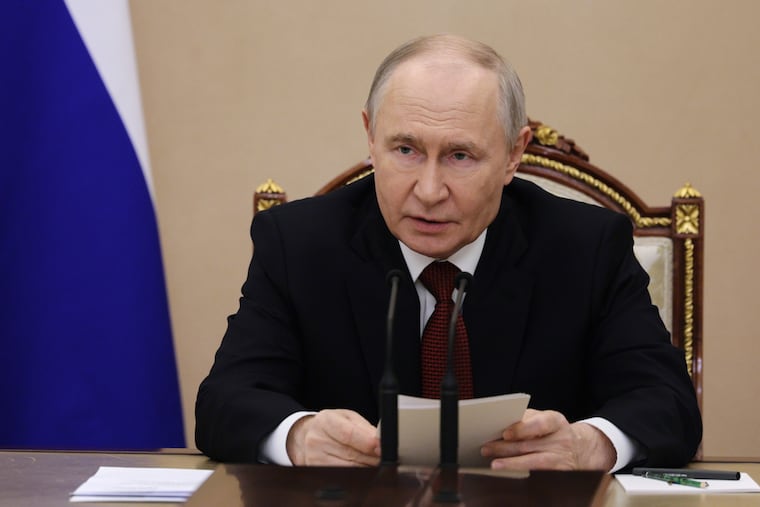
When he appeared June 23 for the first time since the June 18 strikes, which were the largest in the war, he used the moment to blame the West.
“These drones, strikes on civilian infrastructure — what are they for? To destabilize society, to create uncertainty about the actions of the Russian armed forces,” Putin said. At that time, he did not address the fuel shortages in at least 56 regions, according to Mediazona, an independent Russian news outlet.
On Sunday, Putin did acknowledge fuel shortages. At a meeting of top executives and officials, he said that “systemic measures that match the scale of current challenges” must be put in place, adding that a task force was working around the clock to ensure supplies, especially for agriculture.
But Putin has not publicly delegated officials to prepare shelters or early warning systems in case of future strikes.
In the Moscow suburbs of Kotelniki and Lyubertsy, both of which came under drone attack in mid-June, authorities said they would not disclose the locations of bomb shelters or use sirens because the country was not technically on a war footing. They would make this information public only in case of a “period of mobilization and in wartime.”
Lyubertsy’s administrator suggested that people consult a PDF that appeared on a government website with practical instructions on what to do in case of a drone attack.
The head of the Republic of Bashkortostan, a region with 4 million people between the Volga River and the Ural Mountains where Ukraine has attacked refineries, said his administration had decided to not always activate sirens to not stress people out, mentioning a rise in antidepressant use in Russia.
Downplaying danger and resorting to euphemisms to discuss drone attacks and economic pain is a “performance of obedience” to Putin and his regime, said Aleksandra Arkhipova, a teaching and research fellow in social sciences at the École Normale Supérieure in Paris.
She has compiled a list of new war-related terms and euphemisms such as “clap” instead of “explosion,” “deprived of life” instead of “killed,” and “air target” instead of “drone.”
“Russian political authorities right now are all about pictures in the news,” Arkhipova said. They do not want “to create a huge panic which can be shown by local TV and then on the federal news with a lot of crowds crying and running through the streets.”
On the news, the recent attacks on Moscow barely figured, in keeping with the state’s stance. Channel One, the Kremlin’s primary cultural and political megaphone, ran a short segment the morning of the June 18 attacks and then stayed quiet until Putin commented several days later. During the evening news broadcasts on June 18 on Channel One as well as on Rossiya 1, or NTV, “not a single word” about the attacks was uttered, according to Telegram channel Agentstvo News.
Officials and state outlets use confusing and sometimes misleading linguistic formulations to describe certain war-related events, Arkhipova said. In the early days of the war, stores that closed as a result of Western sanctions bore signs for months and in some cases years saying they were “closed for technical reasons.”
Russia’s Federal Air Transport Agency recently announced a “schedule adjustment” at the Krasnodar airport, which is about 150 miles from the front line and in the path of Ukrainian drones. At Sochi airport, authorities don’t write that flights are delayed by incoming drones but instead that the airport is operating according to the “actual schedule” — a confusing term that is meant to distinguish between the two columns on the planned departures and arrivals, “scheduled time” and “actual time.”
When Moscow’s airports are temporarily closed because of Ukrainian drone attacks, the term used refers to accepting flights “by agreement.” Travelers are told that their flight is delayed because of delays to the incoming flight, rather than because the city is under drone attack.
Arkhipova calls this linguistic technique “neutralization.” It is about intentional ambiguity, she said, explaining, “People can understand that something is happening, but what exactly is happening is not that clear.”