Principals who survived school shootings mobilize to help Texas educators
The Principal Recovery Network is a support group that mobilizes to help principals in the immediate aftermath of a school shooting. The pool of principals eligible to join has only grown since 2018.
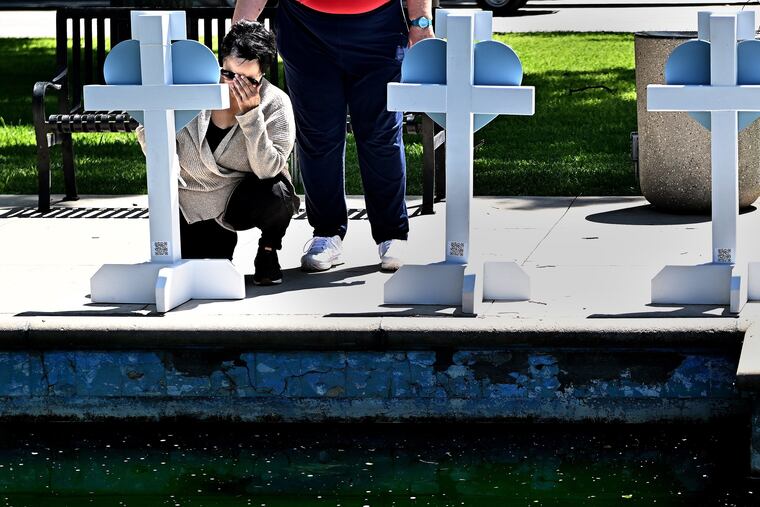
Greg Waples was in a staff meeting at the National Association of Secondary School Principals on Tuesday morning when he learned there was an active shooter at Robb Elementary School in Uvalde, Texas.
"It wasn't immediately apparent how terrible the situation was," Waples said. "We all watched in horror as more details emerged that afternoon and into the evening."
Waples knew what he needed to do - because he had done it dozens of times.
He sent an email to the more than 20 members of the Principal Recovery Network - a support group of sorts that mobilizes to help principals in the immediate aftermath of a school shooting. These educators are qualified to assist, Waples explained, because their schools were also attacked.
"It's like that club that no one wants to belong to," said Frank DeAngelis, the former principal of Columbine High School in Littleton, Colo., where two students killed 12 peers and a teacher in 1999.
The pool of principals eligible to join the group has only grown since the network was founded in early 2018 in response to the deadly rampage that February at Marjory Stoneman Douglas High in Parkland, Fla. Members include current and former principals from Douglas, Sandy Hook Elementary in Newtown, Conn.; Perry Hall High in Baltimore County; and Marshall County High in Kentucky.
Now Robb Elementary, where 19 children and two teachers were gunned down by an 18-year-old, joins that list. The attack there was the 27th school shooting so far this year.
The network's plan of action is usually the same once Waples informs the group of a new attack, said Elizabeth Brown, who took over as principal of Forest High School in Ocala, Fla., in the wake of an April 2018 shooting in which an expelled student brought a sawed-off shotgun to school and wounded one peer before the weapon jammed.
"It's an immediate dialogue," Brown said of the responses to each shooting. " 'What can we do? Who can we call?' . . . Our very first thought is, 'How can we as a group pour into that school community as soon as possible?' "
DeAngelis always makes the first call. His connection to Columbine often cuts through the flood of calls school leaders receive after a shooting. He tells the principals that he knows what they're feeling and that he's there to help.
"I assure them this is not going to be a one-time call," DeAngelis said. "I state, 'It's a marathon not a sprint. Let's not talk about nine months from now. Let's talk about what we're going to do the first month, second month, and so on.' "
Then members decide who will offer further assistance. Most of the time, the principals at nearby schools or with similar backgrounds take the lead, DeAngelis said. For example, with Robb Elementary, those who come from elementary schools or small, rural communities may have unique insights. But in every scenario, the goal is to help the principal in crisis.
Greg Johnson, the principal at West Liberty-Salem High School in Ohio, said he knows firsthand how comforting it can be to hear from other school leaders who had similar experiences. Administrators from two Ohio schools contacted him following a 2017 shooting. One student was shot in that incident before Johnson and his assistant principal, Andy McGill - also a member of the network - convinced the gunman to drop the weapon. The shooting victim survived and is now engaged to Johnson's daughter.
"You might have other colleagues and family members who are very supportive and understanding and empathetic, but they haven't experienced it in the same way as what a building principal does," Johnson said. "It's a unique experience . . . you end up feeling that you're responsible for the physical safety of your students and your staff, and you're responsible for their emotional well-being and their mental well-being."
The network holds both in-person and virtual meetings. The gatherings usually start with principals giving updates on their schools and asking for advice, Brown, of Forest High, said. They also talk about the principals whose schools recently had shootings and share plans for supporting them. On a few occasions, members went to Capitol Hill to meet with their state lawmakers and advocate for stronger gun control.
The group is also working on a handbook known as the "Guide to Recovery." Based on their own experiences, the document lays out guidelines for navigating the aftermath of a school shooting, Brown said. After a crisis, "you don't have time to read through a 50-page handbook on what I should do," said Johnson, who is co-chairing the guide committee with Brown. So they made the handbook short and direct.
It includes advice for students reentering the building, on what to do about empty chairs that belonged to students killed in attacks and how to handle graduations, annual remembrances and memorials. It also points educators to federal grants principals can access to fund mental- and emotional-health needs for staff and students.
The gatherings are also a chance for the principals to discuss their personal trauma, creating a support group-type atmosphere, Johnson said.
"It's important to talk about it," Waples, of the National Association of Secondary School Principals, said. "I think that as hard as some of those conversations have been - and there certainly have been lots of tears - it's been very helpful for the members."
Hearing about another school shooting forces some to relive their trauma. DeAngelis said that every time his phone starts buzzing nonstop, his heart begins to race. Even after 23 years, it still brings him back to Columbine, he said.
Waples said his stomach drops when he hears the news because it means he has to send another email to the network - a task that he dreads.
"It's incredibly difficult and it truly is one of the worst parts of my job," he said. "And I just hope every week that it's a week where we don't have to do that."
But the members still act, Brown said, because they know there is a community in urgent need of their help.
"They will set aside their own trauma to ensure that they are supporting another leader that is dealing with this school in crisis," she said.
The principals say the group has become necessary, but it's not one they ever wanted - or want to expand.
“We wish that we would never have to serve another school community, ever,” Brown said. “We wish that there was no need for this recovery network.”