Could the FIFA World Cup reduce U.S.-South African tensions?
The U.S.-South Africa relationship was long shaped by the Cold War. Today, racial politics are more exposed.
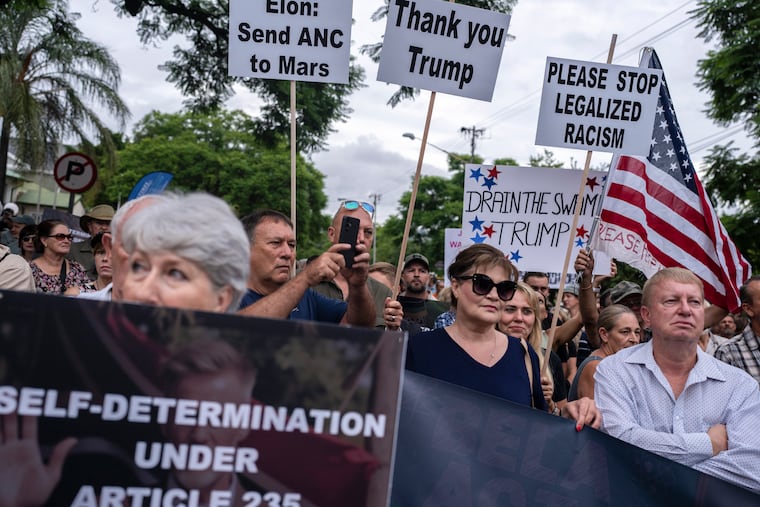
The Trump administration has adopted a confrontational approach toward long-time ally South Africa. Washington has spent the past year spreading falsehoods about “white genocide,” cutting crucial HIV funding and blocking South Africa from the G20 while threatening its trade relationships. The United States has also made a point of resettling white Afrikaners as refugees, while excluding nearly all other refugees around the world.
With the FIFA World Cup approaching, some may hope for a new chapter of “sports diplomacy” to relieve tensions between the countries. When South Africa’s national football team takes the field this summer, it marks Bafana Bafana’s first World Cup appearance in 16 years. But U.S. visa policies initially threatened South Africa’s ability to travel. At nearly every turn, the Trump administration is sending a clear message: it is hostile to a Black-led South Africa and sympathetic to its white minority. The domestic politics of race and white supremacy, long an undertone of U.S.-South African ties, animate the current bilateral relationship.
The Trump administration’s embrace of white South Africans and the tensions with the African National Congress (ANC), the liberation movement-turned-political party that currently governs South Africa as part of a coalition, are not without historical precedent. Throughout the Cold War, Washington maintained close ties with apartheid South Africa’s white minority regime. Race was always part of the equation, but it was camouflaged in the language of anticommunism and strategic interest. Today, with the Cold War long over, racial politics are more exposed.
From the early years of the Cold War, anti-Communism and race were entangled features of the U.S.-South African relationship. For Washington, South Africa’s white minority government was a reliable ally: rich in strategically important natural resources, home to a crucial shipping route and a bulwark against the Soviet Union in southern Africa.
This relationship continued despite the formal consolidation of apartheid in 1948. The Afrikaner-led National Party systematically implemented apartheid, a draconian patchwork of racial segregation policies that stripped Black South Africans of their land and citizenship while blunting Black mobility. Despite this odious lack of democracy, Washington actively encouraged friendly relations with the white-minority-ruled South Africa. Cold War objectives overpowered moral arguments against apartheid.
But the Cold War also shaped racial politics in unexpected ways. Just as Washington tolerated apartheid abroad, it was contending with its own system of racial segregation under Jim Crow. The Cold War created a powerful incentive for the United States to manage its image on race at home and abroad. The Soviet Union eagerly broadcast U.S. racial violence to newly decolonizing nations across Africa and Asia, undermining U.S. claims to lead the free world. This exposed Washington’s liability and motivated federal policymakers, becoming a key driver of civil rights victories and landmark decisions, such as school desegregation.
These dynamics had the potential to threaten U.S. support for South Africa. After all, how could the self-proclaimed leader of the free world maintain its alliance with a government built on white supremacy? The answer, for most of the Cold War, was to turn a blind eye. And in the early Cold War years, domestic pressure campaigns to halt support for apartheid South Africa faced charges of communist subversion, severely blunting their impact and reach. While the Cold War opened the door to domestic civil rights gains, its politics in the early years also stymied avenues of resistance that could force Washington’s hand.
Yet cracks eventually began to show. The rising tide of decolonization further exposed the hypocrisy of U.S. support for South Africa. In 1960 alone, 17 African nations gained independence from European colonial rule. Another turning point was the 1960 Sharpeville massacre, in which South African police killed 69 Black protesters, shocking international opinion and placing the evils of the apartheid state on full display. In turn, African leaders frequently criticized apartheid at the United Nations, placing Washington on the defensive. South Africa faced mounting international isolation, and Washington had to decide between its Cold War alliance with white-led South Africa on the one hand and its credibility with the decolonizing world on the other.
The Nixon and Ford administrations resolved that tension by drawing Washington ever closer to South Africa’s white minority in the 1970s. Even as demands mounted from groups like the Congressional Black Caucus and the blossoming anti-apartheid movement for mandatory economic sanctions and a formal severing of U.S. ties to the regime, Washington remained steadfast. They concluded that gradual, constructive change, which they claimed to desire, could only come from white South Africans themselves not from U.S. pressure. It was an argument that conveniently absolved Washington of any responsibility to pressure Pretoria—and revealed U.S. policymakers’ views that Black South Africans were not credible leaders of their own liberation. Washington’s continued support became more exposed when, in 1974, South Africa was expelled from the United Nations General Assembly.
Following the June 1976 Soweto massacre, where South African police killed over a hundred protesting students, international opinion grew more outraged, adding urgency to calls for sanctions. Winds of change arrived, albeit briefly, when the Carter administration initially took an aggressive approach to apartheid, aligning U.S. foreign policy with an interest in promoting human rights abroad. That agenda changed in the 1980s. President Reagan rejected calls for economic sanctions, instead endorsing “constructive engagement,” the argument that crippling the South African economy would hurt rather than liberate Black South Africans. Critics such as Desmond Tutu rejected this logic, arguing that Black South Africans had repeatedly called for sanctions. The U.S. Congress was also unconvinced. On October 2, 1986, a bipartisan majority overrode Reagan’s veto of the Comprehensive Anti-Apartheid Act, imposing economic sanctions and severing Washington’s formal ties to the regime.
Following decades of pressure, South Africa held its first multiracial elections in April 1994, bringing the ANC and Nelson Mandela to power. Washington warmly welcomed a democratic South Africa, which it now saw as a model for a peaceful transition to majority rule. In a post-Cold War world, the strategic rationale for supporting white South Africa largely disappeared; the U.S. no longer needed its defense against Soviet expansion.
But the Trump administration’s hostile stance today is a signal that the Cold War relationship with South Africa was never purely animated by military necessity; a willingness to accept white minority rule undergirded the U.S.-South African relationship and was consistently reflected in policy. Now, those racial politics have become far more visible. The “white genocide” myth, Afrikaner refugee exception and hostility toward South African diplomats are driven by racial politics and a consistent willingness to privilege the concerns of South Africa’s white minority, unmediated by Cold War necessity.
Whether or not the U.S.-South African relationship can be improved remains to be seen. Sport, which often reaches audiences that diplomacy cannot, also serves as a potential arena for reconciliation. The history of democratic South Africa suggests that sport has, more than once, progressed more rapidly than politics. The 1995 Rugby World Cup was perhaps the most celebrated example, when Mandela used the tournament to signal reconciliation, a moment immortalized in the Clint Eastwood film Invictus.
South Africa’s first participation in the World Cup since it hosted in 2010, on American soil no less, symbolizes that potential. And yet, until Washington reckons with the racial politics driving its relationship with South Africa, both past and present, the World Cup is more likely to highlight the divide than to heal it.
Mattie Webb, PhD, is an assistant professor of history at the Virginia Military Institute (VMI) and a Nonresident Fellow with the Institute for Global Affairs at Eurasia Group.
Made by History takes readers beyond the headlines with articles written and edited by professional historians. Opinions expressed do not necessarily reflect the views of The Inquirer.