South Africa’s president faces potential impeachment after court decision
Political opponents called for Ramaphosa to resign immediately after the ruling, which refers to a case in which more than half a million dollars was stolen after being stashed in a couch at his game farm.
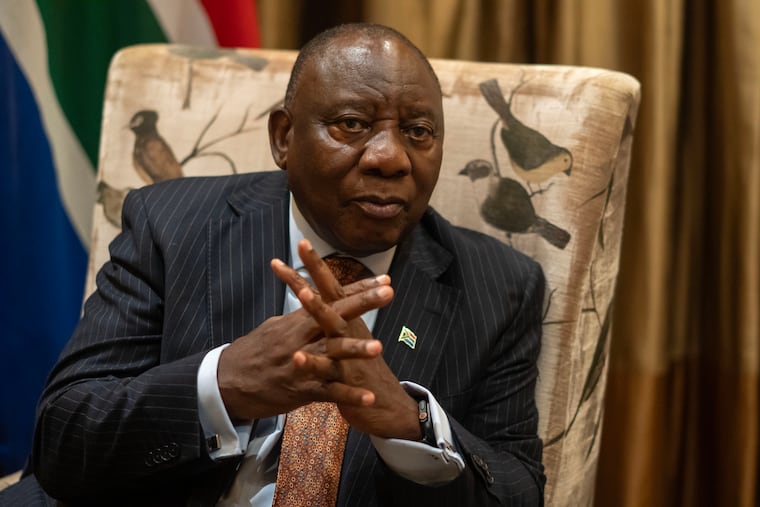
JOHANNESBURG — The political future of South Africa’s president, Cyril Ramaphosa, was dealt a serious blow Friday after the country’s highest court ruled that lawmakers needed to consider impeaching him over a scandal involving a theft on his farm.
Political opponents called for Ramaphosa to resign immediately after the ruling, which refers to a case in which more than half a million dollars was stolen after being stashed in a couch at his game farm.
In its ruling, the Constitutional Court in Johannesburg declared invalid a law that allowed Parliament to reject an independent panel’s recommendation in 2022 that Ramaphosa face an impeachment hearing.
Terminating the impeachment process without considering the merits of the case had the effect of “stifling informed debate and undermining the values of accountability and transparency,” the court’s chief justice, Mandisa Maya, said as she read the decision.
The court ordered Parliament to refer the panel’s report to an impeachment committee of lawmakers that will consider the facts of the case, said Tembeka Ngcukaitobi, a South African lawyer and legal scholar.
If the committee were to find that the case against Ramaphosa can be proven, it would send a resolution to the National Assembly, the lower house of Parliament. The president would be ousted if two-thirds of the lower house’s members voted for his removal.
Many South Africans are now asking whether Ramaphosa would want to subject himself to that potentially embarrassing process, in a case that has dented his reputation as an anti-corruption crusader. He came to power in 2017 vowing to reverse years of graft under his predecessor, Jacob Zuma.
In a statement Friday, Ramaphosa gave little indication of his plans, saying simply that he respected the court’s judgment and that allegations should be subjected to due process.
The independent panel had expressed skepticism at Ramaphosa’s explanation of how such a large sum of money had ended up being hidden in, and then stolen from, a couch in 2020.
The panel said Ramaphosa had abused his power by asking for help from President Hage Geingob of Namibia, a neighboring country where some of the burglary suspects had fled. The panel suggested that Ramaphosa may have flouted foreign currency laws and that he may have violated the constitution in conducting private business that conflicted with his official duties.
Ramaphosa received a reprieve in 2022 when members of Parliament voted against the panel’s recommendation that he face an impeachment hearing. At the time, Ramaphosa’s party, the African National Congress, held 230 of the 400 seats in the lower house. In all, 214 members voted against continuing with the inquiry, while 148 voted in favor.
The Economic Freedom Fighters, an opposition party, challenged Parliament’s decision in court, leading to the Constitutional Court’s ruling Friday.
Ramaphosa now faces a Parliament that is less friendly to him. His party won 40% of the vote in national elections in 2024 and no longer holds an outright majority.
After the panel’s recommendation was issued in November 2022, Vincent Magwenya, a spokesperson for Ramaphosa, said the president was considering all options, including resignation. Ultimately, Ramaphosa stayed and won his party’s backing. But the saga still dogged him.
Ramaphosa’s troubles with the theft started in June 2022, when Arthur Fraser, a political opponent and former national spy chief, filed a criminal complaint alleging that $4 million to $8 million in U.S. currency had been stolen from Ramaphosa’s game farm, Phala Phala, in February 2020. Fraser said the theft was never reported to avoid scrutiny about where the money had come from.
Ramaphosa denied any wrongdoing, but the allegations exploded into a scandal that became known in South Africa as “Farmgate.” Ramaphosa said the actual amount stolen was $580,000 and that the money had been paid by a Sudanese businessperson who was buying 20 buffaloes from the farm. Ramaphosa said a manager at the farm had hidden the money in a couch at the president’s private residence because the manager had been worried that too many workers had access to a safe on the property.
This article originally appeared in The New York Times.