Supreme Court sides with Mississippi man on death row in racial bias case
For two decades, Terry Pitchford has agued his conviction was not valid, pointing to what he says were racially biased selections of the jurors who heard the case.
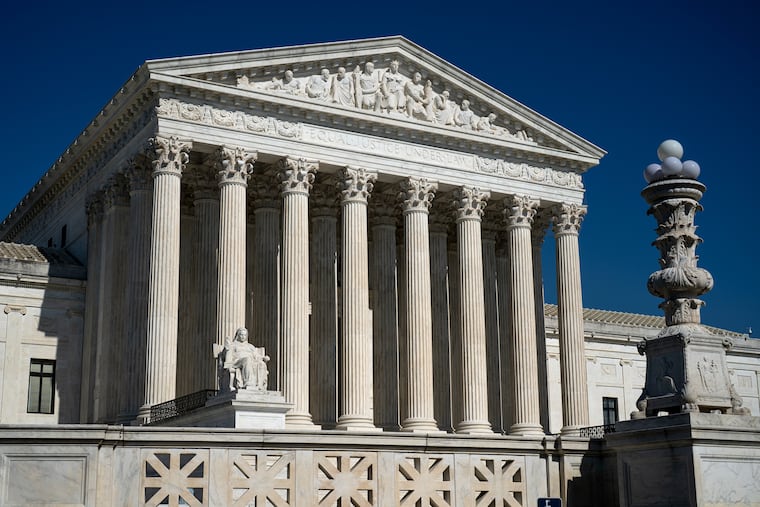
The Supreme Court on Thursday tossed the conviction of a Mississippi man sent to death row for his role in the murder of a shopkeeper, finding that his attorneys were not given the proper chance to challenge potential racial bias during jury selection at his trial 20 years ago.
In a 5-4 vote, the court found that Terry Pitchford, who is Black, did not have the opportunity to challenge the dismissal of four Black potential jurors. It is the second time the high court has thrown out a capital case after the same Mississippi prosecutor was accused of excluding Black jurors.
Pitchford was convicted of murder in 2006 and sentenced to death by a jury in Mississippi. It was his partner who fatally shot shop owner Reuben Britt with a .22-caliber pistol during the armed robbery, according to court filings. Pitchford, who was 18 at the time of the robbery, was accused of being an accomplice.
For two decades, Pitchford had argued his conviction was not valid, pointing to what he said were racially biased selections of the jurors who heard the case. Only one of the 12 jurors was Black — in a county that was 40% African American, according to Pitchford’s filings. More troubling, Pitchford says, is that those jurors were selected by Doug Evans, a prosecutor with a history of maneuvering to keep Black people off juries.
In 2019, the high court reversed the conviction of another Black Mississippi man, Curtis Flowers, whom Evans also prosecuted in a capital murder case. Flowers was tried six times. The justices found, 7-2, that Evans — now retired — had worked relentlessly to keep Black people off the jury.
Evans made similar maneuvers during Pitchford’s trial, selecting a disproportionate number of white jurors compared with Black ones, Pitchford’s attorneys argued. By the time the judge had excused various potential jurors, the pool was composed of 36 White people and five Black people.
Evans then used seven peremptory challenges to strike four of the five Black prospective jurors and three of the white ones. He had marked up his juror list by placing a “W” next to the names of the white people and “B” next to the names of Black people, court records show.
The case turned on whether Pitchford’s attorney took the proper steps to challenge racially biased juror selections. Attorneys for each side can strike jurors without providing a reason, known as a peremptory challenges. But in 1986, the Supreme Court found that such strikes cannot be used to exclude a juror solely on the basis of his or her race. (The prohibition was later extended to gender, as well). The case, Batson v. Kentucky, set out a multistep test for courts to identify racial discrimination in the selection process.
Pitchford says his attorneys were denied the opportunity to challenge the selections under Batson. The Mississippi Supreme Court rejected that argument, finding that Pitchford’s attorneys waived their right to challenge the selection during the trial and declined to review it on appeal.
“In this case, whether due to confusion, oversight, an overly hurried jury selection process, or some other cause, things broke down, and the ordinary trial-court procedure for resolving Batson claims at step three never occurred — notwithstanding the repeated efforts of Pitchford’s counsel to pursue and preserve the Batson objection," Justice Brett M. Kavanaugh wrote in the majority’s opinion.
The majority sided with a federal court’s 2023 ruling that vacated Pitchford’s conviction and death sentence and ordered him a new trial.
Justice Neil M. Gorsuch wrote a dissenting opinion, joined by Justices Clarence Thomas, Samuel A. Alito Jr., and Amy Coney Barrett.
“Put simply, Mr. Pitchford’s account of a muzzled defense team is hard to square with the record. But even if it were a plausible account, that still would not be enough,” Gorsuch wrote.
Notably, Kavanaugh and Chief Justice John G. Roberts Jr. broke from their conservative colleagues in siding with Pitchford.
“We are very pleased to see the Court recognize the extreme failure of the state courts to enforce essential protections under the Constitution,” Pitchford’s attorney, Joseph Perkovich, said in an email.
While reading his opinion, Kavanaugh referred back to the details of the crime that led to Pitchford’s conviction.
Pitchford’s partner, Eric Bullins, was charged with capital murder, but he was not eligible for the death penalty because he was 16 at the time of the killing, according to court records.
Bullins pleaded guilty to manslaughter and was sentenced to 20 years in prison. Pitchford, armed with a gun loaded with pellets meant to kill rats, did not shoot Britt, according to his filings. Pitchford says he shot into the floor when Bullins turned the gun on Britt.