Trump officials cite white supremacists in bid to end birthright citizenship
Alexander Porter Morse, a Confederate officer and Louisiana attorney, argued for legalized segregation in an 1896 case that established the "separate but equal" doctrine and buttressed Jim Crow laws.
Alexander Porter Morse, a Confederate officer during the Civil War and a Louisiana attorney, argued for legalized segregation in the landmark 1896 Supreme Court case that established the “separate but equal” doctrine and buttressed Jim Crow laws.
He is again playing a key role in a monumental case to be argued before the justices Wednesday: The Trump administration has tapped Morse as an authority in its push to upend long-settled law that virtually everyone born in the United States is a citizen.
Over a century ago, Morse was among a trio of thinkers who spearheaded a failed effort — steeped in anti-Black and anti-Chinese racism — to erase birthright citizenship. The Trump administration is reviving their arguments to make its case today, some legal scholars say.
The administration is citing arguments “built on a racist foundation,” Justin Sadowsky, an attorney for the Chinese American Legal Defense Alliance (CALDA), wrote in a friend-of-the-court brief.
Lucy Salyer, a University of New Hampshire history professor who has written on Morse and others, said she was struck that the Trump administration had chosen to elevate those figures and their ideas: “If you know the history and the broader context of what they were trying to achieve, it does ring alarm bells.”
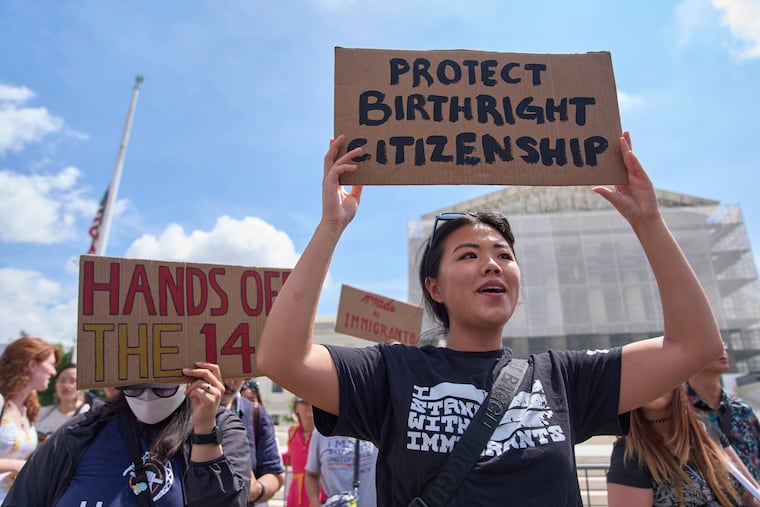
The case, which could redefine who is considered an American, centers on the Citizenship Clause of the 14th Amendment, which grants citizenship to “All persons born or naturalized in the United States, and subject to the jurisdiction thereof.”
When asked for comment about relying on Morse and his compatriots, the Trump administration pointed to a brief in which it wrote, “this Court has repeatedly cited their work in other contexts.” Some legal scholars also argued their stance on birthright citizenship was shared by a number of prominent politicians who did not have racist views.
The Trump administration argues the 14th Amendment does not apply to people in the country illegally or on temporary visas. If the high court agrees, and reverses the long-held interpretation, it could render hundreds of thousands of children born to immigrant parents stateless.
“The Supreme Court has the opportunity to review the Fourteenth Amendment’s Citizenship Clause and restore the meaning of citizenship in the United States to its original public meaning,” White House spokesperson Abigail Jackson said in a statement. “This case will have enormous consequences for the security of all Americans.”
The 14th Amendment was ratified after the Civil War to ensure that the formerly enslaved and their children could become citizens. The amendment overturned the Supreme Court’s infamous Dred Scott decision that denied citizenship to Black people.
Trump administration attorneys cite Morse in their Supreme Court brief to argue the disputed idea that commentators in the 19th century widely agreed that the Constitution “exclude[s] the children of foreigners transiently within the United States” from qualifying for citizenship.
In addition to opposing birthright citizenship, Morse also advocated for limiting the other Reconstruction amendments that abolished slavery and guaranteed Black people the right to vote.
The campaign against birthright citizenship also relied on rising anti-migrant feelings. The push backfired in 1898 when the Supreme Court ruled in United States v. Wong Kim Ark that a man born to Chinese immigrants in San Francisco was a U.S. citizen, enshrining birthright citizenship as the law of the land.
Thousands of Chinese settled in Western states during the latter half of the 1800s to work on the railroads, as miners, and to do other jobs. The prospect that the 14th Amendment would extend citizenship to the children of those immigrants unsettled many Americans.
Francis Wharton, a prominent legal scholar in the late 1800s and State Department official, was one. Wharton attempted to formulate a legal rationale that would allow children born to European immigrants to gain citizenship but deny it to those of Chinese migrants.
He posited that a child’s citizenship should be determined by parents’ nationality, rather than birthplace. Wharton argued people should have a permanent home in the United States or be “domiciled” here for their children to be eligible for citizenship.
He wrote the Chinese were insufficiently “civilized” and could never obtain the proper status because they “regard themselves simply as strangers and sojourners.”
“To admit such rights to an emigrating nation, would be not merely to establish a foreign sovereign, but a foreign barbarism, within our national domain,” Wharton wrote.
He later added that the 14th Amendment’s phrase “subject to the jurisdiction thereof,” which was included to bar children of diplomats and other officials who owed allegiance to a foreign country from becoming citizens, prevented children born to Chinese immigrants from obtaining the status.
As such xenophobic ideas gained traction, a San Francisco attorney named George D. Collins pushed the Justice Department to take up a test case challenging birthright citizenship, writing Chinese immigrants were “utterly unfit, wholly incompetent” to be American citizens. His career later ended in scandal after he was accused of bigamy and perjury.
When the government argued to the high court that Wong Kim Ark was not entitled to citizenship under the 14th Amendment, Collins assisted with its filing and wrote a friend-of-the-court brief.
“Are Chinese children born in this country to share with the descendants of the patriots of the American Revolution the exalted qualification of being eligible to the Presidency of the nation?” Collins and the solicitor general wrote in a cosigned brief. “If so, then verily there has been a most degenerate departure from the patriotic ideals of our forefathers; and surely in that case American citizenship is not worth having.”
The justices ruled the 14th Amendment applied to Wong Kim Ark and virtually all people born in the United States. The precedent has stood for over a century and was infrequently challenged before Trump issued his executive order.
On the first day of his second term, Trump instructed government agencies to stop issuing citizenship documentation to children if neither parent is a U.S. citizen or the mother is on a “lawful but temporary” visa to study, work, or visit. The controversial policy is one of the central pieces of Trump’s anti-immigration agenda.
Solicitor General D. John Sauer argues in his petition to the Supreme Court that the Citizenship Clause applied to the recently enslaved and their children, not to children of temporary visitors or those here illegally.
Sauer wrote birthright citizenship is a powerful incentive for illegal migration; presents national security concerns, because some people illegally enter the United States to carry out hostile acts; and facilitates “birth tourism” — foreigners traveling to the United States to have babies so their children can be U.S. citizens.
Sam Erman, a law professor at the University of Michigan, and Salyer said in interviews the Trump administration’s arguments echo those put forward in the first push to end birthright citizenship.
Like Wharton, the Trump administration says in its brief a child’s citizenship is dependent on the parents’ nationality, not birth in the United States. The government attorneys assert parents must be “domiciled” in the United States for their offspring to qualify for citizenship.
The Trump administration, like Wharton, also highlights the 14th Amendment phrase “subject to the jurisdiction thereof ,” saying it disqualifies children of illegal migrants and temporary visitors from becoming citizens because they can’t demonstrate the necessary political allegiance to the United States the phrase evokes.
“I was really struck reading the government’s brief how familiar it seemed from that period,” Erman said of the late 1800s. “The government argument to a large extent relies on Morse and Wharton and people who are repeating what they said uncritically. If you strip that out of the government’s brief, it looks really weak.”
CALDA also argues in a friend-of-the-court brief that the Trump administration “recycles” arguments by Morse, Wharton and Collins. It points out 19 instances in which the government’s brief cites the same treatises, cases, laws, and legislative history as the Collins and government briefs in the Wong Kim Ark case.
Not all law professors agreed with the arguments. Ilan Wurman, a University of Minnesota law professor who filed a friend-of-the-court brief in the case, said Morse, Wharton, and Collins were among a constellation of advocates who argued birth on U.S. soil should not alone guarantee citizenship.
“The idea that you can find a handful of racists among a number of people who made a similar argument and call the whole argument racist is a classic logical fallacy,” Wurman said.
The litigation over Trump’s birthright citizenship ban kicked off the day after his executive order. Washington state and three other states challenged it in court. A federal judge issued a preliminary injunction against the ban, which was later upheld by an appeals court.
In June, the birthright citizenship case made it to the Supreme Court in a separate case. At that point, the Trump administration did not ask the justices to rule on the substance of the policy, but rather on the narrower question of whether lower courts could issue nationwide injunctions.
In a 6-3 ruling, the justices sided with Trump officials and limited the orders.
Shortly after, a group of individuals represented by the ACLU filed a class-action lawsuit against the birthright citizenship order in New Hampshire. A federal judge issued a preliminary injunction in that case, but before an appeals court could render a verdict on that ruling, Trump officials petitioned the Supreme Court to hear the case.
The Supreme Court has consolidated the cases brought by the states and the individuals represented by the ACLU. A decision is expected by the summer and many legal experts think the Trump administration faces an uphill fight to win the case.
Salyer said the challenge of mounting a credible argument against birthright citizenship — which has long been accepted as legal bedrock — may explain why the administration relies so heavily on Morse, Wharton, and Collins.
“They are not tapping into the central mainstream citations,” Salyer said. “They are using these people because they are the ones that are really pushing that idea.”