The mysterious fight that partially blinded America’s ‘most strenuous’ president
For most of Theodore Roosevelt’s presidency, he kept a secret. He was partially blind in his left eye.
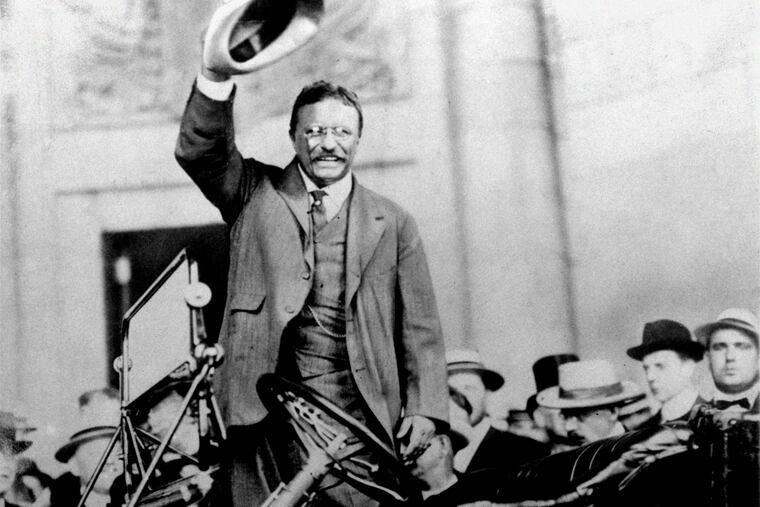
For most of Theodore Roosevelt’s presidency, he kept a secret. He was partially blind in his left eye.
It was only when he was out of office that he revealed the injury and how it came about: During a boxing match. In the White House.
Today, the White House plans to host UFC Freedom 250, as part of the celebrations honoring the semiquincentennial anniversary of American independence. Fourteen fighters will pound each other in seven separate bouts in a 5,000-seat arena that has been erected on the South Lawn.
Democratic lawmakers have widely criticized the planned event. A new lawsuit filed last weekend by the anti-corruption group Public Integrity Project on behalf of two plaintiffs is attempting to stop the event, claiming the plan is “deeply corrupt” and enriches President Donald Trump’s allies.
It will not be the first time the White House has served as a fighting arena. Last time, it was set against the backdrop of a presidency also marked by controversy over razing sections of the executive mansion.
During his roughly 7½ years in office, Roosevelt frequently invited aides, friends, and even professional athletes to the executive mansion to engage in all manner of sportsmanlike battery and barbarity. He was also frequently injured during these sporting matches.
But the damage to his left eye is believed to have occurred while boxing one of his military aides.
According to a 96-year-old letter sent from renowned ophthalmologist William H. Wilmer to Roosevelt’s biographer, Henry F. Pringle, Roosevelt was seen by Wilmer for the eye injury on Dec. 12, 1904. A transcript of Wilmer’s original letter, found in a Harvard University archive, details the approximate timing and extent of Roosevelt’s injury.
“At that time the President gave a history of having noticed for a while a dimness before the left eye after wrestling, and the further history that about two weeks ago, he was struck in the left eye while boxing,” the letter reads. “Since that time, he had noticed black spots before the eye. At first it seemed rather central and blurred the vision, but, now, it seems to have moved about two inches to the left … Examination at the time showed a few spots of hemorrhage in the retina of the left eye and some floating opacities in the vitreous.”
Roosevelt was told to take a break from “his very vigorous exercises” or else he might completely lose vision in the eye, according to the letter. The president protested, however, because he had already scheduled a jiu-jitsu match for 8 a.m., boxing at noon, a sport called “singlestick” involving wooden swords after that, then a long walk or horse ride in the afternoon. The doctor ultimately prevailed, and Roosevelt took his rest.
While Wilmer claims that the hemorrhage in Roosevelt’s eye healed, he later developed a cataract “reducing vision in the left eye to perception of light” — perhaps a result of the injury, Wilmer wrote.
Only a handful of people learned about Roosevelt’s medical condition at the time. The truth did not become public knowledge until October of 1917, after Roosevelt quietly checked himself in at a health camp in Stamford, Conn.
By that point it had been over eight years since the end of his presidency, but it wasn’t long before reporters discovered him. “The colonel is what is technically described as a ‘patient,’” reported the Springfield Daily News. “There is absolutely nothing the matter with him, except the extent of his girth.” In more polite terms, Roosevelt was there to lose some weight.
During his two terms as commander in chief, Roosevelt had dazzled the country with his relentless exercise regime. But at 58, after years of political setbacks, America’s “most strenuous citizen” — as he was playfully called in the press — was feeling depleted and bloated.
Historian Michael Cullinane, co-director of the Theodore Roosevelt Center, said that Roosevelt was stuck at home on the political sidelines during World War I. “He’s writing ferociously for journals and magazines about the war, and he’s very sedentary,” Cullinane said. “And so, what he realizes is that, if he doesn’t look after himself, he’s liable to have a heart attack or some weight-related illness.”
The health camp offered a rapid weight-loss program. And by the end, Roosevelt had lost 14 pounds, slimming down to 215. He gathered a group of reporters to witness the results. It was there, reminiscing about the glory years of his exercise routine, that he revealed the bombshell.
“The last boxing I did was in Washington. I boxed with my aides most of the time, but one day a young captain of artillery came along and broke some blood vessels in my left eye. I have never been able to see out of it since, although I don’t believe many people knew it.”
When pressed for more details by reporters, Roosevelt refused. “There is to be nothing more to say about the matter,” he said.
The mystery captivated newspapers. “Who hit the Colonel in the eye?” asked the Philadelphia Inquirer. There was no shortage of suspects. Roosevelt made it a regular habit of boxing with all sorts of White House visitors during his presidency.
“Every day, he built into his routine, some amount of exercise. And the people who exercise with him wound up being the ones who then had access to power,” Cullinane said.
Reporters scrambled to discover the identity of “the young captain of artillery” who had delivered the fateful blow. Within days they had uncovered their suspect: Col. Dan T. Moore, a cousin of the first lady Edith Roosevelt.
“I was one of the military aides at the White House in 1904 and 1905,” Moore confessed to the Evening Star. “The colonel and I boxed four or five times a week, I guess.”
Roosevelt’s injury had been such a secret, it had even been kept from Moore.
“I never knew the colonel had lost the sight of one eye in a glove bout until I read that interview the other day,” Moore told the Evening Star. “And I certainly do hate to think I was responsible for it.”
Cullinane said it was kept secret to protect Roosevelt’s modesty. “I mean, health issues, it’s no different now as then,” he said.
Roosevelt didn’t seem to have any hard feelings, which Cullinane credits to his sportsmanship. But this also wasn’t a fluke. Roosevelt was constantly getting himself injured as president. According to newspapers, he had almost had the same eye poked out the year prior, in fact, while fencing at the White House.
The rapier of his sparing partner, Gen. Leonard Wood, thrust through Roosevelt’s mask, narrowly missing his eye and leaving a serious bruise on his forehead. Then, just a week later, Roosevelt’s right wrist was severely injured in a singlestick match, again against Wood. “Such a collection of scars as that borne by President Roosevelt was never owned by an American Chief Executive before. He is the ‘most wounded’ President of the United States,” the Boston Post declared.
One mystery surrounding the injury to Roosevelt’s eye is pinpointing where the match occurred on the White House grounds. While newspaper accounts refer to a “gymnasium,” the White House Historical Association, which tracks these sorts of things, has no record of such a designated facility existing in 1904.
The White House underwent a massive renovation during Roosevelt’s tenure. After a century of different presidents and first ladies redecorating random rooms, the Roosevelts decided the whole house needed an overhaul.
“The decor was like a mix of like a Gilded Age, Victorian hotel, and steamboat gothic,” said Matthew Costello, chief education officer at the White House Historical Association. “When you see the photographs post-1902 renovation, I would argue, you see a White House that is much more recognizable to us today.”
Both the West Wing and East Wing were built during Roosevelt’s renovation, and many of the mansion’s iconic spaces were transformed. Not everyone was happy, though.
Among the most unpopular parts in the renovation plan: tearing down the enormous 45-year-old greenhouses on the west side of the mansion to make room for the new West Wing and turning the East Room into a state dining room, which would also function as a “handsome ballroom,” according to the Marion Star.
“Criticism of all these alterations are frequent and various,” wrote the Chattanooga News. “Many shake their heads, as though something were ‘rotten in the state,’ and mournfully talk of the desecration of the old mansion where Jefferson, Madison … and all the other noble executive chiefs were wont to keep ward over the nation’s destinies as they sat in stately communion.”
But Roosevelt’s “desecration” of the White House didn’t stop there. The venerated Cabinet Room, where for decades former presidents like Ulysses S. Grant had consulted with their top advisers, was rumored to have been converted into Roosevelt’s “department of physical culture.”
After the renovations were complete, Roosevelt was leading a group of guests on a tour of the second floor, taking pains to point out everything he had kept intact, when they arrived at the old Cabinet Room. “When the door was opened, ‘Presto change!’” the St. Louis Globe-Democrat reported: “All the guests rubbed their eyes. Before them were floor mats, shields, boxing gloves, wire masks, fencing gloves, padded vests, swords and foils, single sticks and other athletic paraphernalia.”
An unnamed White House official dismissed the rumor in the Times Herald. “It all depends on what you think is necessary to make up a gymnasium,” the official said. “If you require trapezes, and parallel bars, and flying rings, and all sorts of apparatus for exercising the muscles you would never be satisfied with the old Cabinet room for that purpose; for those things are not there. But if the President wants to singlestick there, I suppose he can find room enough, just as in any other of the rooms in the house.”
He might have injured his eye in that room — or not. According to historical accounts, it would appear Roosevelt was fighting all over the White House. There are stories of him wrestling and fencing in the basement, practicing jiu-jitsu in the library and boxing in the attic. The whole house served as his gymnasium.
Last month, the White House began erecting the UFC “octagon” fighting arena on the South Lawn.
Every president makes the White House their own to some extent. While the White House has long been a sacred symbol of American democracy, it is also a private home, and the history of the mansion is filled with these personal touches from past presidents, some more controversial than others, Costello said.
“There’s been tree houses, jungle gyms, swing sets, victory gardens, tennis courts, basketball courts, swimming pools, putting greens, Hoover ball — that was a big popular game during Herbert Hoover’s presidency,” he said. “But to the best of my knowledge, no octagons.”