U.S. uses hundreds of Tomahawk missiles on Iran, alarming some at Pentagon
The U.S. military has fired more than 850 Tomahawk cruise missiles in four weeks of war with Iran, burning through the precision weapons at a rate that has alarmed some Pentagon officials.
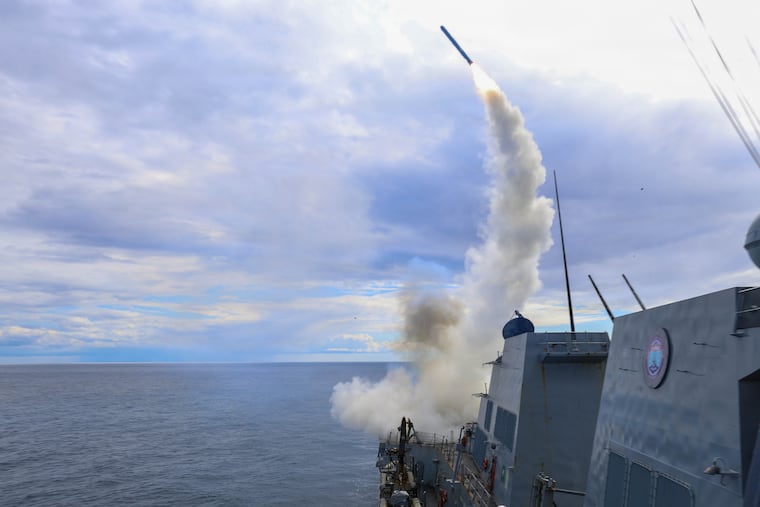
The U.S. military has fired more than 850 Tomahawk cruise missiles in four weeks of war with Iran, burning through the precision weapons at a rate that has alarmed some Pentagon officials and prompted internal discussions about how to make more available, said people familiar with the matter.
The missiles, which can be launched from Navy surface warships and submarines, have been a staple of U.S. military attacks since they were first used in combat in 1991 during the Persian Gulf War. But only a few hundred are manufactured each year, meaning the global supply is limited. The Pentagon does not publicly disclose how many missiles are in its inventory at any one time.
Tomahawks are prized in part because they can travel more than 1,000 miles, reducing the need to send American pilots into well-defended airspace. The heavy reliance on them in the Iran conflict will require urgent discussions about whether to relocate some from other parts of the world, including the Indo-Pacific, and a concerted long-term effort to build more, said several U.S. officials, speaking on the condition of anonymity to discuss sensitive military planning.
The dilemma has laid bare broader concerns in both the Pentagon and Congress about the Trump administration’s war in Iran, its shifting explanations for why the conflict is necessary, and the risks a shortage could pose to the United States as it balances the potential for future conflict in other parts of the world. It comes as the White House deliberates over a possible major escalation in Iran, to include the use of ground troops, while pursuing negotiations to end hostilities.
The Pentagon has tracked the number of Tomahawks used with an increasing focus on what the burn rate will mean for not only a sustained campaign against Iran but for future military operations as well, people familiar with the matter said. One official characterized the number of Tomahawks left in the Middle East as “alarmingly low,” while another said that without intervention, the Pentagon is closing in on “Winchester” — military slang meaning out of ammunition — for its supply of Tomahawk missiles in the Middle East.
Sean Parnell, a Pentagon spokesman, did not directly address questions about the number of Tomahawk missiles expended or remaining in the Middle East and said the U.S. military “has everything it needs to execute any mission at the time and place of the President’s choosing and on any timeline.”
He asserted that the news media is “biased and obsessed with portraying the world’s strongest military as weak,” and said that scrutiny of weapons employment to date in the war inaccurately suggests that the Defense Department has failed to provide U.S. personnel “every advantage to be successful” while attempting to “frighten and sow doubt in the minds of the American people.”
The Financial Times reported earlier that the Pentagon had burned through years of Tomahawk missiles in Iran, without specifying how many.
Modern Tomahawks have been in service since 2004 and allow U.S. forces to communicate with the missile via satellite. They can strike preprogrammed targets or locate adversaries on the fly through GPS. It also can loiter over a battlefield and has a camera on board capable of relaying battle-damage information to commanders.
The most recent versions of the missile can cost as much as $3.6 million a piece and require up to two years to build, according to Navy documents. In recent years, they have been purchased in small batches, with just 57 included in last year’s defense budget.
Many of the 850-plus expended Tomahawks were fired in the opening days of Operation Epic Fury, the Trump administration’s name for the war in Iran, people familiar with the matter said. They include at least one that struck in the vicinity of an elementary school in the Iranian city of Minab early in the operation. U.S. officials have since opened an investigation into the incident, which Iranian officials have said killed scores of children.
Defense Secretary Pete Hegseth and Adm. Charles “Brad” Cooper, who oversees U.S. operations in the Middle East as head of U.S. Central Command, have said that as U.S. and Israeli forces destroyed Iranian air defenses and other military capabilities early on, American pilots have been able to push inland and conduct airstrikes using munitions that the Pentagon has in greater abundance.
The U.S. military also has fired more than 1,000 air-defense interceptor missiles in response to Iranian counterattacks across the region, including from the Patriot and Terminal High Altitude Area Defense (THAAD) systems, which are considered the world’s most advanced, two other officials familiar with the issue said. The inventory of those weapons also is limited and not publicly disclosed.
The Tomahawk’s high burn rate means the Navy has needed to take the step of conducting resupply aboard at least some of the warships involved in the Iran operation. Each naval destroyer can carry dozens of the missiles, which are 20 feet long and about 3,500 pounds. The Navy typically does so in port, but has been developing the capability to do so at sea.
MacKenzie Eaglen, a senior fellow at the American Enterprise Institute, said that before Operation Epic Fury began late last month, the Navy probably had between 4,000 and 4,500 Tomahawk missiles on hand. Others naval analysts have said the number could be much lower, perhaps closer to 3,000, following their extensive use in recent operations, including the Trump administration’s strikes last year in Iran, Yemen and Nigeria.
Mark Cancian, a senior adviser at the Center for Strategic and International Studies, said if the military has fired more than 800 Tomahawks against Iran, “that would be about a quarter of the total inventory and would leave a large gap for a conflict in the Western Pacific.” His think tank assesses that the Navy may have had as few as 3,100 Tomahawks on hand at the start of the war a month ago.
“It would take several years to replenish,” Cancian said.
The Navy has purchased almost 9,000 Tomahawks over the lifetime of the missile program, according to a CSIS assessment. Thousands of those are less advanced early variants that are now obsolete and retired, CSIS found.
The missile is built by Raytheon with help from other manufacturers. The defense industry has capacity to produce about 600 missiles per year, said Ryan Brobst, deputy director of the Center on Military and Political Power at the Foundation for Defense of Democracies.
Trump administration officials have adamantly disputed concerns that the Iran war will deplete key U.S. munitions. White House press secretary Karoline Leavitt said this month that the U.S. military “has more than enough munitions, ammo and weapons stockpiles to achieve the goals of Operation Epic Fury laid out by President Trump — and beyond.” Hegseth has asserted the same, telling reporters March 5 that, “we’ve got no shortage of munitions” and U.S. stockpiles would “allow us to sustain this campaign as long as we need to.”
The administration nonetheless has convened meetings on the issue, inviting executives from numerous defense contractors, including Raytheon, to the White House. Trump said on social media afterward that the companies had agreed to “quadruple Production of the ‘Exquisite Class’ Weaponry.” A similar meeting is expected again in two months, the president wrote.
Hegseth personally has urged defense firms to speed delivery of key weapons, said one person familiar with the defense secretary’s conversations with industry executives.
As The Washington Post first reported this month, the Pentagon is seeking more than $200 billion from Congress to fund the war in Iran, an enormous ask that has already run into resistance from lawmakers opposed to the conflict. Hegseth, when asked about that reporting, said last week that the final budget request “could move.”
“It takes money to kill bad guys,” he told reporters at the Pentagon on March 19, saying the forthcoming ask of Congress is intended to ensure “we’re properly funded for what’s been done, for what we may have to do in the future [and] ensure that our ammunition is — everything’s refilled and not just refilled, but above and beyond.”
Alex Horton contributed to this report.