Trump fashions America’s 250th anniversary in his own image
In a speech delayed for hours by severe weather, he casts himself as central to the "Golden Age" he wants Americans to see.
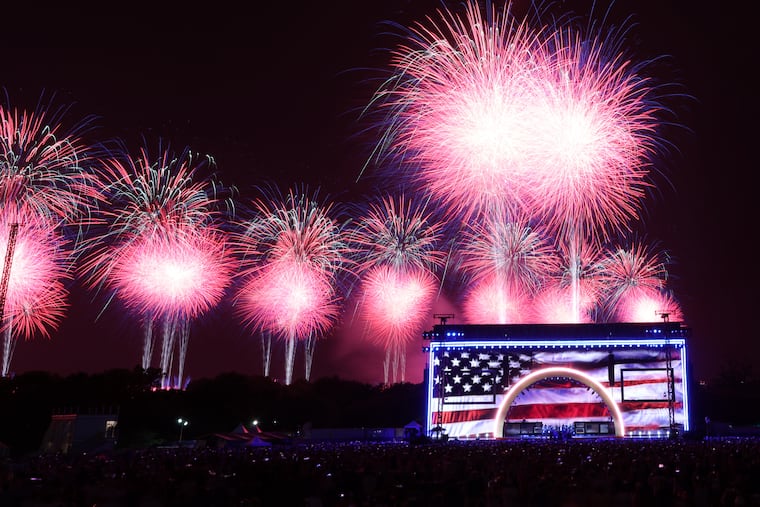
For all the power he has flexed over the past year and a half, President Donald Trump could not control the scorching, dangerous, record-shattering weather in the nation’s capital for the 250th anniversary of America’s independence, or the lightning strikes in the distance that prompted officials to evacuate the National Mall ahead of his planned speech.
But nearly every other aspect of the celebration in Washington bore Trump’s imprint, as decisions he made transformed an official commemoration of American history into another polarizing moment in American politics.
After a chaotic scene unfolded early Saturday evening, with Secret Service officials forcing defiant Trump supporters to flee the president’s Salute to America event as severe weather loomed, Trump told them all to come back. The show would go on.
His supporters, wearing gear bearing his name and slogans, trekked back to stand in security lines again in the rain.
“I said, ‘There’s no way — if we have to speak in front of one person at 4 o’clock in the morning, I’m going to be here,’” Trump declared when the rain had stopped and he began speaking after 11 p.m. to a crowd half the size of what it had been earlier. “There’s no way we can be deterred."
“This is an evening for the ages. I believe this is something very special,” Trump said into the night, describing the attendees’ perseverance and late-hour return as “bigger than if we didn’t have the lightning blaring.”
“But this is bigger. A little more inconvenient, but it’s bigger. I think, in its own way, it’s more beautiful.”
It was but the latest twist in a national celebration that Trump defined in his terms — and for which the president has called the shots.
Ever the showman, Trump throughout his speech brought notable Americans out onto the stage with him — war veterans as old as 107 who saluted from wheelchairs, astronauts from the Artemis II and Apollo 17 missions, and families of soldiers killed in battle.
He praised the “unstoppable spirit that created the world’s most powerful industries and built the strongest military anyone had ever seen‘" but also reprised his political grievances.
Trump joked that he was serving his third term as president, a reference to his false claims that the 2020 election was stolen from him. He prompted cheers from his supporters as he touted his bill to assert federal control over election rules — legislation that Senate Republican leaders have repeatedly told him won’t pass as it is currently written. And he lobbed several verbal attacks at “communists,” his label for the democratic socialists who have won several recent Democratic primary elections.
Before Saturday night’s rally, Trump didn’t pretend that the celebrations would be anything other than his usual unapologetic rhetoric.
“Has anyone ever seen a Happy Dumocrat?” the president wrote of his opposing political party on social media on Saturday morning, his first Fourth of July greeting of the day. Weeks earlier, Trump had abruptly announced that he would also serve as the headlining act of a rally kicking off the two-week Great American State Fair on the National Mall, calling himself “the Number One Attraction anywhere in the World, the man who gets much larger audiences than Elvis in his prime.”
“Only Great Patriots invited” Trump wrote of the launch of a fair that was, in theory, open to all, later billing the kickoff to the 250th anniversary festivities as a “Trump rally.”
Milestone anniversaries like the semiquincentennial present rare moments of shared civic ritual, occasions when presidents are widely expected to place themselves within the sweep of the American story, rather than at the center of it. This year’s celebration, instead, reflected both Trump’s vision of America, and America’s divisions over Trump.
The decision to have Trump speak late Saturday also reshaped a long-standing July Fourth tradition. Security restrictions prevented attendees from bringing coolers or arriving throughout the evening, and the speech was already set to delay the fireworks until after 10:30 p.m.
The pyrotechnics finally began moments before midnight, with Trump remaining in a climate-controlled box at the National Mall to watch. The massive show set a record, organizers said.
As Americans sweltered through a dangerous heat wave, with Washington’s heat indexes reaching 115 degrees, Trump had warned that he planned to “make a really long speech … just to show that I can do anything.” Organizers instructed those attending not to arrive too early to limit their time outside.
In the end, the late-night speech was about 35 minutes long.
The National Mall fair itself, long touted as a showcase for American greatness and national unity, instead became a Rorschach test. Trump supporters praised the patriotic atmosphere and military flyovers.
His critics, meanwhile, pointed to images of sparse crowds, a mock-up of Trump’s proposed triumphal arch on the grounds, and administration officials touting their accomplishments as evidence that the president’s personal involvement had undercut what might otherwise have been a broader civic celebration.
With just months to spare before the occasion, Trump had pushed aside America 250, the long-standing bipartisan commission tasked a decade ago with planning anniversary festivities, replacing it with his own group of political allies, Freedom 250. His advisers argued the move was necessary because the commission had become bogged down by bureaucracy.
But as Trump’s chosen planning organization became increasingly seen as a partisan entity, vendors and performers alike ultimately pulled out of the fair, which has struggled to draw large crowds for much of its first week.
Besides supplanting the bipartisan commission, Trump has increasingly put his imprint on other aspects of this year’s commemoration. His face appears on a commemorative gold coin marking the anniversary and on limited-edition “patriot passports.” Administration officials have pushed for a $250 bill bearing his portrait, and Trump this week posted an image of a $100 bill featuring his autograph — marking the first time a sitting president’s signature has been featured on U.S. currency.
As he has throughout the anniversary celebration, Trump cast himself as central to the story he wants the country to tell about itself: that America was diminished before him, revived by him, and is now celebrating its founding through his restoration — a promised “Golden Age.” At Mount Rushmore on Friday night, he told the crowd that he “saved, almost single-handedly,” the Second Amendment and that he was going to “give our country its identity back.”
“We never had the American Dream, however, like we have it right now,” Trump said Saturday on the National Mall. “The American Dream is back. Very strong. Beautiful."
Republican President Gerald Ford took a different approach during the nation’s bicentennial celebration in 1976, even as he was running for reelection in the aftermath of Watergate and the Vietnam War. In his remarks, Ford made no mention of the campaign, the Democratic front-runner Jimmy Carter, or his GOP primary challenger, Ronald Reagan.
Ford’s only reference to electoral politics came as a broader reflection on self-determination: “This November the American people will, under the Constitution, again give their consent to be governed,” he said, outside Independence Hall in Philadelphia. “This free and secret act should be a reaffirmation by every eligible American of the mutual pledges made 200 years ago by John Hancock and the others whose untrembling signatures we can still make out.”
But comparisons with past presidents are complicated by the fact that patriotism itself has become more polarized, said Tevi Troy, a presidential historian and senior fellow at the Reagan Institute.
“There’s a feeling out there that Republicans are more patriotic than Democrats, or that the patriotism gap can differ depending on which party is in the White House,” Troy said. “While Trump does things in terms of partisanship that you can safely say are unprecedented, he is also president in a more divided time.”
A recent Gallup poll found that national pride has fallen to its lowest point since the organization began asking in 2001 how proud respondents were to be an American. Just 33% reported being “extremely proud,” down eight percentage points from a year ago and 37 points since a high in 2003. The partisan gap there is wide, with Republicans reporting much higher American pride while Democrats and independents have hit record lows for their respective groups, Gallup found.
John Pitney, a former national Republican official who now teaches political science at Claremont McKenna College, said Trump is diverging from the tradition of presidents who have used moments of national triumph and tragedy to speak as Americans first, not as partisans.
“I remember Reagan at Normandy in 1984 — the 40th anniversary of D-Day, surrounded by people who were veterans of that war,” Pitney said. “There is a reason why that speech is still remembered. It wasn’t about him.”