Federal commission delays vote on Trump’s White House ballroom project
The National Capital Planning Commission’s chair cited the amount of public comment as the reason for the delay.
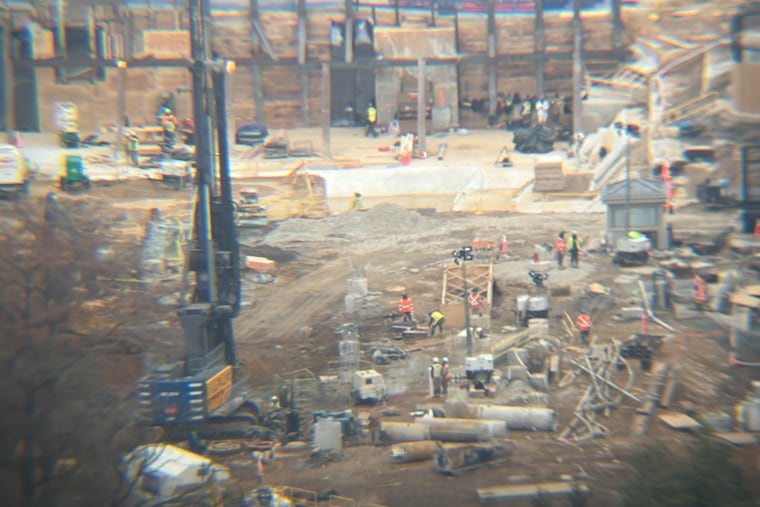
A federal planning commission on Thursday delayed a vote on President Donald Trump’s planned White House ballroom until next month, citing “significant public input,” including tens of thousands of comments — nearly all of them critical of the project.
The National Capital Planning Commission had planned to review the proposal and vote on it — the final procedural hurdle for an effort to dramatically remake one of the most revered symbols of American power and democracy.
But partway into the meeting, commission Chair Will Scharf said that he expects public comment to last five to nine hours, with over 100 people signed up to testify, which will likely require the board to recess Thursday evening and resume Friday morning. The commission will discuss and vote on the project at its April 2 meeting, he said.
Ahead of Thursday’s hearing, the agency received more than 35,000 comments about the project, according to a Washington Post analysis of submissions posted on the commission’s website. The “vast majority” came from those who oppose the plan, commission staff said. The Washington Post found that more than 97% of comments were critical of the president’s plans. (The Post used artificial intelligence to classify the submissions and measured its accuracy against a hand-checked sample.)
The delayed vote is a snag in Trump’s push to rush the project through the approval process so construction can be completed before the end of his second term. Securing approval at the commission’s next meeting, however, could keep the project on schedule; the White House has said it plans to begin aboveground construction as soon as next month.
The commission’s endorsement would be the last bureaucratic obstacle in the Trump administration’s push to secure approval for the $400 million ballroom from two federal committees charged by Congress with reviewing the designs of major construction projects in Washington. Late last year, the White House laid out a strategy to complete the process within nine weeks, a plan that’s now been pushed to just over three months.
Historic preservationists have sued to stop the project, and a federal judge is considering their challenge, which alleges that Trump is unlawfully pursuing a project that requires express authorization from Congress.
Last week, the National Capital Planning Commission’s executive director, Marcel Acosta, recommended that the 12-member panel approve the project. In an 11-page report published Friday, Acosta said the proposed structure will provide presidents with a larger permanent event space while protecting “the historic integrity and cultural landscape of the White House.”
Acosta’s assessment contrasts sharply with the public response. Tens of thousands of comments criticized what opponents described as a rushed approval process, insufficient public input and a design that would overshadow the main White House building.
The president has made the building a priority of his second term, and he returns to it often in public remarks and social media posts. He clashed with the project’s previous lead architect about the size of the addition.
Trump has made strategic moves to secure its success, including reshaping the membership of the two federal bodies that must sign off on the project: the National Capital Planning Commission and the Commission of Fine Arts. Last month, the Commission of Fine Arts, which now includes Trump’s 26-year-old executive assistant, voted unanimously to approve the project. Chair Rodney Mims Cook Jr. called it a “desperately needed” and “very beautiful structure,” whose design he credited to Trump.
The National Capital Planning Commission is led by Will Scharf, the White House staff secretary and Trump’s former personal lawyer, whom the president appointed in July. The commission includes a pair of other White House officials, James Blair and Stuart Levenbach. It also has nine seats apportioned to sitting cabinet secretaries and other officials who have a role in overseeing Washington, although senior officials and lawmakers usually send a representative in lieu of attending themselves.
Although federal design commissions have traditionally acted as a constraint on government construction projects — often holding extended deliberations that last for years — Trump has pressed to move the project along swiftly so it can wrap before his term concludes.
Last year, the president ordered the rapid demolition of the East Wing annex without first seeking authorization from Congress or the review committees. Trump’s plan for a new ballroom building on the site that matches the “height and scale” of the main White House has advanced despite objections from a federal judge, architecture experts and historic preservationists, who argue that the structure would be too big, dwarfing a centuries-old American symbol.
White House officials want the commission to approve in one fell swoop the ballroom building’s preliminary and final plans, which the body normally takes up individually at separate meetings, giving agency planners time to incorporate commission feedback before resubmitting updated plans. For example, the planning commission approved a new White House perimeter fence in three steps over seven months, starting with a conceptual design in July 2016 and ending with final plans in February 2017.
Last week, Trump scored another victory on the ballroom front. U.S. District Judge Richard J. Leon ruled that construction on the project could proceed, citing procedural problems with a lawsuit challenging the president’s ability to unilaterally build the structure. The National Trust for Historic Preservation, a congressionally chartered organization that advocates for protecting historic sites, amended and refiled its complaint Sunday, three days after Leon’s ruling.
Trump has repeatedly defended the project’s $400 million price tag, saying it is a benefit to taxpayers that the project will be paid for with private donations.
“I built many a ballroom. I believe it’s going to be the most beautiful ballroom anywhere in the world,” Trump said Monday at a ceremony in which he awarded the Medal of Honor to three Army soldiers.
Democrats and government watchdog organizations have raised concerns about those donors, which include major corporations such as Amazon, Google, and Palantir — companies that together have billions of dollars in federal contracts. Critics have questioned whether donors could receive special access or other benefits in return. (Amazon founder Jeff Bezos owns the Washington Post.) Some Democrats say improvements to the White House complex may be warranted but contend that the ballroom should be far smaller and subject to congressional oversight to ensure transparency.
Polls have found that most Americans oppose the project. Twenty-five percent of respondents said they supported tearing down the East Wing to build the ballroom, compared with 58% who opposed doing so, according to an Economist/YouGov poll conducted last month.