Trump’s deportations are costing Americans jobs, study finds
A new study casts doubt on a central tenet of the president’s immigration policy.
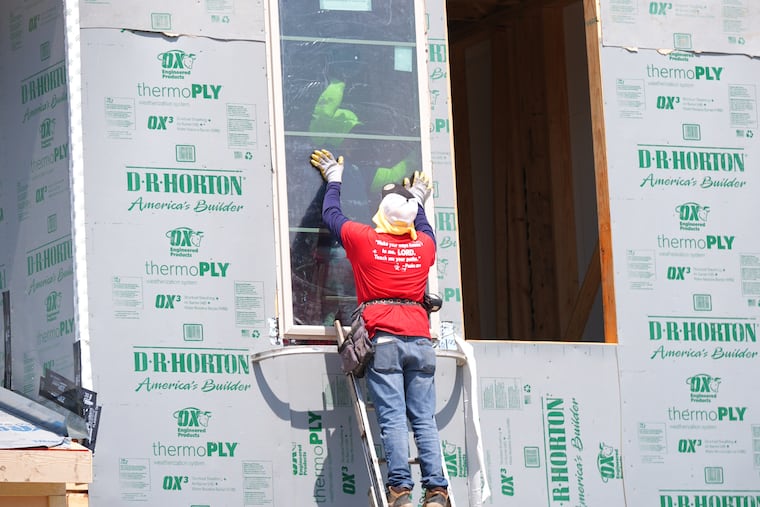
The Trump administration has long claimed that mass deportations would deliver more jobs and higher wages to U.S.-born workers. But a new study casts doubt on that assertion, undermining a central tenet of the president’s immigration policy.
Recent surges in deportations have led to job losses for immigrant and U.S.-born workers, while wages have stayed flat, according to the study, published by the National Bureau of Economic Research, a nonpartisan research organization. Construction, which depends heavily on immigrant labor, was impacted more than any other industry studied, with U.S.-born workers losing more jobs as a result of the deportations than the workers lacking legal status who remained.
The study offers the first national analysis of the effects of the Trump administration’s aggressive deportation operations on the labor market, comparing communities that experienced surges in deportations between January 2025 and October 2025 with those that did not.
Analyzing federal labor data, researchers focused on four industries that rely heavily on immigrant workers lacking legal status: agriculture, construction, manufacturing, and wholesale. Deportations had a chilling effect on each of those industries, disproportionately affecting men, who accounted for more than 90% of the immigration arrests. Taken together, the affected industries saw a 5% drop in employment for male workers lacking legal status and a 1.3% drop for male U.S.-born workers without a college degree.
The researchers found no evidence that employers increased wages to attract U.S. workers. Instead, work slowed.
In construction — where the researchers estimated 15% of the workforce is undocumented — U.S.-born workers have paid a price for the deportations, the study found: Employment dropped by 3% for male American-born workers without a college degree and 7.5% for workers lacking legal status. For each arrest, six U.S.-born workers lost a job, and four workers lacking legal status lost one.
“Construction companies view it as easier to reduce production, reduce the construction of new homes and new buildings in general, rather than try to increase wages for U.S.-born workers,” said Chloe East, an author of the study and an economics professor at the University of Colorado, Boulder.
Previous research has also shown that increased immigration enforcement slows housing construction, drives up home prices, and leads to job losses for U.S.-born workers.
At the State of the Union address in February, President Donald Trump claimed that thousands of new construction jobs had been created, saying, “More Americans are working today than at any time in the history of our country.” In a news release earlier this year, the White House argued that the construction industry had benefited from the deportations.
But the residential construction industry has been slowing. Permits for new housing units were down 7.4% year over year in March 2026, to 1.372 million units, according to the census. In April 2026, residential construction jobs were down 1.5% year over year, according to federal jobs data.
“Given high interest rates, given rising material prices and fewer people available to provide roofing, tiling, carpeting, and other flooring services, it renders fewer projects financially viable,” said Anirban Basu, chief economist to Associated Builders and Contractors, a national trade organization.
Even before the deportation surge, the construction industry was facing labor shortages amid an aging, depleted workforce that lacked a robust pipeline of newly trained workers. The exodus of foreign workers during the 2008 foreclosure crisis, when almost 2 million construction workers lost their jobs, has had a lasting impact. The country has failed to build enough homes since then, in part because of a persistently anemic labor force, leading to a drastic housing shortage that is driving the current crisis.
“I assume we’re going to see a similar long-term shock to the construction sector,” East said.
In recent months, Adrian Avila, president of AVICA Construction and Development, a homebuilder in Los Angeles, has watched older immigrant workers self-deport amid fears of Immigration and Customs Enforcement raids. “It became a mind shift for some individuals,” he said. “Maybe it’s time to hang up the hat, literally hang up the hard hat.”
Avila, whose company is rebuilding homes destroyed in the Eaton fire last year, has had to delay projects to accommodate the labor shortage but hasn’t raised wages because he said he pays competitively. A labor crunch he thought was a few years away feels like it has arrived.
“We thought we were going to have some time to fill in those gaps” in the labor force, said Avila, who is also the president of the Los Angeles chapter of the National Hispanic Construction Alliance. “But now with this, that gap is becoming bigger.”
Projects that once took Samantha Jones, a general contractor in South Florida, two or three months to complete now take five or six. Last year, Jones lost 14 of her 34 workers through arrest or self-deportation, including 11 in a span of three weeks in August, nearly driving the company she’s owned for 17 years out of business.
“People think we hire migrant workers because they’re cheap labor,” Jones said. “It’s not because they’re cheap labor; it’s just that their skill set fits our industry better.”
The workers, many of whom have worked for her for decades, arrived with specialized skills in masonry and carpentry. “We don’t really have any trade schools here in the South,” she said.
Jones anticipates raising the prices she charges clients by 15% — money that would not go toward higher wages, but to cover the loss of business from delays. Last week, ICE was active in the area again, keeping some workers home out of fear. “It’s horrible logistically,” she said.
But in Miami, Omri Farache, the owner of Mia Remodeling Contractors, is hopeful that the deportations will ultimately benefit him. He sees a future when he is no longer outbid by an unlicensed contractor willing to work for less money. “Honestly, it’s good eventually,” he said. “I feel like more regulated, less handyman pricing around is good for me.”
Some contractors are struggling to find qualified workers to fill the new vacancies. In Minneapolis, Josue Alvarez, the owner of Milestone Construction, a drywall subcontractor, has been interviewing candidates to replace one of his painters, who was deported back to his native Guatemala in December. Alvarez had come to rely on the worker, who had eight years of experience and was willing to put in long hours.
“He was a dependable guy, someone I could lean on,” said Alvarez, who shut down his business for six weeks during the winter’s ICE surge out of a concern his other workers would be arrested.
Amid a tight labor market, Alvarez said other subcontractors are also racing to replace the workers they’ve lost as projects pile up. Some of the subcontractors he once competed against have gone out of business. “Pretty much everybody is on the hunt,” he said. “A lot of companies lost a lot of good employees.”
However, he said, in the four years that he has owned his company, no U.S.-born worker has ever applied for a job. And none have applied to fill his current opening, either.
This article originally appeared in The New York Times.