Trump’s hand-picked panel votes to put his face on a U.S. gold coin
The proposal calls for a 24-karat gold coin depicting Trump leaning on a desk with clenched fists. A Mint official told the panel that Trump had personally approved the design.
A federal arts commission voted Thursday to approve a commemorative U.S. gold coin featuring Donald Trump, the administration’s latest effort to celebrate the president, even as Democrats and members of another federal committee say the idea is deeply inappropriate and potentially illegal.
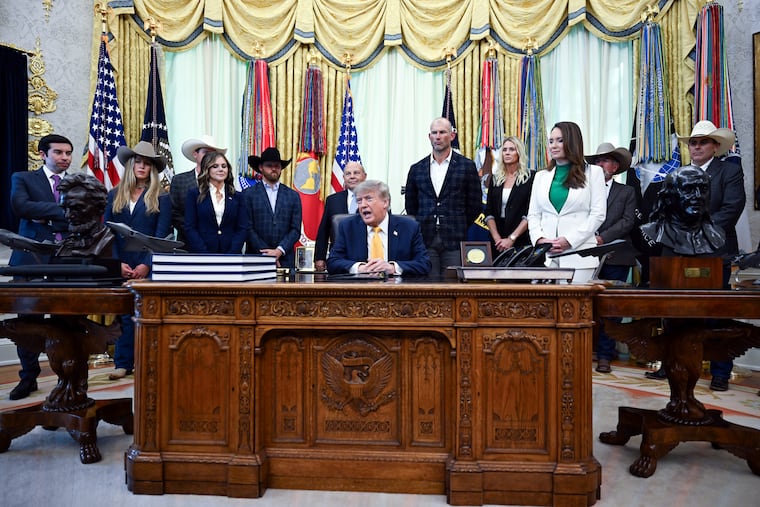
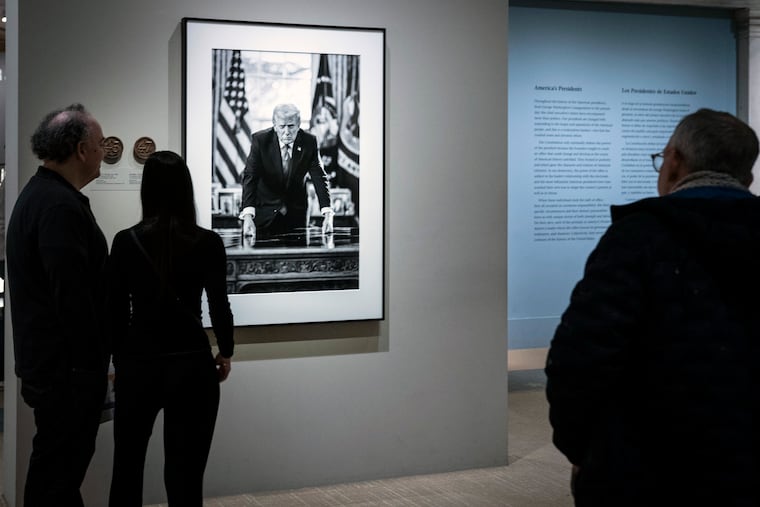
The proposal calls for a 24-karat gold coin depicting Trump leaning on a desk with clenched fists, based on a photograph taken by his chief White House photographer and now displayed in the Smithsonian’s National Portrait Gallery. Such gold coins from the U.S. Mint typically sell for several thousand dollars. A Mint official told the panel that Trump had personally approved the design.
Members of the Commission of Fine Arts — composed entirely of Trump appointees, including a 26-year-old executive assistant whose only listed credential for the post was managing Trump’s portrait project — spent several minutes discussing potential changes to the coin, including how big to make it, before officially endorsing it.
“I think the larger the better, and the largest of that circulation, I think, would be his preference,” said Chamberlain Harris, Trump’s executive assistant. Harris also said that the image captured Trump looking “very strong and very tough” and that it would be “fitting” to have him on a coin to mark the nation’s 250th anniversary.
James McCrery II, who served as Trump’s first architect on his planned ballroom before wrangling with the president over its size, encouraged Treasury officials to make the coin “as large as possible, all the way to three inches in diameter,” as he led the vote to approve it.
But new coin designs are supposed to receive approval from two panels — and that second panel, the bipartisan Citizens Coinage Advisory Committee, refused last month to consider the proposed gold coin. In interviews, members opposed putting a sitting president on currency, saying it would break with democratic norms and reek of subservience to royalty.
“It’s wrong. It goes against American culture and the traditions that drive what we put on our coinage,” said Michael Moran, a Republican coin collector whom then-Senate Majority Leader Mitch McConnell (R., Ky.) recommended for appointment. “I didn’t sign up for this.”
Several members of the coin committee said the Trump administration could seek to mint the coin without their panel’s approval but would probably face legal challenges.
The coin committee is composed of numismatists, or experts in coin collecting, as well as a historian and an artist who specializes in medallic arts. Its most famous former member — retired basketball star Kareem Abdul-Jabbar, a longtime coin collector — said he was disheartened because he believed well-designed coins could inform and inspire. He cited as examples a 1998 silver dollar that honored Crispus Attucks, who was enslaved, escaped, and was killed in the Boston Massacre in 1770, and a 2017 gold coin that depicted Lady Liberty as an African American woman.
“I’m not enthusiastic about memorializing Mr. Trump on a coin because he has done so much damage to our country,” said Abdul-Jabbar, who served on the committee a decade ago. “It takes a huge consensus to get agreement on something like this, and I’m not inclined to be supportive of the president’s request.”
The White House did not respond to questions about the commemorative coin and whether it was appropriate to commission it. The Treasury Department, which oversees the Mint, said the commemorative coin was appropriate for this year’s anniversary.
“As we approach our 250th birthday, we are thrilled to prepare coins that represent the enduring spirit of our country and democracy, and there is no profile more emblematic for the front of such coins than that of our serving President, Donald J. Trump,” U.S. Treasurer Brandon Beach said in a statement.
Only one past president — Calvin Coolidge — was featured on a U.S. coin in his lifetime. Coolidge’s portrait appeared on a commemorative coin to mark the nation’s Sesquicentennial in 1926, a year when he was president, with an image of George Washington overlaid. Coolidge’s inclusion sparked controversy, and most of the coins were later melted.
The Trump-themed gold coin marks the administration’s latest effort to shape U.S. currency. Officials last year proposed a separate $1 coin design featuring the president’s likeness, intended to honor the Semiquincentennial and enter circulation, but the coin committee balked at taking up the proposal. Mint officials argue that because the committee declined to consider the coin, the administration is not bound by its review — a claim that current committee members dispute.
Meanwhile, the arts commission in January approved the Trump-themed $1 coin. The Treasury Department has not yet specified whether or when that coin will enter circulation.
Democrats have bristled at efforts to recognize Trump on currency and attempted to stop it. Sen. Catherine Cortez Masto (D., Nev.), one of several Democrats who introduced legislation last year intended to block any living or sitting president from being featured on U.S. currency, told the Washington Post that the Trump-themed gold coin was “embarrassing” and against the nation’s values.
“Monarchs and dictators put their faces on coins, not leaders of a democracy,” added Sen. Jeff Merkley (D., Ore.). Lawmakers and congressional staff have also cited laws they say should constrain the administration, such as a 2005 law that restricted some $1 coins to honoring deceased presidents.
Donald Scarinci, a Democrat whom Senate Minority Leader Chuck Schumer (D., N.Y.) recommended to the coin committee, said that gold coins presented a “loophole” because the Treasury Department has the independent power, without congressional authority, to mint them.
“They can definitely make the coin without our review. But it would be an illegal coin,” Scarinci said. “It’s not about Donald Trump. It’s about whoever the president is. It’s not something done in a democracy.”
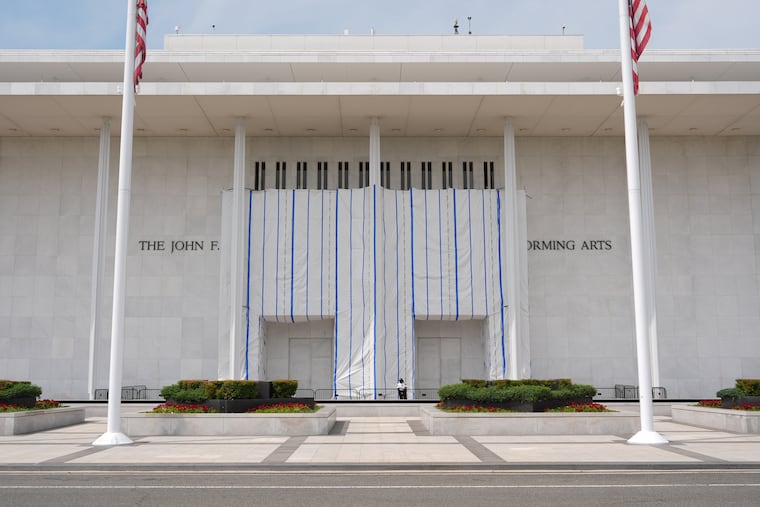
The wrangling over the coin comes amid a bigger fight over how Trump and his allies are seeking to memorialize the 79-year-old president. Trump’s deputies have put his name on buildings, such as the Kennedy Center and the U.S. Institute of Peace, drawing complaints from lawmakers and lawyers who say that only Congress can rename the facilities, and GOP lawmakers have proposed renaming Dulles International Airport after him.
Trump has also sought to remake White House grounds, proposing a visitor screening center also under consideration Thursday and demolishing the White House’s East Wing to build his long-desired ballroom. His projects extend into Washington, with plans to construct a 250-foot triumphal arch along with other projects that would leave a physical imprint on the city.