‘Morally acceptable’ for U.S. troops to disobey orders, archbishop says
Timothy P. Broglio, who heads the Catholic archdiocese for the U.S. military, expressed concern at President Donald Trump’s threats to seize Greenland by force.
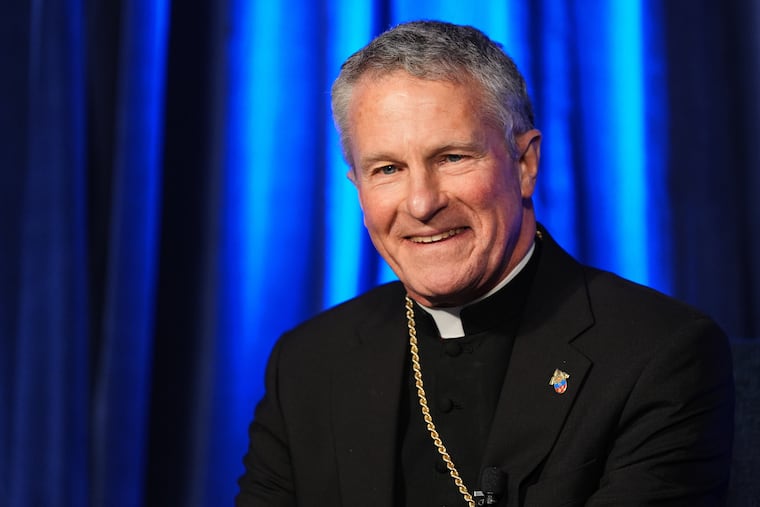
As the Trump administration intervenes in Venezuela, readies troops for a possible deployment to Minnesota, and threatens to seize Greenland, the Catholic archbishop for the U.S. armed forces said it “would be morally acceptable” for troops to disobey what violated their conscience.
Archbishop Timothy P. Broglio is one of a chorus of Catholic leaders questioning the administration’s use of force. His comments also underscored the mounting concern being voiced by the first American pontiff, Pope Leo XIV, as well as his top cardinals in the United States, over the Trump administration’s foreign policy.
“Greenland is a territory of Denmark,” Broglio told the BBC Sunday. “It does not seem really reasonable that the United States would attack and occupy a friendly nation.”
Asked whether he was “worried” about the military personnel in his pastoral care, Broglio replied: “I am obviously worried because they could be put in a situation where they’re being ordered to do something which is morally questionable.”
“It would be very difficult for a soldier or a Marine or a sailor to by himself disobey an order,” he said. “But strictly speaking, he or she would be, within the realm of their own conscience, it would be morally acceptable to disobey that order, but that’s perhaps putting that individual in an untenable situation — and that’s my concern.”
As head of the D.C.-based Archdiocese for the Military Services USA, Broglio oversees the chaplains who serve Catholics and others at U.S. military bases, Veterans Affairs healthcare facilities and diplomatic missions worldwide.
A former president of the U.S. Conference of Catholic Bishops, the Ohio native is seen as a church conservative. As the Obama administration was ending Don’t Ask, Don’t Tell, he spoke against allowing LGBT troops to serve openly. When the Trump administration disqualified transgender people from serving in the military, he said “sexual orientation and gender identity issues” reflected an “incorrect societal attitude.”
He has also criticized military strikes on boats the administration says are smuggling drugs. U.S. forces have killed at least 115 people in more than 30 such strikes in international waters in the Caribbean and the Pacific since September.
“In the fight against drugs, the end never justifies the means,” he said in a statement last month. “No one can ever be ordered to commit an immoral act, and even those suspected of committing a crime are entitled to due process under the law.”
He issued the statement after the Washington Post reported that commanders in the first known boat strike saw survivors and ordered a second barrage to kill them. He did not refer to the incident, but appeared to allude to it.
“As the moral principle forbidding the intentional killing of noncombatants is inviolable,” he said, “it would be an illegal and immoral order to kill deliberately survivors on a vessel who pose no immediate lethal threat to our armed forces.”
Trump is set to arrive Wednesday in Davos, Switzerland, for the World Economic Forum, at which European leaders plan to discuss his demand to seize and annex Greenland — a demand that has transformed the annual gathering of the world’s political and financial elite into an emergency diplomatic summit.
Members of the military take an oath to the Constitution, not to the president. They swear an oath of enlistment to “support and defend the Constitution of the United States against all enemies” and “obey the orders of the President of the United States and the orders of the officers appointed over me,” according to the Uniform Code of Military Justice. They have an obligation not to follow “manifestly unlawful orders,” but such situations are rare and legally fraught, The Washington Post reported. Military personnel can be court-martialed for failing to obey lawful orders.
The Pentagon in November announced an investigation into Sen. Mark Kelly (D., Ariz.), a prominent Trump critic and combat veteran, after he spoke in a video with five other Democrats reminding U.S. service members of their duty under military law to disobey illegal orders. The message move criticized by Trump at the time as “SEDITIOUS BEHAVIOR,” and the other lawmakers said this month they were now under investigation by his administration for the video.
Kelly filed a lawsuit earlier this month seeking to reverse Defense Secretary Pete Hegseth’s letter of censure and effort to potentially demote him in rank.
Broglio’s comments echoed concerns made in a joint statement Monday by the three highest-ranking U.S. Catholic archbishops, who warned that a resurgence in the use or threat of military force, including by the United States in Venezuela and Greenland, had thrown “the moral foundation for America’s actions in the world” into question.
“The events in Venezuela, Ukraine and Greenland have raised basic questions about the use of military force and the meaning of peace,” wrote Cardinals Blase Cupich of Chicago, Robert McElroy of D.C., and Joseph Tobin of Newark.
In the days after the U.S. operation in Venezuela to capture Nicolás Maduro, and after Trump said he was now “in charge” of that nation, the pope insisted on respect for Venezuela’s sovereignty.
In a Jan. 9 meeting with diplomats in Vatican City, Leo decried a new era in which multilateralism is being replaced by “a zeal for war” and “peace is sought through weapons as a condition for asserting one’s own dominion.” He did not name the United States.
Broglio, in his comment on the U.S. boat strikes, invoked just war theory. In Catholic teaching, the “defensive use of military force” against an aggressor may be legitimate as a final resort under strict criteria.
According to the Catechism of the Catholic Church, the damage inflicted by the aggressor must be “lasting, grave and certain”; all other means of stopping it “must have been shown to be impractical or ineffective”; there must be “serious prospects of success”; and the action “must not produce evils and disorders graver than the evil to be eliminated.”