Kurt Volker, Trump’s former Ukraine envoy, says Giuliani got misinformation on the Bidens
The former special U.S. envoy to Ukraine told lawmakers Thursday that he warned Ukrainians to steer clear of American politics.
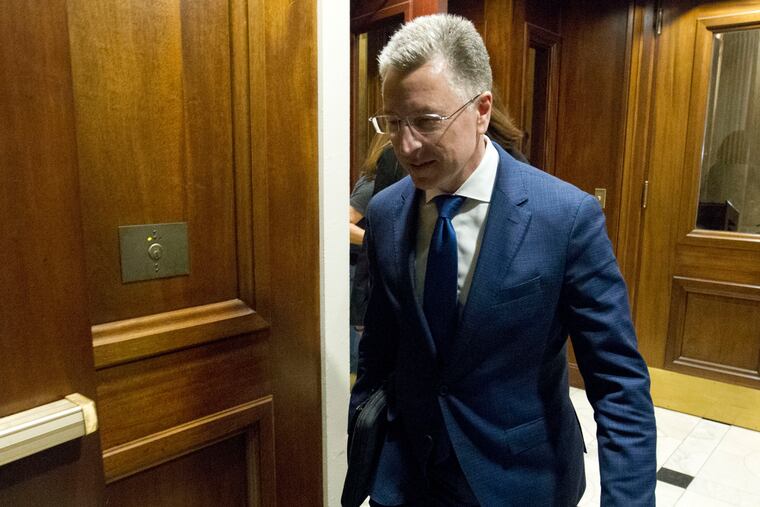
WASHINGTON — The former U.S. special envoy for Ukraine told House investigators on Thursday that he warned President Donald Trump’s personal attorney, Rudy Giuliani, that Giuliani was receiving untrustworthy information from Ukrainian political figures about former vice president Joe Biden and his son, according to two people familiar with his testimony.
Kurt Volker, who resigned last week after being named in a whistleblower complaint that sparked the House impeachment inquiry of Trump, said he tried to caution Guiliani that his sources, including Ukraine's former top prosecutor, were unreliable and that he should be careful about putting faith in the prosecutor's theories, said the people, who spoke on the condition of anonymity to discuss the closed-door meeting.
Volker's testimony offers the first inside account of the Trump administration's efforts to press for a Ukrainian investigation into Biden, who as a leading 2020 Democratic candidate to challenge Trump for the White House has become a fixed target of the president's attacks.
At the heart of Trump's effort is Giuliani's contention that, as vice president, Biden pushed for the firing of Ukraine's former prosector general, Viktor Shokin, as part of a corrupt plot to halt investigations into a Ukrainian natural gas company that employed Biden's son Hunter.
Joe Biden and his defenders have denied the accusation, and noted that Biden's push to remove Shokin was part of a broader international effort that included the European Union and the International Monetary Fund, where leaders viewed Shokin as inept.
Volker also told lawmakers Thursday that he and other State Department officials cautioned the Ukrainians to steer clear of U.S. politics. Getting involved, he said he told them, would open the nation to allegations that it was interfering in an American election and could be detrimental to Ukraine long-term, according to these two individuals.
Volker faced hours of questioning Thursday from members of the House committees leading an impeachment inquiry into Trump, the first of five former and current State Department officials to testify as part of the probe.
In discussing Giuliani's sources, Volker specifically mentioned former Ukrainian prosecutor general Yuri Lutsenko, a controversial figure in Ukrainian politics due in part to his battles with the country's anti-corruption bureau.
Andrew Weiss, the vice president for studies at the Carnegie Endowment for International Peace, said trusting Lutsenko was a risky move given his status as a "discredited Ukrainian law enforcement figure."
"This is Ukraine politics 101," Weiss said.
Volker was named in the whistleblower complaint as the diplomat who set up a meeting between Giuliani and a top adviser to Ukrainian President Volodymyr Zelensky amid Trump's effort to compel an investigation of the Bidens. House investigators asked Volker if that pressure included withholding a leader-level meeting with Zelensky and about $400 million in military aid from the country, those familiar with the meeting said.
Volker acknowledged, these people said, that the Trump administration had extended an invitation to Zelensky shortly after his election in the spring and that it was later withdrawn. Volker told House investigators that Trump's delay in meeting Zelensky and the decision to halt military aid deeply concerned Ukrainian officials, who view Washington as a critical ally against Russia, the people familiar with his testimony said.
Volker said Thursday that he was never given an explanation about the aid suspension, which analysts called striking.
"Volker is telling us that he spent two-plus years of his life pushing a policy line on Ukraine very energetically yet, at a critical moment in that country's political life, he had little or no visibility about what the president was actually up to, the information Trump was relying on, or even what Trump was trying to accomplish," said Weiss.
Democrats left the deposition arguing that Volker's testimony only further confirmed the damage Trump and Guiliani did to U.S. foreign policy at the expense of the president's political interests. Volker, they said, made clear that the Ukrainians were confused and upset by the administration's decisions to delay the diplomatic visit and the stall the military aid — and that they did notknow how to handle the situation.
Republicans said that Volker's testimony fell far short of revealing the "quid pro quo" narrative promoted by Rep. Adam Schiff, D-Calif., who as head of the House Intelligence Committee is leading the impeachment inquiry along with the heads of the House Foreign Affairs and Oversight committees.
"Nothing he has said supports the narrative you've been hearing from Mr. Schiff and the Democrats, nothing," Rep. Jim Jordan, R-Ohio, one of Trump's top allies on Capitol Hill allies, said after more than two hours of Volker's testimony.
Throughout Volker's interview, Giuliani continued to tweet images of text messages he exchanged with the former special envoy, posts attempting to counter criticisms that he was conducting rogue U.S. foreign policy in his capacity as Trump's personal lawyer.
"Volker reached out to me," Giuliani tweeted.
In advance of his appearance Thursday, Volker had turned over a number of documents to congressional staffers including chains of text messages with Giuliani and other State Department officials, said people familiar with the documents. On Thursday, Fox News and ABC News each obtained text messages appearing to show a top U.S. diplomat to Ukraine, Bill Taylor, expressing concern that the Trump administration was trying to carry out a quid pro quo. "I think it's crazy to withhold security assistance for help with a political campaign," read the message.
The group text included Volker and the U.S. ambassador to the E.U. Gordon Sondland, who denied that a quid pro quo was in the works. "Bill, I believe you are incorrect about President Trump's intentions. The President has been crystal clear: no quid pro quo's of any kind. The President is trying to evaluate whether Ukraine is truly going to adopt the transparency and reforms that President Zelensky promised during his campaign," Sondland said.
Volker started his job at the State Department in 2017 in an unusual part-time arrangement that allowed him to continue consulting at BGR, a powerful lobbying firm that represents Ukraine and the U.S.-based defense firm Raytheon. During his tenure, Volker advocated for the U.S. to send Ukraine Raytheon-manufactured antitank Javelin missiles — a decision that made the missile firm millions of dollars. BGR has said Volker recused himself from all Ukraine-related matters in response to criticisms about conflicts of interest.
On Thursday afternoon, the State Department announced that it had approved the sale of 150 additional Javelin missiles to Ukraine for up to $39.2 million and notified Congress.
Volker also kept his job as executive director of the McCain Institute, an affiliation that may explain why Volker never penetrated Trump's inner circle, given the president's open disdain for the late Sen. John McCain.
Previously, he served as the U.S. ambassador to NATO during the George W. Bush administration.
In late July, a day after Trump's call with Zelensky, the whistleblower says Volker and Sondland held a meeting with Zelensky and gave him advice about how to "navigate" Trump's request.
The White House denies the charge of a "quid pro quo" with Ukraine and says that Trump withheld aid to Ukraine out of frustration over Europe's lack of support for Ukraine and continued problems related to corruption in the country.
When asked whether he thought anything improper occurred on the phone call, Secretary of State Mike Pompeo said Wednesday that everything the Trump administration has done related to Ukraine has been "remarkably consistent" and focused on confronting the "threat that Russia poses" and rooting out "corruption" in Ukraine.
The Washington Post’s Mike DeBonis and Dan Lamothe contributed to this report.