Trump claims killing of Iran protesters ‘has stopped’ even as Tehran signals executions ahead
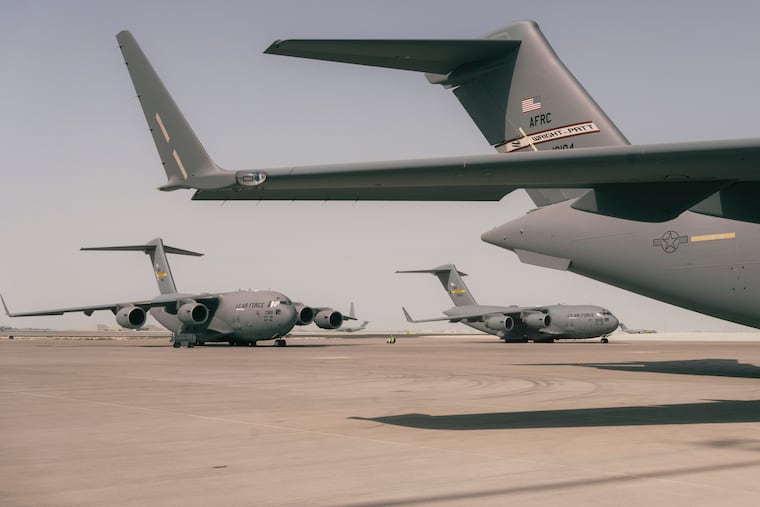
Meanwhile, the U.S. withdraws some of its forces from the Middle East as President Trump weighs strikes on Iran.
WASHINGTON — President Donald Trump said Wednesday that he’s been told “on good authority” that plans for executions in Iran have stopped, even as Tehran has indicated fast trials and executions ahead in its crackdown on protesters.
The president’s claims, which were made with few details, come as he’s told protesting Iranians in recent days that “help is on the way” and that his administration would “act accordingly” to respond to the Iranian government. But Trump has not offered any details about how the U.S. might respond and it wasn’t clear if his comments Wednesday indicated he would hold off on action.
“We’ve been told that the killing in Iran is stopping — it’s stopped — it’s stopping,” Trump said at the White House while signing executive orders and legislation. “And there’s no plan for executions, or an execution, or executions — so I’ve been told that on good authority.”
The president on Tuesday consulted with his national security team about next steps after telling reporters he believed the killing in Iran was “significant.”
Vice President JD Vance, Secretary of State Marco Rubio, and key White House National Security Council officials began meeting last Friday to develop options for Trump, ranging from a diplomatic approach to military strikes.
The Iranian security force crackdown on the demonstrations has killed at least 2,586, the U.S.-based Human Rights Activists News Agency reported.
On Wednesday, Iranian officials signaled that suspects detained in nationwide protests would face fast trials and executions while the Islamic Republic promised a “decisive response” if the U.S. or Israel intervene in the domestic unrest.
The threats emerged as some personnel at a key U.S. military base in Qatar were advised to evacuate by Wednesday evening following Trump’s escalated warnings of potential military action over the killing of peaceful demonstrators.
Mohammad Pakpour, commander of Iran’s paramilitary Revolutionary Guard, reiterated Iranian claims, without providing evidence, that the U.S. and Israel have instigated the protests and that they are the real killers of protesters and security forces who have died in the turmoil, according to Iran’s semiofficial Tasnim news agency.
He added that those countries will “receive the response in the appropriate time.”
Earlier Wednesday, Gholamhossein Mohseni-Ejei, Iran’s judiciary chief, said the government must act quickly to punish more than 18,000 people who have been detained through rapid trials and executions. Mohseni-Ejei’s comments about rapid trials and executions were made in a video shared by Iranian state television online.
“If we want to do a job, we should do it now. If we want to do something, we have to do it quickly,” he said. “If it becomes late, two months, three months later, it doesn’t have the same effect. If we want to do something, we have to do that fast.”
The comments stand as a direct challenge to Trump, who warned Iran about executions in an interview with CBS aired Tuesday. “If they do such a thing, we will take very strong action,” Trump said.
“We don’t want to see what’s happening in Iran happen. And you know, if they want to have protests, that’s one thing. When they start killing thousands of people, and now you’re telling me about hanging — we’ll see how that works out for them. It’s not going to work out good.”
One Arab Gulf diplomat told the AP that major Mideast governments had been discouraging the Trump administration from launching a war with Iran, fearing “unprecedented consequences” for the region that could explode into a “full-blown war.” The diplomat spoke on condition of anonymity because he wasn’t authorized to speak to journalists.
Satellite internet service offer
Iran’s government cut off the country from the internet and international telephone calls on Jan. 8.
Activists said Wednesday that Starlink was offering free service in Iran. The satellite internet service has been key in getting around the internet shutdown. Iran began allowing people to call out internationally on Tuesday via mobile phones, but calls from people outside the country into Iran remain blocked.
“We can confirm that the free subscription for Starlink terminals is fully functional,” said Mehdi Yahyanejad, a Los Angeles-based activist who has helped get the units into Iran. “We tested it using a newly activated Starlink terminal inside Iran.”
Starlink itself did not immediately acknowledge the decision.
Security service personnel apparently were searching for Starlink dishes, as people in northern Tehran reported authorities raiding apartment buildings with satellite dishes. While satellite television dishes are illegal, many in the capital have them in homes, and officials broadly gave up on enforcing the law in recent years.
Death toll continues to rise
The Human Rights Activists News Agency said 2,417 of the dead were protesters and 147 were government-affiliated. Twelve children were killed, along with 10 civilians it said were not taking part in protests.
More than 18,400 people have been detained, the group said.
Gauging the demonstrations from abroad has grown more difficult, and the AP has been unable to independently assess the toll given the communications being disrupted in the country.