Trump’s plan to close Kennedy Center for 2 years draws backlash
President Donald Trump said Sunday that he plans to close the center construction and renovation.
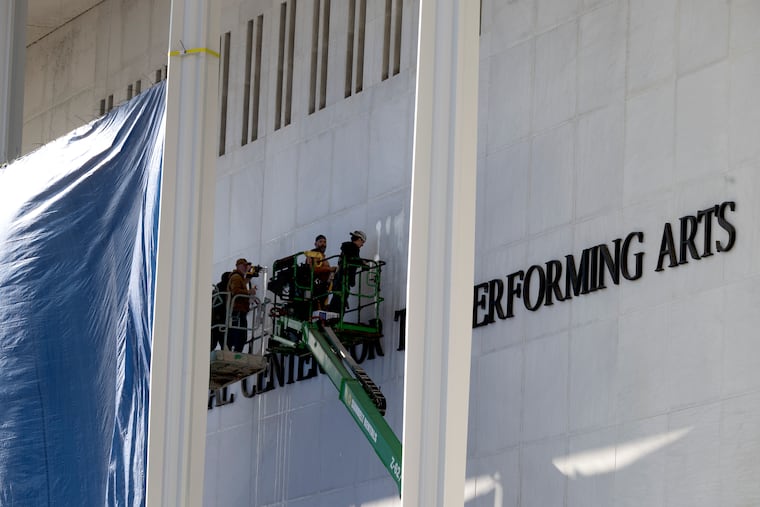
President Donald Trump said Sunday that he plans to close the Kennedy Center for roughly two years for the facility to undergo construction. The proposal comes amid a series of cancellations and internal upheaval since he took over the arts institution and presidential memorial nearly a year ago and remade it in his name and image.
“I have determined that The Trump Kennedy Center, if temporarily closed for Construction, Revitalization, and Complete Rebuilding, can be, without question, the finest Performing Arts Facility of its kind, anywhere in the World,” Trump wrote in a post on Truth Social. “In other words, if we don’t close, the quality of Construction will not be nearly as good, and the time to completion, because of interruptions with Audiences from the many Events using the Facility, will be much longer.”
Under Trump’s proposal, which he said is subject to board approval, the Kennedy Center could close on July 4, coinciding with America’s 250th anniversary, with construction beginning immediately.
“Financing is completed, and fully in place!,” Trump wrote. “This important decision, based on input from many Highly Respected Experts, will take a tired, broken, and dilapidated Center … and turn it into a World Class Bastion of Arts, Music, and Entertainment, far better than it has ever been before.”
Kennedy Center President Richard Grenell confirmed the plans in a Sunday evening email to staff obtained by the Washington Post. “We will have more information about staffing and operational changes in the coming days,” he wrote.
In a post on X, Grenell cited the $257 million designated “for capital repair, restoration, maintenance backlog, and security structures” through the One Big Beautiful Bill last year.
“It desperately needs this renovation and temporarily closing the Center just makes sense … ,” Grenell wrote. “It also means we will be finished faster.”
The center has already made some physical changes under the new leadership, adding Trump’s name to the building’s facade, despite legal concerns, and painting the outside columns white. Portraits of the first and second couples now hang in the center’s Hall of Nations, and the exterior is sometimes lit up in red, white and blue.
It was not immediately clear what the closure would mean for annual events held at the center such as the Mark Twain Prize for American Humor or the Kennedy Center Honors.
The Kennedy Center did not immediately respond to requests for comment. A White House official referred the Washington Post to Trump’s post.
Three current staffers, who spoke to the Post on the condition of anonymity for fear of reprisal, said they had not been previously notified of any plans to close the center, though some had long speculated a shutdown was possible.
“Once again, Donald Trump has acted with a total disregard for Congress,” said Rep. Joyce Beatty (D., Ohio) who had sued the Trump administration in December in her capacity as an ex officio trustee to stop the name change. “The Kennedy Center is congressionally funded, and Congress should have been consulted about any decision to shut down its operations or make major renovations, especially for two years,” she said in a statement.
The center’s board in December voted to add the president’s name to the arts venue and presidential memorial — its sign now reads “The Donald J. Trump and The John F. Kennedy Memorial Center for the Performing Arts” — prompting a fresh wave of cancellations and tumult.
Members of the Kennedy family responded to the news of the closure. Jack Schlossberg, John F. Kennedy’s grandson, wrote on X that while Trump can take over the institution, his grandfather’s legacy will endure. “JFK is kept alive by us now rising up to remove Donald Trump, bring him to justice, and restore the freedoms generations fought for,” he said.
Joe Kennedy III, Robert F. Kennedy’s grandson and a former Democratic congressman for Massachusetts, called the decision “painful,” saying that the center was built by and for the people as a shared point of connection.
“Do not be distracted from what this Administration is actually trying to erase: our connection, our community, and our commitment to the rights of all,” he wrote on X.
Rep. Brendan Boyle (D., Pa.) condemned the move, saying on X that “Trump is desecrating our national performing arts center.” Sen. Andy Kim (D., N.J.) pointed to Trump’s bad bet in the late 1980s on what was the world’s largest casino-hotel complex in his state. “We can’t let him do to the Kennedy Center what he did to Atlantic City,” he said in a tweet.
Most recently, the Washington National Opera announced Jan. 9 it would move out of its longtime home, citing changes to the center’s business model and support.
The Kennedy Center said it ended the relationship, but a person speaking on the condition of anonymity because they were not authorized to represent either party told the Post that it was “definitely a WNO decision” spurred by the board’s vote.
U.S. law and customs generally bar memorializing living figures. The statute establishing the center designates it as the John F. Kennedy Center for the Performing Arts and requires the board to “assure” that “no additional memorials or plaques in the nature of memorials shall be designated or installed in the public areas” of the building. The law does allow plaques and inscriptions recognizing major donations.
Months before the renaming vote, the center’s board changed its bylaws to ensure only members appointed by the president had voting powers, the Post previously reported. The center said it was following long-standing practice.
Democratic lawmakers have introduced legislation and a lawsuit to reverse the addition of Trump’s name.
One of the groups behind the litigation is Democracy Defenders Action. In a statement Sunday, co-founder Norm Eisen questioned the motivations behind the center’s closure, which he said would inflict further damage. “We will be considering all legal remedies to address this new and concerning development,” he said.
Since remaking the board of trustees and becoming chairperson of the Kennedy Center last February, Trump has frequently said the building was in poor shape. The Kennedy Center is “in tremendous disrepair, as is a lot of the rest of our country,” Trump told reporters in March. “Most of it, because of bad management. This is a shame, what I’ve watched and witnessed.”
Trump and his new leadership have claimed that the center has broken elevators, was infested with rats, and that the concrete in the parking garage was crumbling.
They also repeatedly accused the previous leadership of financial mismanagement, declining requests from the Post to substantiate the claims. Former leaders denied the accusations. (Senate Democrats are themselves investigating the Kennedy Center, accusing Grenell of “self-dealing, favoritism, and waste,” which he has denied.)
Grenell has said the center will rely on “common-sense programming,” meaning popular programming that breaks even. In the past year, sales of subscription packages and tickets have fallen dramatically. Empty seats became a common sight at the center.
Dozens of artists and productions, including composer Philip Glass, soprano Renée Fleming, acclaimed banjoist Béla Fleck, and Wicked composer Stephen Schwartz, have canceled upcoming events.
Meanwhile, almost every head of programming has resigned or been dismissed. Ben Folds and Fleming quit their roles as artistic advisers earlier last year. Last week, Kevin Couch, the center’s senior vice president of artistic programming, resigned less than two weeks after his hiring was announced.