Why Trump’s algae problem is much bigger than the Reflecting Pool
In his battle to clear algae from the water by the Lincoln Memorial, the president has overlooked the real causes of unsightly — and often dangerous — algal blooms.
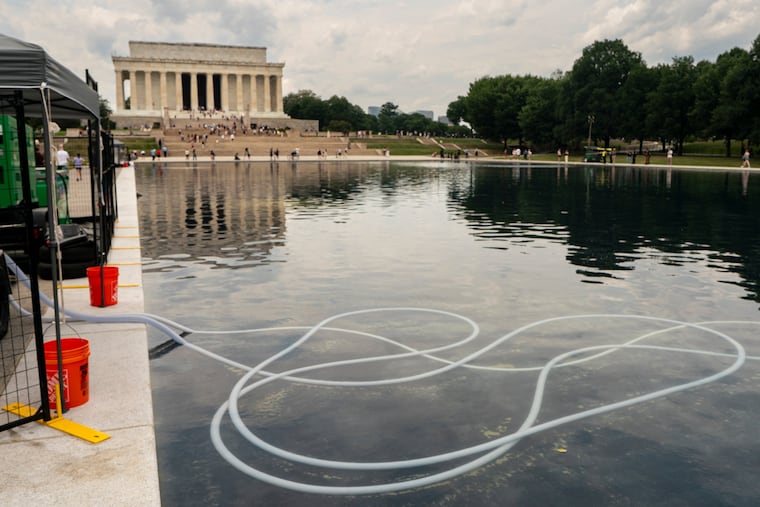
In his battle to clean the murky waters of the Lincoln Memorial Reflecting Pool, President Donald Trump has tried draining, painting, hydrogen peroxide, and what the Interior Department describes as “high-tech nanobubble ozone technology.” But he has seemingly overlooked two of the most important factors that experts say are driving unsightly — and sometimes dangerous — profusions of algae: pollution and climate change.
Algae thrive in warm, still waters, causing populations to explode as global temperatures rise, said environmental engineer Steve Chapra, an emeritus professor at Tufts University.
Meanwhile, rampant human development has increased the amount of fertilizer and sewage produced by farms and cities, and severe storms intensified by the warmer atmosphere are causing more of these pollutants to run off into local waterways — providing algae with the nutrients they need to grow.
In a 2017 study, Chapra and his colleagues projected that climate change would cause a more than fivefold increase in the number of days when U.S. water bodies are affected by harmful algal blooms.
Short-term measures like those Trump has pursued may temporarily reduce algae populations in some water bodies, Chapra said. But unless they grapple with warming and nutrient pollution, any efforts to address these blooms in the Reflecting Pool and elsewhere are doomed to fail in the long run.
The consequences could be profound, because the problems presented by blooms go far beyond aesthetics, he added. They can disrupt aquatic food chains, deplete oxygen in water bodies and even produce deadly toxins.
“It’s probably the biggest water quality problem in the world,” Chapra said. “The Reflecting Pool is the canary in the coal mine.”
A spokesperson for the Interior Department did not respond to questions about whether the department had considered nutrient pollution or water temperature in planning the pool’s refurbishment. In an email, the agency reiterated that the National Park Service is using hydrogen peroxide and ozone nanobubbles, which break up algae by damaging their cells.
The root causes of blooms
Algal blooms have long thrived in the Reflecting Pool, thanks to stagnant, shallow water enriched by pollution and warmed by sweltering D.C. summers.
Since 2012, the pool has been filled from the Tidal Basin, which in turn is fed by the Potomac River. Both water bodies contain excessive amounts of nitrogen and phosphorous — the nutrients most loved by algae — and are designated as “impaired” by the Environmental Protection Agency, meaning they don’t meet basic water quality standards for swimming, fishing, and supporting aquatic life.
Trump said his $14 million renovation this spring would clean the pool’s algae-clouded waters by sealing leaks and painting the bottom “American flag blue.”
But the refurbishment didn’t address the pollution that is the root cause of algal growth, said Hans Paerl, an aquatic ecologist at University of North Carolina at Chapel Hill. The pool was refilled on June 4 using the same nutrient-rich Tidal Basin water as before.
The spate of warm, sunny days that followed — June so far has been about 2 degrees Fahrenheit hotter than normal, according to the National Weather Service — provided ideal conditions for the photosynthetic creatures to multiply. Those high temperatures may have been exacerbated by the pool’s new dark blue coating, which absorbs more heat than its previous gray finish, Chapra said.
Within days, satellite data showed that the Reflecting Pool contained more algae than at any recorded point in June for at least five years.
The bloom that turned the pool green shortly after it was refilled was likely caused by a single-celled organism called cyanobacteria, Paerl said. Pictures of the pool showed a characteristic bright green scum coating the surface of the water.
Cyanobacteria blooms are the most dangerous, Paerl said, because they produce toxic compounds that can cause rashes, vomiting, and neurological problems in people who touch or ingest them.
After the Interior Department treated the pool with hydrogen peroxide, which breaks down cyanobacteria’s cell membrane and disrupts photosynthesis, the cyanobacteria bloom seemed to wane.
But the water’s sickly green sheen remains. Aquatic ecologist Rosalina Christova, a George Mason University researcher who acquired a sample from the Reflecting Pool on June 15, found that the water had been colonized by a genus of multicellular green algae called Desmodesmus. In an email, she called the population “very dense.”
The green algae are more resistant to the effects of hydrogen peroxide, and they were likely able to capitalize on the nutrients released from the disintegrating bodies of the slain cyanobacteria, Paerl said.
“This created a niche for another player, so to speak,” he said. “Nutrients keep cycling through there and feed whatever blooms.”
A growing global threat
Though the administration’s concerns about algae in the Reflecting Pool are in part cosmetic, the proliferation of blooms in waterways across the planet pose a significant — and growing — threat, said Joaquim Goes, a biogeochemist at Columbia University.
By studying satellite images of the ocean, he found that microalgae scums — caused by the same tiny organisms as those afflicting the Reflecting Pool — have expanded at a rate of 1% per year since 2003. The phenomenon has disrupted food chains and created oxygenless “dead zones” where fish can’t survive.
“It is spreading like wildfire all over the world,” Goes said. “And there is no question that temperature is playing a role.”
Blooms are also increasing in freshwater bodies that supply people’s drinking water, research shows.
A 2022 EPA assessment found that 49% of U.S. lakes showed excess amounts of chlorophyll a, the photosynthetic compound that indicates presence of cyanobacteria and green algae. Detections of microcystins, a class of toxin produced by cyanobacteria, increased by almost 30 percentage points since the previous assessment was conducted five years earlier.
Massive cyanobacteria blooms have poisoned important fisheries, such as in Lake Erie. They can imperil important ecosystems, like the Everglades below Florida’s Lake Okeechobee. They have been linked to the deaths of dogs, cattle and, in rare cases, humans.
Even green algae, which do not produce toxins, can clog filtration systems and disrupt drinking water supplies. When they die, the decomposition of their bodies depletes oxygen in the surrounding water, killing other aquatic life.
The National Office for Harmful Algal Blooms, funded by the National Oceanic and Atmospheric Administration, estimates that phenomenon causes an average $50 million in damage to the U.S. economy each year. Individual severe events can cause even greater harm: An unprecedented “red tide” cost roughly $2.7 billion in decreased tourism revenue when it forced the closure of beaches across southern Florida in 2018.
Lasting solutions
Theories about the persistence of the Reflecting Pool algae abound.
The Interior Department has blamed residual organisms that remained in supply lines after the renovation. Some have speculated that the recent blooms are a product of liberal “sabotage.”
The Trump administration has said it plans to drain the pool again to address algae growth and paint that is peeling from its bottom.
But those measures are unlikely to prevent algae from reemerging, said environmental engineer Victor Bierman, a retired water quality consultant and former EPA scientist.
As summer heat continues to ramp up, he worries the green algae could be replaced by cyanobacteria, which have no predators and readily outcompete other microbes at high temperatures.
“You can get rid of an existing bloom, but if you don’t change the underlying conditions … you’re going to grow more algae,” Bierman said.
Officials could stymie growth by increasing the flow of water through the pool, but that would disrupt the still surface needed for it to be reflective, he added. A better option would be installing an enhanced filtration system that removes nutrients from the Tidal Basin water before it is pumped into the pool.
Ultimately, said Chapra, algae blooms will continue to plague the Reflecting Pool and countless other water bodies until people address the human-made problems of nutrient runoff and climate change.
“If you don’t follow the science, then you think it’s magic or espionage, and it’s not,” Chapra said. “This is basic biology.”