Reflecting Pool’s algae bloom and peeling paint reflect Trump’s treatment of U.S. history
The reflecting pool was designed so visitors could see themselves, as well as the Washington Monument and the Lincoln Memorial. Trump has changed that — and with it, the pool's symbolic importance.
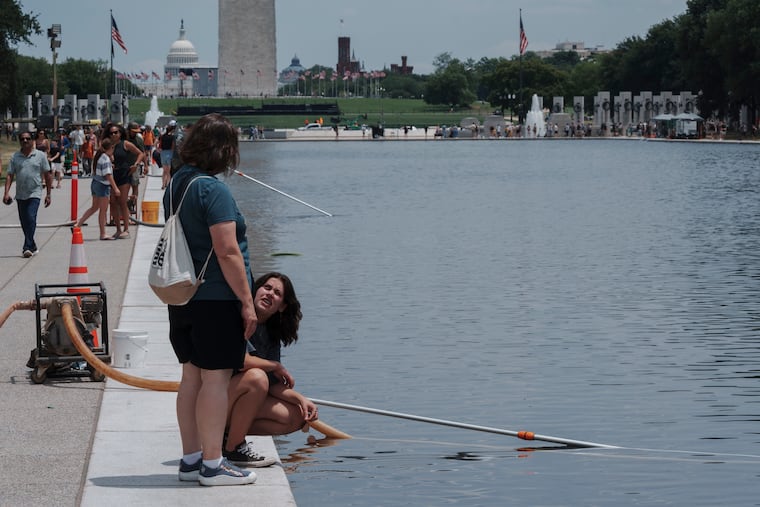
President Donald Trump’s latest D.C. renovation, painting the Lincoln Memorial Reflecting Pool “American Flag Blue,” to celebrate the country’s 250th birthday has instead turned the symbolic heart of the National Mall Algae Bloom Green. The paint is peeling, and the water is a swampy muck.
Trump has asserted, without evidence or corroboration, that vandals cut a 250-foot gash into the new lining and poured corrosive chemicals into the basin. Yet, the explanation for what has happened appears to be more mundane and predictable than the cloak-and-dagger sabotage Trump has suggested. Rosalina Stancheva Christova, an aquatic ecologist from George Mason University’s Algal Ecology Laboratory, sampled the water and found an ordinary, non-toxic bloom — the kind any ordinary swimming pool owner has fought in their own backyard.
And yet, the problem with the renovation runs far deeper than all of this. Trump’s painting project reflects a fundamental lack of understanding of the original purpose and vision for the reflecting pool. For more than a century, the basin has functioned as a civic mirror, a place where visitors could see themselves reflected alongside the monuments that commemorate the nation’s story. Today that possibility is gone.
The roots of the reflecting pool lie in the “City Beautiful” movement of the late 19th and early 20th centuries. The Gilded Age and decades of laissez-faire growth had left many of America’s cities in disrepair, full of tenement districts, boss-run wards and blight.
American architects Daniel Burnham, Charles McKim, Frederick Law Olmsted Jr. and Augustus Saint-Gaudens wanted to change that, and they were inspired by European urban renewal projects like Baron Georges-Eugene Haussmann’s redesign of Paris. In 1893, at the World’s Columbian Exposition in Chicago, they explored the principles that spawned their movement to reimagine American cities — demonstrating how monumental architecture and carefully designed landscapes could express civic ideals.
Their experience in Chicago helped to convince the men that beautiful, orderly, civic space could repair the disordered industrial cities the Gilded Age had left them. Their vision reflected a broader Progressive Era faith that urban renewal and public investment could address the social problems of industrial America while restoring civic pride through monumental construction projects designed to project an image of a robust and resilient nation.
In 1903, all four architects became members of the Senate Park Commission (McMillan Commission) whose mandate was to replace decades of haphazard development in Washington D.C. with a coherent civic plan.
They set their sights on the National Mall, which was, at that time, a disunified Victorian garden punctuated by marshland with a public green transected by a railroad depot and tracks.
The commission’s 1901 report complained that the mall “has been diverted from its original purpose and cut into fragments, each portion receiving a separate and individual informal treatment, thus invading what was a single composition.” Their redesign plans aimed to unify the space into a legible and cohesive civic story and the reflecting pool eventually became the spine for that narrative.
Over the next two decades, the McMillan Plan gradually reshaped the mall.
Architect Henry Bacon was charged with designing the Lincoln Memorial. In 1911, he completed his first sketches, and he incorporated the commission’s vision by extending the mall’s central axis westward and anchoring it with the reflecting pool. Bacon imagined the pool as a mirror reflection, where visitors could see both the Washington Monument and the Lincoln Memorial. As a result, Bacon created a linear and legible connection between the man who presided over the creation of the republic at one end and the man who led the nation through the war for its preservation at the other.
In 1919, the Army Corps of Engineers began excavating a former Potomac marshland known as the Kidwell Flats, to enable construction of the pool. The project took four years and was still under construction at the time of the Lincoln Memorial’s dedication in 1922.
The pool quickly became a symbolically rich venue for crucial moments in U.S. history. In 1939 the African American contralto Marian Anderson sang from the memorial steps to a crowd of approximately 75,000 people massed along the pool after the Daughters of the American Revolution refused to let her perform at Constitution Hall.
Twenty-four years later, a quarter million people lined both banks of the pool to hear the Reverend Dr. Martin Luther King Jr. proclaim his dream, to challenge the nation to complete the unfinished journey toward racial equality and achieve a meaningful resolution of the issues that had nearly destroyed the nation.
The pool reflected those crowds, those moments and those movements only while they occupied the space. Each reflection vanished and was replaced by another individual, another gathering, another episode in the nation’s story.
Yet, despite its symbolic significance and its success as a site for large scale civic dialogue, from a physical standpoint, the pool faced problems almost from day one. At issue was the soggy foundation created by the choice of marshlands for the reflecting pool’s site.
During its construction, the Army Corps of Engineers had attempted to mitigate the potential problem with concrete support beams and a drainage system undergirding the pool. But almost immediately these mitigation systems proved inadequate. The result was cracks and leaks that have plagued the pool for its entire lifetime.
Numerous administrations have tried to solve the issues. In 1986, the Reagan Administration drained the pool and poured an entirely new concrete foundation. Even this did not solve the problem. The pool continued to leak nearly 30 million gallons per year.
In 2011, Barack Obama’s administration undertook another round of renovations. While matters improved, the pool still leaks 16 million gallons of water per year.
The current issue with the reflecting pool and Trump’s response to it, however, go well beyond structural inadequacies and sabotage theories. They reflect a lack of understanding about the pool’s purpose.
In April, Trump posted a doctored image of himself and his officials in swimsuits lounging in the reflecting pool, a woman in a bikini reclining in the water beside them. But the pool is a mere 18 inches deep, not swimming pool/ lounging depth and Bacon never intended anyone to use it that way. He built a basin you stand beside because its work happens in the mind of the person at the rim. Trump’s artificial intelligence revisionism gets the object exactly wrong — an instrument of contemplation made over into the feature of a tacky resort.
Trump directed the Department of the Interior to repaint the pool in time for the nation’s 250th anniversary and used an emergency exemption to award a no-bid contract to a company that specialized in painting swimming pools. The result essentially took an area that was a swamp, before its transformation into a civic mirror, and returned it to a swamp. An algae-greened surface now sits where the reflection used to be, and the connection the pool held, the citizen to the monuments, individual to the national story, has been severed.
When the pool functions as a mirror surface, it is a monument that embodies an evolving republic rather than a finished one. Trump’s swamp has transformed it into a static, murky image that defies the idea of a nation moving forward. As this history makes clear, the health of the republic depends on its ability to see itself clearly, and Trump’s algae-infested reflecting pool is a symbolic reflection of a nation and a history he and his administration continue to try to obscure from clear view.
Susan Deily-Swearingen holds a Ph.D. in history from the University of New Hampshire, and has taught at multiple universities since 2015. She has a forthcoming book about the persistent legacies of the U.S. Civil War in contemporary politics and society, and frequently writes about historical memory and the echoes of the past in the modern world.
Made by History takes readers beyond the headlines with articles written and edited by professional historians. Opinions expressed do not necessarily reflect the views of The Inquirer.