Trump reconsidering $1.8 billion fund as it hits roadblocks
The fund has met with legal obstacles and a backlash among Republican lawmakers.
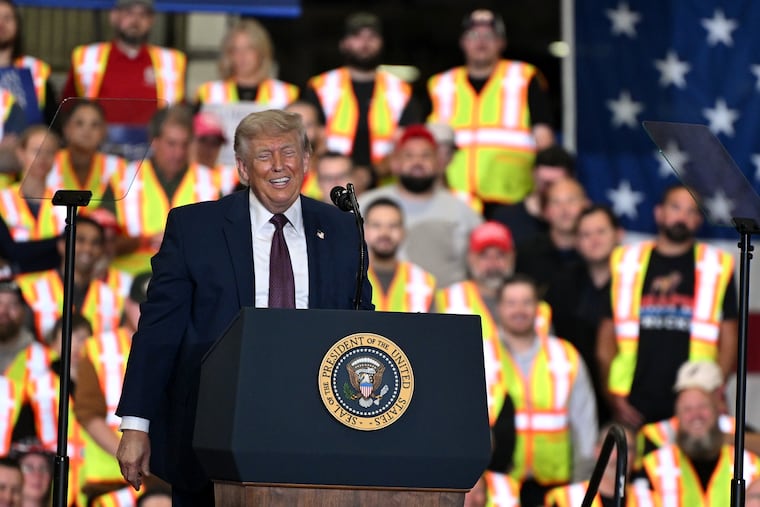
WASHINGTON — President Donald Trump is backing off his plan to establish a $1.8 billion fund to compensate people who claimed they were victims of unfair prosecution by the government, according to two people familiar with the president’s thinking.
The people, who spoke on condition of anonymity to describe the president’s thinking, said he had been leaning for days toward scrapping the fund, which has sparked backlash from critics who characterized it as a scheme to reward Trump’s political allies with public benefits. But as with all things involving Trump, he could still decide to reverse course, especially as he tracks media coverage of his decision.
Another sign of Trump’s retreat came earlier Monday, when the Justice Department said in a statement that it would abide by a federal judge’s temporary order not to proceed with any steps to activate the fund until at least June 12, when a hearing on the fund is scheduled. The department said the administration disagreed with the decision but did not make clear whether it intended to fight the issue further in court.
Privately, some administration officials expressed relief that the judge’s ruling showed a way out of what most had seen as a mess of the Trump team’s own making.
The White House referred to the Justice Department’s statement that it would abide by the temporary order.
Beyond the legal challenges, Trump has also faced increasing pressure from both parties on Capitol Hill to torpedo the fund, which emerged as part of a deal the Justice Department brokered over Trump’s $10 billion lawsuit against the IRS.
The fund was so appalling to Senate Republicans that in May they abruptly abandoned their plans to take up a filibuster-proof bill to fund the president’s immigration crackdown rather than advance Trump’s personal agenda and take what would have been a politically toxic vote for the fund.
In May, Todd Blanche, the acting attorney general, appeared on Capitol Hill to meet with Senate Republicans for a two-hour, closed-door meeting to explain the fund that turned highly contentious. Senators vented that he had provided them with no explanations of how the fund would function or whether there would be any guardrails around the money.
The impasse on the fund was part of a broader split between Trump and Senate Republicans, who for most of the year have dutifully fallen in line behind him and his agenda, as he has intervened against incumbents in GOP primaries, endorsing candidates who will have a harder path to victory in a general election and threaten to erase the Senate majority.
The fund suffered a major legal setback Friday when, in a surprise move, Judge Kathleen M. Williams, who oversaw Trump’s lawsuit against the IRS, suddenly reopened the case, saying that she wanted to investigate “grievous allegations” that the hasty deal to resolve it had been “premised on deception.”
Williams had always had qualms about the lawsuit, given that Trump was suing a federal agency that he controlled and so was effectively on both sides of the case. And her reason for revisiting the suit was to investigate whether the president had essentially colluded with his own government to settle the case “to avoid judicial scrutiny.”
That same day, the compensation fund suffered another blow in the courts, when a federal judge in Alexandria, Va., put it on hold altogether until she could consider its underlying merits at a hearing scheduled for June 12. The ruling by that judge, Leonie Brinkema, emerged from a case that was filed by a former federal prosecutor who had been fired after helping to lead the prosecution of the rioters who attacked the Capitol on Jan. 6, 2021. The former prosecutor, Andrew Floyd, claimed that he had been wronged by the Trump administration but could not make a claim to the fund because it had been unfairly established to give money only to supporters of the president.
The deal establishing the compensation fund had been negotiated by senior Justice Department officials — chief among them Trent McCotter, the principal associate deputy attorney general — and a small group of lawyers representing Trump, including Boris Epshteyn, his top outside legal adviser. The talks took place under significant pressure from a federal judge who had given the Justice Department until May 20 to tell her whether — and how — it planned to muster an independent defense of the IRS against the man who ultimately controlled the agency.
That deadline set off a scramble as Trump’s lawyers and the Justice Department looked for a way to settle the suit and avoid further scrutiny from the judge. It put the Justice Department in an especially tight spot: Department leaders did not want to go into court and fight the suit, as they normally would, but they also did not want to settle it by paying Trump directly, concerned that such a move would be politically damaging.
In the end, they came up with a Plan B, establishing the so-called Anti-Weaponization Fund to make payments to Trump allies and supporters who claimed they had been wronged in the courts by the Biden administration. A second part of the deal gave Trump, his family, and his businesses broad protections against IRS investigations, a potentially lucrative boon to all of them.
If Trump does fully abandon the compensation fund, there are still other possible avenues for his allies to seek restitution from the government for what they claim is weaponization. They could file individual lawsuits or administrative claims asking for money, which the government could simply agree to settle one by one.
In March, for example, the Justice Department agreed to pay $1.25 million to Michael T. Flynn, Trump’s former national security adviser, to settle claims that he was wrongfully prosecuted for making false statements to federal agents investigating ties between Russia and Trump’s 2016 presidential campaign. Several Jan. 6 rioters, including members of the far-right group the Proud Boys prosecuted on charges of seditious conspiracy, have also sued the department for claims of prosecutorial misconduct.
Even if Trump moves forward with abandoning the fund, Democrats on Capitol Hill are signaling they still plan to corner Republicans into taking politically toxic votes related to the fund.
On Monday, Senate Minority Leader Chuck Schumer (D., N.Y.) kicked off the week noting that Senate Democrats were launching a coordinated effort to “kill the slush fund.”
“If Republicans return to reconciliation, we will be ready with amendments to shut the fund down,” Schumer wrote in a letter to Senate Democrats. “If they try to bury the issue, we will force them to the Senate floor. If they try to sneak behind appropriations, we will fight them there too.”
And three Democratic senators, Adam B. Schiff of California, Mark Kelly of Arizona, and Elissa Slotkin of Michigan, introduced legislation to shut down the fund as well as any other attempt at abusing the Justice Department’s settlement fund.
Senate Majority Leader John Thune (R., S.D.) told reporters Monday the best way forward was for the administration itself to shut down the fund.