Trump faces narrowing options on Venezuela action
The president's stated aim to stop drug trafficking and immigration from Venezuela has shifted to a push to control its oil.
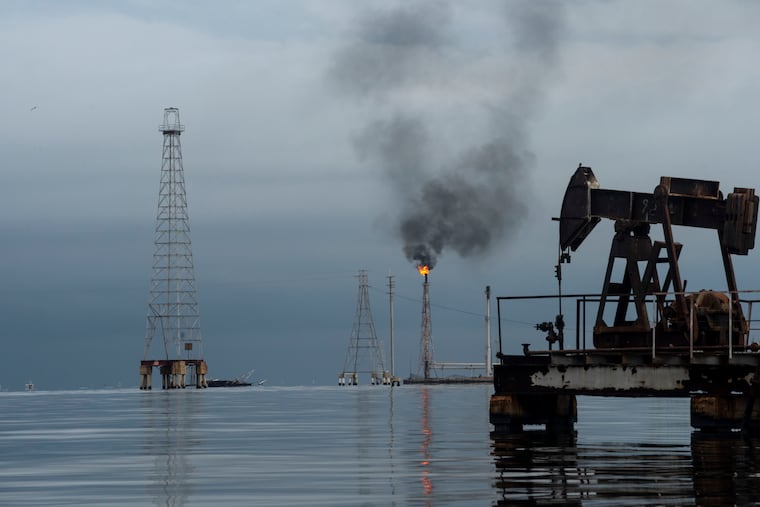
The day after President Donald Trump declared he had ended 94% of all seaborne drug trafficking to the United States and reduced illegal migrant border crossings to “zero,” he announced an entirely new rationale for his escalating campaign against Venezuelan President Nicolás Maduro.
Venezuela had stolen “Oil, Land and other Assets” from the United States to finance those criminal activities, Trump said Tuesday in a social media post, an apparent reference to decades-old expropriations and the breaking of contracts with U.S. oil companies when Caracas began nationalizing the industry.
Unless what he alleged was U.S. property was returned “IMMEDIATELY,” Trump said, the military juggernaut he has assembled in the Caribbean to blow up alleged traffickers and seize tankers transporting Venezuelan oil “will only get bigger, and the shock to them will be like nothing they have ever seen before.”
As Trump continues the boat strikes — now numbering 28, with at least 104 killed — and with the declaration of a “blockade” of all sanctioned vessels transporting Venezuelan oil, he has all but abandoned the public pretense that his goal is simply stopping migrants and drugs, rather than Maduro’s removal.
His “days are numbered,” Trump told Politico in an interview published Dec. 9. Asked Thursday whether he was leaving open the possibility of war with Venezuela, Trump told NBC: “I don’t rule it out, no.”
Maduro is the “indicted head of a cartel, now designated as a foreign terrorist organization,” said a person familiar with administration thinking, one of several individuals and former U.S. officials who spoke on the condition of anonymity to talk about internal deliberations. The administration named Maduro, already facing a 2020 U.S. indictment for drug trafficking, as the head of the designated Cartel de los Soles, a network of senior Venezuelan political and security officials it says is involved in human and drug trafficking to finance terrorist attacks in the United States.
“At the end of the day, that person is either going to stand trial or be given a chance to negotiate exile … in a third country,” the person said of the Venezuelan leader.
But with Maduro still sitting tight, Trump’s options seem to be narrowing rapidly.
In an emailed response to questions, White House deputy spokesperson Anna Kelly said, “Nothing is ‘narrowing.’” Trump, she said, “has already taken decisive action to stop the illegal migrant invasion, deport violent criminals, and defend our homeland against evil narcoterrorists — which is saving countless lives across the country. President Trump retains all options to keep Americans safe.”
Airstrikes on land, which U.S. officials have said would probably target isolated encampments associated with cocaine trafficking or selected military assets and installations, are “going to start” happening, Trump said last week.
If that doesn’t work in persuading Maduro to flee, regional experts and former officials say, there are only two U.S. choices left — withdrawal or regime change by force.
The prospect of invasion and a military ground operation with the possibility of American deaths, however, may be unpalatable to a president who has vowed “no more wars” and has thus far limited overseas military involvement to standoff strikes by air and sea.
“It’s conceivable to me that in a month, two months, the president … declares victory on grounds that maritime drug trafficking is way down,” Elliot Abrams, Trump’s first-term special envoy on Venezuela, said Tuesday on the School of War podcast. But “if Maduro survives and Trump walks away, it’s a defeat.”
While some in Congress have sharply opposed ongoing U.S. military action in the Caribbean and eastern Pacific without legislative approval, let alone a ground invasion of Venezuela, others have called on Trump to move more decisively.
“You cannot allow this man to remain standing after this show of force,” Sen. Lindsey Graham (R., S.C.) said of Trump’s Caribbean deployment of 15,000 troops and dozens of warships and aircraft. Graham, a retired Air Force legal officer, spoke after a closed briefing Tuesday for Senators by Defense Secretary Pete Hegseth and Secretary of State Marco Rubio on a controversial Sept. 2 airstrike that killed 11 people aboard an alleged trafficking boat — including two who initially survived and were hit again while flailing amid the wreckage.
“Is the goal to take him out?” Graham asked about Maduro, saying he hadn’t received answers from the administration. “If it’s not the goal … I think it’s a mistake.”
But as lawmakers continue to argue and the administration ups the ante, “the most interesting question is why is [Trump] doing all this at all,” Abrams said in an interview with the Washington Post.
Trump’s fixation on Venezuela melds a number of his own domestic political aims and the priorities of senior officials around him. The administration’s new National Security Strategy, which shifts U.S. focus to the Western Hemisphere, promises to reward countries that comply with “America First” policies and punish those that do not.
For Rubio — the son of Cuban immigrants who fled the island several years before the 1959 takeover by Fidel Castro and who made his political career in the anti-Castro cauldron of South Florida — the collapse of Cuba’s communist government has long been a prime goal.
Cuba’s economy has been propped up by Venezuela under Maduro and his predecessor, Hugo Chávez, through a steady supply of oil despite heavy U.S. sanctions. In addition to economic ties and ideological affinity, Maduro’s personal safety is said to be provided by elite Cuban security forces. Many think that the end of Venezuelan aid would be a death knell for the government in Havana.
“Rubio is the driving force behind the military buildup in Venezuela policy in the last several months, but he has not convinced the president yet to use military force,” said a second former official. Others, however, say it is Trump who wants to escalate.
For White House Deputy Chief of Staff Stephen Miller, the architect of Trump’s draconian anti-immigrant policy, the hundreds of thousands of Venezuelans who fled to the United States, during Trump’s first term and the Biden administration, provide an easy target. Miller has echoed Trump’s charges that most of the Venezuelans in the U.S. were sent by Maduro from prisons and mental institutions to terrorize and kill Americans.
Those sentiments contrast with Trump’s first term, when the flow of what eventually would be millions of fleeing Venezuelans spread across the hemisphere was viewed more sympathetically. Then-Secretary of State Mike Pompeo, who traveled to the Venezuela-Colombia border to greet them in the spring of 2019, said they were escaping what he called the political and economic “horror” of Maduro’s corrupt and failing socialist economy and demanded they be allowed to leave.
At the time, Trump also said that “all options” were on the table to oust Maduro, charging that in addition to abusing his own people, he had stolen the 2018 election that gave him a second term in office and had formed U.S.-threatening alliances with Russia, China, and Iran. Trump stepped up sanctions, sent U.S. warships to the Caribbean — although fewer than the current armada — and recognized legislative assembly leader Juan Guaidó as Venezuela’s legitimate president.
With Guaidó as his guest, Trump told Congress during his 2020 State of the Union address that Maduro was “a socialist dictator” and a “tyrant who brutalizes his people.” The amount of deadly fentanyl entering the country, primarily from China and Mexico, had begun to soar even before Trump took office, reaching its peak as the COVID pandemic waned and beginning an ongoing decline, along with overdose deaths, in 2024, according to U.S. government figures.
During first-term debates in the Trump White House over what to do about Maduro, some advocated the use of military force to oust him, according to subsequent books by then-Defense Secretary Mark T. Esper, who opposed it, and national security adviser John Bolton, who supported it.
With his time in office winding down and Gen. Mark A. Milley, then chairman of the Joint Chiefs of Staff, and CIA Director Gina Haspel also advising against the use of force, according to Esper and others, Trump backed off.
The number of arriving Venezuelans, many crossing the border illegally, increased sharply under the Biden administration. Many were allowed to stay legally under a temporary protected status that recognized the economic and political hardships Trump himself had said were the reason for their flight.
Maduro, who reneged on agreements with the Biden administration to allow a fair election in 2024, was inaugurated for his third term in January, only 10 days before Trump was sworn in again. By then, Guaidó had long since faded from memory. A new opposition figure, María Corina Machado, came to the fore and — though barred by Maduro from running against him — led her party to a landslide win that was widely acknowledged to have been stolen.
Trump lost little time moving on his campaign promise to expel migrants and end opioid deaths, touting crime statistics he wildly inflated and blamed on Biden. In one of his first second-term acts, he ordered the end of protected status for Venezuelans and other migrants, and began widespread deportations. Trump charged that Maduro controlled a Venezuelan gang, Tren de Aragua, and had sent it to the United States to wreak criminal havoc, allegations that were not supported by U.S. intelligence assessments.
Tren de Aragua and Cartel de los Soles are among roughly two dozen foreign organizations that the administration has designated, under a February Trump executive order, as “narcoterrorists.”
By summer, despite some early attempts at negotiations with Maduro that included an offer to expand U.S. oil operations in Venezuela, Trump had opted for a military path. Though Venezuela is not a source of fentanyl and is a trafficker but not a producer of cocaine, according to U.S. law enforcement, pressure against Maduro was seen as a visible reminder to drug-producing countries such as Mexico and Colombia of the consequences of noncooperation.
Miller, current and former U.S. officials said, had first proposed striking Mexican cartels and traffickers as a way to stop drugs and migrants. But as the administration surged thousands of U.S. troops to the southern border and increased intelligence cooperation, Mexico began to curb cartel action. Miller and his team were left looking for another target.
The administration sent warships to the Caribbean, and on Sept. 2, Special Operations forces struck an alleged drug-smuggling boat carrying 11 men with missiles. It had come from Venezuela, Trump said without providing evidence, and was carrying “bags” of fentanyl and cocaine for Tren de Aragua. The United States, he told Congress that month, was in an “armed conflict” with terrorists.
On Dec. 10, U.S. forces in the Caribbean seized an oil tanker, the Skipper, that had just filled up in Venezuela and was headed to Asia. The ship, already under U.S. sanctions for carrying illegal Iranian oil, was to be hauled to a Texas port. Asked by reporters what would happen to the oil, Trump said, “Well, we keep it, I guess.”
On Saturday, the Department of Homeland Security said a second vessel carrying Venezuelan oil in the Caribbean had been “seized” in a joint operation by the Coast Guard and Defense Department. That ship, the Centuries, was not under U.S. sanctions and it was unclear whether it had merely been boarded by U.S. forces or taken under their control.