Zelensky open to withdrawing troops in new peace draft, awaits Russian reply
It is the first time Ukraine’s Volodymyr Zelensky has inched toward any compromise on the issue of territory in the eastern Donbas region, which Russia claims.
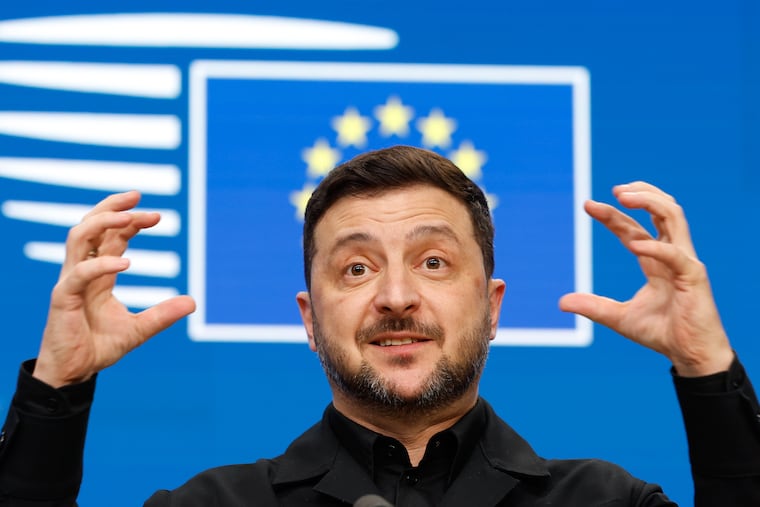
KYIV, Ukraine — Ukrainian President Volodymyr Zelensky presented journalists a new version of a peace plan Wednesday that suggests he is open to withdrawing troops from eastern Ukraine to create a demilitarized zone if Russia agrees to do the same as part of a settlement to end the war.
The suggestions marks Zelensky’s first inch toward any sort of compromise on the issue of territory in the eastern Donbas region, which Russia has demanded full control of despite failing to take several major cities militarily. The issue of territory remains one of the most contentious in discussions, with Ukraine arguing that giving up its land will only embolden Russia to attack again.
The 20-point draft Zelensky publicized Wednesday is far from final and has not been agreed to by Russia, which will probably oppose several major points, including the demand for both sides to withdraw their forces from Ukraine’s east.
The document is the latest iteration of a proposal to end the war after weeks of difficult negotiations following a U.S. threat last month to cut off all support for Ukraine unless the country signed on to a 28-point version that made major concessions to Russia.
That warning triggered a diplomatic frenzy, including many meetings between a Ukrainian delegation and President Donald Trump’s negotiators, including special envoy Steve Witkoff and the president’s son-in-law Jared Kushner.
The latest plan makes clear that Ukraine continues to oppose the idea that it would be forced to withdraw its troops from its east but would consider doing so if Russia did the same. The goal would be to create a free economic zone that is not controlled by either military, Zelensky said.
Any such agreement, however, would require a national referendum, which would be difficult to organize without a ceasefire in place. It would also require Russia agreeing to this and other points in the document, which remains unlikely.
The establishment of a free economic zone would require significant work to determine who would control the territory, including potentially foreign peacekeepers. Russia has previously opposed the idea that foreign troops be stationed in Ukraine and the two sides will likely find it difficult to agree which countries would contribute troops to such a mission.
Such an arrangement was suggested by the United States, which has repeatedly raised various suggestions that would prioritize business after the war. Zelensky previously said that if Ukrainian forces were to withdraw from any territory, it would only be logical for Russian forces to withdraw the same amount. He had also cast skepticism on how to secure such a zone, citing potential vulnerabilities to Russian infiltration.
Russia has previously stated that even if it did withdraw its military from some regions, it would expect to still control the area with police and national guard units.
Zelensky also said Wednesday that the current draft includes a peacetime Ukrainian military of 800,000 troops. The initial version would have limited the size to 600,000. Ukraine has repeatedly stated that its best security guarantee is its own armed forces.
The draft also includes references to security guarantees that would amount to similar protections as NATO’s Article 5, which sees an attack on one member as an attack on all. An earlier draft of the plan had barred Ukraine from becoming part of NATO, which was deemed unacceptable to Ukrainians, who have put joining the alliance into their constitution.
Zelensky has emphasized in recent remarks that no one can view Ukraine as an obstacle to the peace process, but any plan cannot condemn future generations of Ukrainians to war with Russia.
Kremlin spokesman Dmitry Peskov did not respond to specific points in the plan Wednesday but told journalists that Russia’s main demands “are well known to our colleagues in the U.S.”
Russia intends “to formulate our further position and continue our contacts in the very near future through the existing channels that are currently working.”
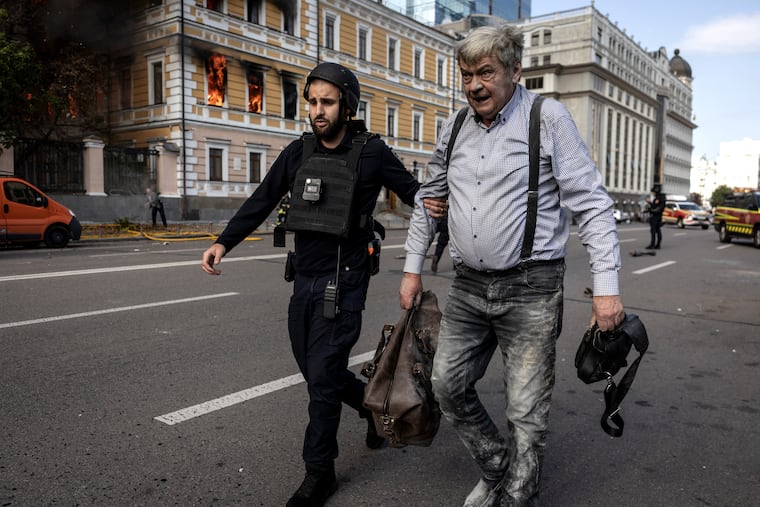
Russia has shown little sign it is interested in finding a real settlement to the war. Ukraine had requested a Christmas truce, which Russia declined. Russia has continued to aggressively bomb Ukraine in recent days, targeting the energy grid and triggering more widespread blackouts across the country. Russia’s early-morning attack on Tuesday killed three people, including a 4-year-old child.
Warnings continue that more bombardment is likely as the energy system is under greater stress responding to the subzero temperatures taking hold across Ukraine.
On Wednesday, meanwhile, a police car exploded in Moscow, killing two police officers in the same spot where a general was killed by a car bomb two days earlier. Ukraine did not claim responsibility for the attacks but Russia has suggested Kyiv could be behind the operations.
The Russian Investigative Committee said in a statement that two traffic police officers saw a suspicious individual near a police car. As they approached to detain him, an explosive device detonated.
Two prominent Russian military bloggers pointed fingers at Ukrainian and European special services, blaming them for the attack and attempting to destabilize Russia from within.
“I believe that the Ukrainian (British, and U.S.) intelligence services are trying to open a second (subversive) front inside Russia,” state media military correspondent Alexander Sladkov wrote on his Telegram blog.
Sladkov also questions whether the CCTV surveillance system bolstered in Moscow in recent years would help identify those responsible for the attack, and noted that if the investigation results are not released this week, it will be a “demonstration of weakness.”
Another war reporter, Alexander Kots, wrote that the explosion “clearly bears the mocking signature” of special services from Ukraine and Britain.
“This is a typical British anti-crisis: sow panic among the population, destabilize it from within, create a sense of insecurity, undermine the authority of the authorities and the security services, provoke public discontent with the special military operation, and provoke rallies calling for its swift end,” Kots wrote.