67 boat strikes. 221 dead. The cocaine hasn’t slowed, officials report.
The Trump administration’s deadly military strikes have not reduced the amount of cocaine entering the United States. In Florida, the price of the drug is down any about 50% in the last five years.
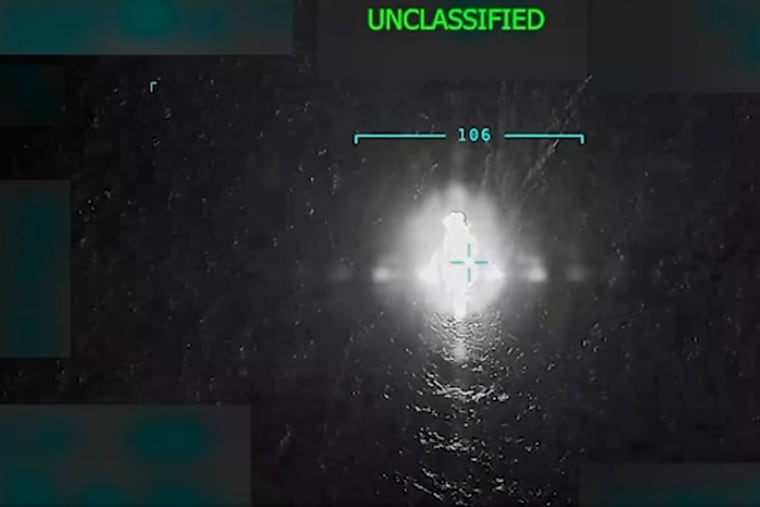
The Trump administration’s deadly military strikes on alleged drug trafficking boats have not reduced the amount of cocaine entering the United States, but they’re prompting criminal organizations to develop new strategies and tactics and undermining traditional investigative methods, according to a previously unreported assessment by the Drug Enforcement Administration, a closed-door congressional briefing, and interviews with current and former U.S. and foreign officials.
In a recent assessment reviewed by the Washington Post, DEA analysts found the strikes had failed to affect the supply or price of cocaine in the United States and had led traffickers to diversify beyond go-fast boats and to avoid international waters, opting instead for larger boats and hemming close to coastlines, where U.S. forces are less likely to open fire. In a closed-door briefing last month, Pentagon officials told lawmakers the strikes in international waters off South and Central America had not reduced the drug’s purity.
Traffickers are also relying more on aircraft, which take off from clandestine airstrips along the Colombian-Venezuelan border and head east to Guyana and Suriname to avoid U.S. forces, according to the DEA assessment.
“When you squeeze the balloon on one side, it always expands on the other side,” one DEA official told the Post. “They always find the weak spots and exploit them.” The official spoke on the condition of anonymity because they were not authorized to discuss the matter publicly.
Chief Pentagon spokesperson Sean Parnell said Operation Southern Spear was accomplishing “exactly what it was designed to do: detect, disrupt, and dismantle designated terrorist organizations and the networks they rely on to traffic narcotics, generate illicit revenue, and threaten the security of the United States and the Western Hemisphere.”
“Transnational criminal organizations have continually adapted their tactics for decades,” Parnell told the Post. “That does not indicate the pressure is ineffective. It demonstrates that we are imposing systemic friction on their operations.”
The DEA did not comment. A spokesperson for Senate Armed Services Committee Chairperson Sen. Roger Wicker (R., Miss.) did not respond to a request for comment.
Preliminary findings two months after the strikes began last September showed that they had disrupted smuggling routes, the DEA analysts reported, causing increases in cocaine prices and drug-related violence. But prices have since reverted to previous levels. “Smugglers have adapted to the intensified pressure,” they wrote. “Price and availability have not been noticeably affected.”
In one example, they allege, traffickers on Colombia’s La Guajira peninsula pay officials to disclose the locations of U.S. ships, then launch their vessels “once U.S. military assets have departed the area.”
The Colombia Defense Ministry didn’t return a request for comment.
Pentagon officials told members of the Senate Armed Services Committee last month that DEA analysis of confiscated cocaine showed high levels of purity, according to a congressional aide familiar with the briefing. High purity suggests supply remains consistent, the DEA official said; dealers do not need to dilute the drug to stretch inventory.
The reports contradict public claims by President Donald Trump. Trump has said at least 15 times, including as recently as last month, that the strikes have reduced maritime drug trafficking into the country by 97% or 98%. “98.2% of Drugs coming into the U.S. by Ocean or Sea have STOPPED!” he wrote on Truth Social in April.
Trump has transformed traditional U.S. drug enforcement into a military campaign that fuses the legal and strategic approaches of the war on drugs and the war on terror. In the past year, U.S. forces have attacked at least 67 boats, captured Venezuelan President Nicolás Maduro, killed Tren de Aragua leader Héctor “El Niño” Guerrero, and attacked an alleged camp of FARC dissidents in Ecuador.
The boat strikes have killed at least 221 people since September. Legal analysts have denounced them as executions without trials. Administration officials say they’re aimed at reducing the flow of “deadly poison” into the country.
The White House defended the approach.
“These measures have not only eliminated narcoterrorists themselves, but also discouraged bad actors from trying to smuggle drugs into our country should they meet the same deadly fate,” spokesperson Anna Kelly said in a statement to the Washington Post. “President Trump is using every tool at his disposal to save lives from the scourge of illicit narcotics, and any suggestion that these efforts have not been effective are laughable.”
The U.S. militarization of the decades-long war on drugs has begun to influence Europe, where a lead enforcement agency is urging nations to adopt more aggressive tactics.
But a senior Colombian security official said the boat strikes have had a minimal impact.
“There was a dissuasive effect in one type of transportation,” the official said. “So it has forced them to seek out other methods. Taking the drugs out through ports has increased, stockpiling it on large ships.” The official, like others interviewed for this article, spoke on the condition of anonymity because they were not authorized to discuss the subject publicly.
Trump and other officials initially described the attacks as part of a broader war against fentanyl, the leading cause of illicit drug deaths in the United States, an issue on which Trump campaigned. But the majority of fentanyl enters the United States by land, not sea. On the shipping routes targeted by Operation Southern Spear, the principal illicit cargo is cocaine.
When the military began blowing up boats, Monroe County, Florida, Sheriff Rick Ramsay was thrilled. His jurisdiction includes the Florida Keys, for centuries a smuggler’s playground.
“This is war, and they are bringing death to the U.S. every time they get a boat here,” he said. “Every boat that doesn’t arrive will save U.S. lives.”
The “kinetic strikes” haven’t stopped the flow of cocaine there, he said. “We see drugs floating up on a weekly basis,” he said. “Floating up on beaches, behind houses. … It’s continuing on strong.”
Still, he said, they’re a “necessary evil.”
“You don’t give up just because you’re losing the battle.”
Marine Gen. Francis L. Donovan, the commander of U.S. Southern Command and senior officer overseeing Operation Southern Spear, told the Senate Armed Forces Committee in March that the strikes are “probably not the most effective tool” and “aren’t the answer.”
“But putting total systemic friction from point of production to point of delivery,” he said, “I believe that actually kinetic strikes will be one of the many tools.”
But the strikes have made investigating drug trafficking more challenging, according to the DEA official. Investigators typically rely on low-level informants to provide intelligence on routes and meeting points to build cases against higher-ranking managers and bosses. Now those sources are being pulled back from the field, the current official said, to protect them from being killed in U.S. attacks.
Based on pricing, there might, in fact, now be more cocaine circulating in the United States. In Florida, cocaine is selling for $13,000 to $15,000 per kilogram, a senior DEA official said, a drop of roughly 50% over the last five years.
Global cocaine production, centered in Peru, Bolivia, and particularly Colombia, has reached an all-time high, the U.N. Office on Drugs and Crime reported last month. From 2014 to 2024, the office reported in its 2026 World Drug Report, the area under coca cultivation tripled to more than 1,480 square miles and illicit cocaine manufacture quadrupled to 4,100 tons.
“The business is so extraordinarily profitable that the cartels do not mind paying freight costs that are five or even 10 times higher,” an Ecuadorian naval intelligence official said. “They know that while the United States may destroy one speedboat, they will successfully get 10 semisubmersibles — or other speedboats that evade detection — through.”
Xinming Du, an economist at the National University of Singapore, reported in March that Colombia’s cocaine boom was linked to 1,000 to 1,500 overdose deaths in the United States annually.
The boat strikes, she said, are unlikely to diminish cocaine supply in the United States.
“Coca cultivation at the source in Colombia is the supply factor most directly linked to U.S. [cocaine] overdose deaths,” she said. “With source production at record levels, total flow is driven mainly by what is grown rather than by what is intercepted in transit.”
Derek Maltz, the DEA’s acting administrator during the first four months of Trump’s second term, has called for greater military involvement to fight trafficking. He said the strikes send a necessary message to the world.
“America is now actually in a real drug war," Maltz, who retired from the DEA in May 2025, told the Post. “Over the years we talked about a drug war, but we didn’t fight them as if they were enemies.”
He acknowledged that the strikes hadn’t succeeded at “disrupting the flow of cocaine.”
“We are seeing very significant cocaine seizures inside the U.S.,” he said. “We’re back to seeing hundreds of pounds of cocaine being seized.”
The U.S. Coast Guard continues to stop and board vessels it suspects of carrying drugs.
As commander of Coast Guard Station Miami Beach, Lt. Matthew Ross is responsible for operations over more than 4,000 square miles of ocean. On one boat in December, station personnel found 3,715 pounds of cocaine, the largest bust by a small-boat Coast Guard station in 30 years, Ross said. They found 1,535 pounds on another, in May, and 900 pounds on a third later that month.
“Smugglers have been bringing contraband into South Florida for 400 years,” Ross said. “They aren’t going to stop.”