Iran targets commercial ships, Dubai airport, and oil facilities as concerns grow over global energy
Iran has attacked commercial ships across the Persian Gulf and targeted Dubai International Airport, escalating a campaign of squeezing the energy-rich region as global energy concerns mounted, as American and Israeli airstrikes pound the Islamic Republic
DUBAI, United Arab Emirates — Iran fired upon commercial ships on Wednesday and targeted Dubai International Airport, escalating a campaign of bottling up the oil-rich Persian Gulf as global energy concerns mounted and American and Israeli airstrikes pounded the Islamic Republic.
Iran’s response to the surprise Israeli and U.S. bombardment that started 12 days ago has upended trade routes, choked supplies of fuel and fertilizer coming out of the gulf, and threatened air traffic through one of the world’s most-traveled regions. Both sides have dug in, hoping to outlast the other.
Iran’s new supreme leader, Ayatollah Mojtaba Khamenei, was wounded at the start of the war, on the day when his father and predecessor, Ayatollah Ali Khamenei, was killed in an Israeli airstrike, an Israeli intelligence assessment has found.
An Israeli intelligence official and a reservist with knowledge of the assessment spoke on condition of anonymity because they were not authorized to discuss the matter with the media. They gave no details on the nature of the injuries.
The 56-year-old, whose wife was also killed in the Israeli strike, has not been seen since becoming supreme leader on Monday. Yousef Pezeshkian, the son of Iranian President Masoud Pezeshkian, wrote on social media that he had heard Mojtaba Khamenei was wounded but that friends said “he is healthy and there is no problem.”
New strikes in Tehran and across the Persian Gulf
In Tehran late Wednesday, witnesses said they heard loud airstrikes, explosions, and heavy fire by antiaircraft batteries. They could also hear the buzzing of drones overhead. A person driving to Tehran described overcast skies as smoke from bomb and missile blasts mingled in air that smelled of burnt powder and gasoline. All of the witnesses spoke on condition of anonymity for fear of reprisal.
The fallout across the Middle East widened as Israel struck what it said were targets connected to Iran-backed Hezbollah insurgents in Lebanon. The United Nations refugee agency said at least 759,000 people have been internally displaced in Lebanon, while more than 92,000 others have crossed into neighboring Syria.
Elsewhere, two Iranian drones hit near the Dubai airport, home to the long-haul carrier Emirates and the world’s busiest for international travel. Four people were wounded but flights continued, the Dubai Media Office said.
At Oman’s Port of Salalah, firefighters battled a blaze Wednesday at fuel storage tanks after days of Iranian attacks, according to the Oman News Agency.
U.N. body demands an end to Iranian attacks on neighbors
The U.N. Security Council voted Wednesday to approve a resolution demanding a halt to Iran’s “egregious attacks” on its Gulf neighbors.
“The international community is resolute in rejecting these Iranian attacks against sovereign countries that are threatening the stability of the peoples, especially in a region of strategic importance to global economy, energy, security, and security of global trade,” said Bahrain’s U.N. ambassador, Jamal Alrowaiei.
The 13-0 vote in the U.N.’s most powerful body reflects Iran’s isolated position as it has aggressively responded to Israeli and U.S. strikes. China and Russia — two Iranian allies — abstained from the vote.
Their U.N. ambassadors called the proposal “extremely unbalanced” in not mentioning the strikes against Tehran that began the war.
Russia’s U.N. ambassador, Vassily Nebenzia, said it might leave the impression that Iran, “on its own volition and out of malice, conducted an unprovoked attack on Arab states.” Iranian U.N. Ambassador Amir Saeid Iravani said the resolution “deliberately ignores the root causes of the current crisis.”
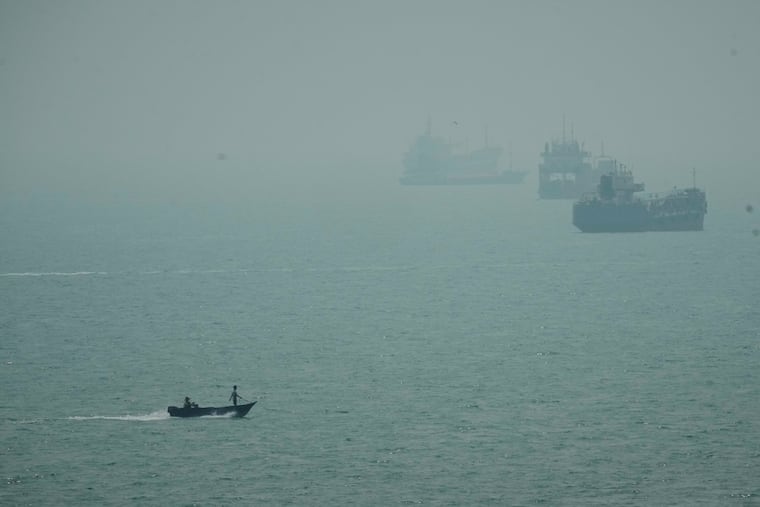
Iran has effectively stopped cargo traffic through the narrow Strait of Hormuz, through which a fifth of all traded oil passes. It has also targeted oil fields and refineries in Gulf Arab nations, aiming at generating enough global economic pain to pressure the United States and Israel to end their strikes.
At least 12 incidents involving vessels around the strait have been confirmed since fighting began, according to two global trackers, and at least seven mariners have been killed.
A projectile hit a Thai cargo ship off the coast of Oman in the Strait of Hormuz, setting it ablaze. Authorities are searching for three missing crew members from the Mayuree Naree after 20 were rescued by the Omani navy, according to Thailand’s Marine Department.
Iran appears to still be exporting oil through the strait
The United States has pledged to keep the strait open and has led intense airstrikes targeting Iran’s navy and the port city of Bandar Abbas. The U.S. military said Tuesday it destroyed 16 Iranian minelayers near the strait.
Some tankers, believed linked to Iran, are continuing to get through the strait, making so-called dark transits — meaning they are not turning on trackers that show where they are. Vessels carrying sanctioned Iranian crude often turn off their trackers.
The commodity-tracking firm Kpler said Iran has restarted crude exports through its Jask oil terminal on the Gulf of Oman. A tanker loaded roughly 2 million barrels at Jask on March 7, it said.
IEA acts to ease pressure by releasing some oil reserves
Oil prices remained well below Monday’s peaks, but the price of Brent crude, the international standard, was still up more than 20% Wednesday from when the war began. Consumers around the world are feeling the pain at the pump.
The International Energy Agency agreed Wednesday to release the largest volume of emergency oil reserves in its history, in a bid to counter the war’s impact on energy markets.
The Paris-based organization said it will make 400 million barrels of oil available from its member countries’ emergency reserves, more than twice the amount they released four years ago in response to Russia’s invasion of Ukraine.
That could replace supplies currently off the market for roughly three weeks, said Bruce Bullock, director of Maguire Energy Institute at Southern Methodist University.
While visiting Ohio on Wednesday, President Donald Trump told Cincinnati television station WKRC that he will tap the U.S. Strategic Petroleum Reserve to try to curtail rising gas prices. He didn’t specify how many barrels of oil the U.S. would release.
Israel launches new strikes on Lebanon
Israeli strikes set a building ablaze in central Beirut, engulfing the top two floors. Lebanon’s Health Ministry said four people were wounded.
Other Israeli strikes on southern and eastern Lebanon killed 14 people, and a Red Cross worker died of wounds sustained earlier this week, when he and his team were hit by an Israeli strike while they were rescuing people from an earlier attack.
Lebanon’s Health Ministry said Wednesday that 634 people have been killed in the country since the latest fighting began.
Iranian authorities say more than 1,300 people have been killed there, and Israel has reported 12 people dead. Seven U.S. soldiers have been killed while eight more have suffered severe injuries.
Iran vows to target banks, threatens World Cup boycott
Iran’s joint military command said it would start targeting banks and financial institutions in the Middle East. That would put at risk particularly Dubai, in the United Arab Emirates, which is home to many international financial institutions, as well as Saudi Arabia and the island kingdom of Bahrain.
The threat came after a Tehran location of Bank Sepah, a state-owned financial institution sanctioned by the U.S. over funding Iranian armed forces, came under attack Wednesday, killing staffers there, according to the state-run IRNA news agency.
In a separate development, Iran’s sports minister said the country’s team cannot take part in the forthcoming soccer World Cup in North America in June because of the “wicked acts” of the United States. It was scheduled for three group-play games in Inglewood, Calif., and Seattle.
Ahmad Donyamali told Iranian state TV that “it’s not possible for us to take part in the World Cup” after the U.S. waged “two wars” against Iran in less than a year, referring to U.S. strikes on Iranian nuclear sites last June. He said Iranian players would not be safe in the United States.