Beijing rejects Trump’s claim of meddling, but avoids a fight
China on Friday said it had "no interest in interfering in U.S. elections and had never done so.
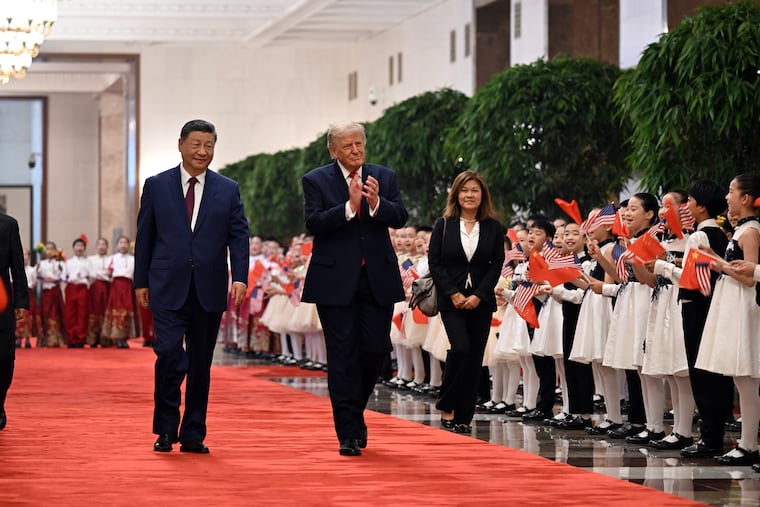
China on Friday rejected President Donald Trump’s claim that it had meddled in U.S. elections as baseless. But its response was relatively restrained, a sign that Beijing did not want to let the accusation derail a thaw in relations that both sides have spent months trying to preserve.
Trump had said in a speech that China had carried out “the largest compromise of election data in history” starting with the 2020 cycle, one of several claims he made that was either overstated or untethered from reality.
In Beijing, a Foreign Ministry spokesperson, Lin Jian, said China had “no interest in interfering in the U.S. elections and has never done so,” adding that the claims “are aimed at vilifying China.” It leveled a vague accusation back at Washington for “wantonly” interfering in other countries.
The response was firm but made no demands for retractions or threats of punishment. On China’s social media, commentators who are usually stridently nationalist were mostly quiet.
China experts said this showed that Beijing saw Trump’s speech as an attempt at playing to American voters before midterm elections, rather than a broadside directed at China.
It also underscored a desire on Beijing’s part to maintain a truce that was struck in May during a summit between Trump and China’s top leader, Xi Jinping.
Trump’s rhetoric on China during his address was “definitely harsh,” said Sun Yun, a scholar of China at the Stimson Center, a research group in Washington. But Trump had built up so much goodwill in China in recent months, she added, “there is some resilience in the relationship.”
Playing the China card
From Beijing’s perspective, Trump was taking aim at China for domestic political reasons, experts said. Officials in China understand that the Republicans are under pressure as midterm elections approach.
Chinese state media commentaries have argued that Trump has lost some of the support of his political base following his military intervention in Venezuela and the war in Iran. They have noted that he has failed to keep factory jobs at home, while consumers “bear higher fuel costs and inflation.”
Viewed through this lens, Trump’s speech was an attempt at mobilizing voters by fanning the idea of foreign intervention, said Wu Xinbo, an American studies scholar at Fudan University in Shanghai.
“Trump played this card mainly for domestic politics; it was not aimed at China-U.S. relations,” Wu said, adding that this was something Chinese officials would likely not respond to if it was a one-off.
Documents released by the White House that Trump said bolstered his claims suggest there is evidence of a pro-China influence effort and that Beijing was skeptical of Trump. But that was a minority perspective inside the intelligence agencies, and the intelligence officers who held that view said they had only low or medium confidence in their assessments.
China wants to preserve the stability
The U.S.-China relationship steadied in October after Beijing agreed to suspend its limits on exports of rare earth metals, and Washington halved tariffs on China related to fentanyl. “We’re not going to hurt China,” Trump said at the time.
After Trump met with Xi in Beijing, China said both sides had agreed that U.S. tariffs would not rise further. They agreed on a relationship based on “constructive strategic stability,” a vague term meant to signal that both sides would limit hostilities.
During his trip, Trump invited Xi to the White House on Sept. 24, a meeting that officials are now working toward. Beijing expects the upcoming visit to help improve trade ties.
Any disruption to the fragile detente will hinge on whether Trump decides to take additional action on his claims of election meddling.
If Trump were to take fresh actions against China, like putting new tariffs on Chinese goods, Wu said, “China would certainly retaliate.”
Chinese economy needs the U.S.
China may also be tempering its response because it wants to make nice with the United States on trade disputes as its own economy stumbles and as its companies face pushback from foreign governments.
This week, China reported that its economy grew at the slowest pace in three years. It is also facing increased scrutiny in other parts of the world as its exports surge, raising alarm among politicians in Europe and Southeast Asia. Chinese shipments overseas climbed 27% over the month of June, and its trade surplus with the world climbed to more than $125 billion, its second largest on record.
At home, Chinese families are feeling poorer, consuming less, and seeing fewer job prospects. That means that China needs markets overseas to keep its factories churning, grow its economy, and create new jobs, said Ja Ian Chong, an associate professor of political science at the National University of Singapore.
“Having more access to the U.S. market could also take some of the pressure off China’s economic relationships with a bunch of other countries from Europe to Africa and Asia,” he said.
This article originally appeared in the New York Times.