How China and Russia are using Maduro’s capture to sway U.S. discourse
Contradictory narratives and conspiracy theories might be generated by foreign powers.
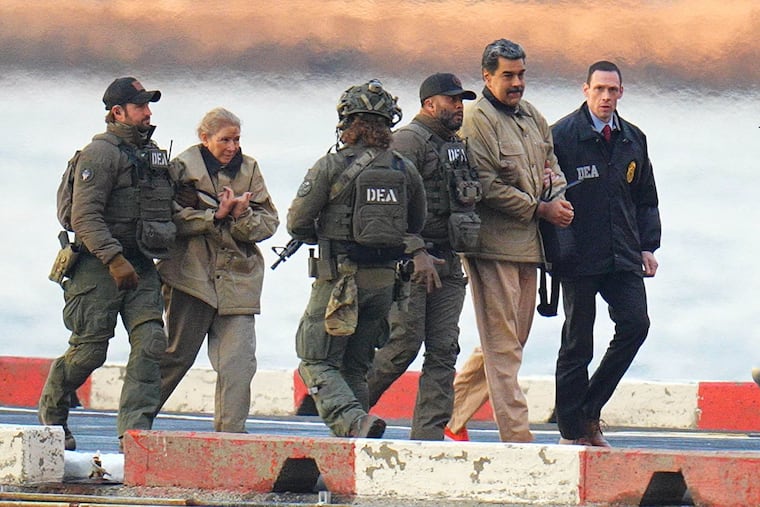
Two days after Venezuelan President Nicolás Maduro was captured by U.S. Special Forces, a MAGA-friendly social media commentator who uses the name David Freeman shared news footage on X showing Venezuelans cheering and dancing on a South Florida street.
“Democrats are absolutely FURIOUS over the joy for what President Trump just accomplished,” the social media user wrote to his 1.6 million followers.
The same day, Maimunka News, an account that usually posts about the war in Ukraine, elevated a video report from the Kremlin-backed news outlet RT stressing that Venezuelans were demanding Maduro’s release.
Neither video was exclusive or particularly surprising. But both the accounts that promoted them were part of a covert Russian influence operation that has been saturating U.S.-focused information ecosystems with a chaotic stream of often contradictory narratives and conspiracy theories about Maduro’s capture using a network of social media accounts, influencers, and fake websites, according to research from the Atlantic Council’s Digital Forensic Research Lab.
“I call it the ‘throw spaghetti at the wall’ approach, where they test out various conspiracies … [and] promote contradictory narratives,” said Layla Mashkoor, deputy director of research for the Washington-based group, which linked the social media activity to a covert Russian network known as Storm-1516. “It’s really an approach that doesn’t necessarily seek to amplify a single, cohesive message, but rather just seeks to dilute the entire information environment to confuse individuals.”
The aim, she said, is “to create chaos that makes it difficult for the everyday person who might encounter this to then be able to discern what are they seeing that might be true.”
As they have done during many other high-profile and contentious news events, such as the 2024 U.S. presidential election campaign, Russia and China have launched influence operations to quickly capitalize on controversy — this time surrounding the U.S. operation to seize the Venezuelan president — by spreading conspiracy theories, inflammatory claims, manipulated media, or disingenuous content, researchers said. The campaigns about Venezuela illustrate how government actors seek to influence foreign political discourse online during high-pressure news events when authoritative information about what happened is still unfolding.
Beijing’s communication efforts have centered on showing how the United States acts unilaterally and in a disorderly way, the researchers found. China, whose officials condemned the U.S. strike on Venezuela and Maduro’s capture as violations of international law, sought to bolster its narrative that the United States is an unstable and unreliable player on the world stage, according to the research.
Beyond sowing uncertainty, the Russian influence operation seeks to dilute the narrative that it failed to protect one of its closest allies, a sensitive point following the downfall of Syria’s Bashar al-Assad in 2024, Mashkoor said.
“There’s a sort of fine line and fine balance where Russia is both trying to obscure the fact that it was unable to protect its ally by painting the U.S. as the unreliable ally,” Mashkoor said.
The Chinese and Russian campaigns represent a small sliver of the deluge of misinformation about Maduro’s capture that is swirling online. Social media posts falsely claiming to show the moment when Maduro was captured or that misidentify or conjure up protests for or against the U.S. operation continue to flood social media.
Propaganda and disinformation campaigns have become easier to produce and often harder to spot with the rise of artificial intelligence, which allows users to easily create fake articles and doctored or completely fake video or audio footage of events, and spread them on social media with a few clicks, researchers said.
But conspiracy spreaders are also relying on more traditional deception methods — such as using old video footage from other events and mischaracterizing the context — to take advantage of the heightened attention on the political events in Venezuela, said Tyler Williams, vice president of intelligence at the social network analysis firm Graphika.
For instance, a cluster of X users from countries including Yemen have repurposed footage of the anti-Trump No Kings protests from October to criticize U.S. intervention in Venezuela by alleging the videos showed Americans opposing Maduro’s capture. Some posts used footage that still featured the No Kings logo in the upper-left corner, while other posts carried footage with a different logo covering the original footage, according to Graphika.
“It’s a very messy information environment, and we haven’t seen kind of a coalescing of narratives between state actors and your usual online users,” Williams said. “I think it’s still early days, and it’s still quite a mess.”
The Russian-backed Storm-1516 campaign spread several other narratives on X including false conspiracy theories that the Rothschild family was involved in orchestrating the U.S. actions in Venezuela and that Maduro’s capture was a false flag operation rather than a genuine development, according to the Digital Forensic Research Lab. Another Russian operation, the Pravda Network, regurgitated talking points from Kremlin-affiliated sources about the developments in Venezuela on sites that mimic news sites that target U.S. audiences, the research found.
By contrast, China sought to mock President Donald Trump by mimicking his digital political style. Several inauthentic X accounts promoted a video produced by the Chinese state broadcaster CCTV that featured an AI-generated parody of a popular meme song that derides U.S. foreign military interventions. The original language video, which was initially posted on Douyin, the Chinese equivalent of TikTok, features a dancing baldheaded eagle in a suit boasting about U.S. conflicts in Iraq, Syria, and Venezuela leading to greater control of oil.
The video, which received more than 1.9 million likes in China, did not get much traction in English on X. But it did seem to demonstrate how China operatives were willing to shift their content strategy to match the political style of the moment in the United States, according to Mashkoor.
“It speaks to a larger cultural shift in how political dialogue reaches people online, and how it embraces online culture and digital native trends and tropes,” Mashkoor said. “We’re kind of in a new era of how states … try to communicate to each other and to domestic and foreign audiences.”