China condemns U.S. strike in Venezuela after top diplomat met with Maduro
A Chinese special envoy met with the Venezuelan leader in Caracas just hours before the U.S. military action.
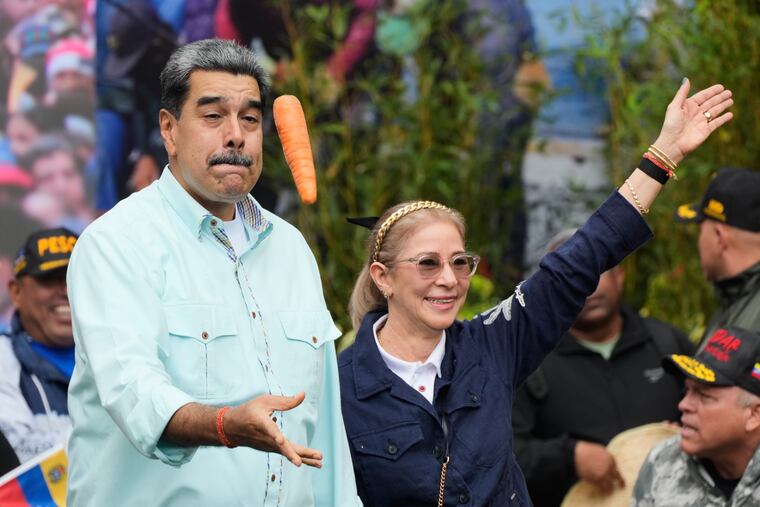
China strongly condemned the overnight U.S. strike on Venezuela and the capture of President Nicolás Maduro, which came just hours after a Chinese special envoy met with the Venezuelan leader to reaffirm Beijing’s support for the imperiled regime, calling the action “deeply shocking” and a serious violation of international law.
Shortly before the surprise U.S. attack unfolded, a delegation of Chinese officials arrived in Caracas, led by Beijing’s special envoy for Latin American and Caribbean affairs, Qiu Xiaoqi, and met with Maduro to discuss the rising tensions with the United States. It was Maduro’s last publicly reported official meeting before he and his wife were captured by U.S. forces and flown out of the country.
President Donald Trump on Saturday said that the United States will now “run” Venezuela for an unspecified amount of time, following the operation that saw over 150 U.S. military aircraft marshal for a spectacular extraction mission.
Maduro’s exit marked an abrupt end to a monthslong effort by China to support the embattled leader, as fears grew in Beijing that the United States would soon attempt to seize Chinese-flagged oil tankers as part of its blockade of the country. Beijing has been the regime’s most influential global ally and Venezuela’s primary financial lifeline through loans and oil purchases, accounting for around 80% of the country’s total oil exports.
At 7:30 p.m. Friday, Maduro shared a final message on his Telegram channel, lauding his meeting with Qiu as reaffirming “the strong bonds of brotherhood and friendship between China and Venezuela. A relationship that stands the test of time!” It was accompanied by a video set to triumphant music showing Qiu — a vice-minister level diplomat — and his team walking through what appeared to be the hallways of the presidential palace and shaking hands with Maduro.
Just 6½ hours later, Chinese officials in Caracas were stunned when the U.S. strike began, setting off a furious string of missives back to Beijing, according to one Chinese diplomat familiar with the situation. “It was completely shocking,” the official said, speaking on the condition of anonymity because they are not authorized to speak to media.
On Saturday, China’s Foreign Ministry issued a sharp rebuke, strongly condemning the U.S. raid. “Such hegemonic acts of the U.S. seriously violate international law and Venezuela’s sovereignty, and threaten peace and security in Latin America,” it said in a statement. Separately, the Foreign Ministry and China’s embassy in Venezuela warned citizens to avoid traveling to the country.
“China employed rare, forceful language previously reserved for political assassinations and mass casualty events,” sail Neil Thomas, a fellow at Asia Society Policy Institute’s Center for China Analysis.
According to Venezuelan reports and the Chinese official, Qiu met with Maduro to review the roughly 600 political and economic agreements between the two countries and address concerns over the rising threat of a U.S. military intervention and potential threats to Chinese oil tankers.
Chinese leader Xi Jinping met with Maduro in May last year on the sidelines of Russia’s Victory Day celebrations. According to the Chinese readout of the meeting, Xi described the two countries’ relationship as an “all-weather strategic partnership” and reaffirmed China’s support for Venezuela’s sovereignty.
Asked on Saturday how the takeover would affect U.S. relations with major oil buyers including China, Trump said that “in terms of other countries that want oil, we’re in the oil business, we’re going to sell it to them. We’re not going to say we’re not going to sell it to them.”
China has long viewed Venezuela as a key political ally in Latin America as it seeks to expand its influence in the region. This month, Beijing released its first major Latin America strategy update in nearly a decade, more explicitly incorporating security cooperation — including military exchanges — into its framework and reaffirming support for the sovereignty of regional partners.
Republican lawmakers focused on China policy welcomed the move Saturday, saying it curtailed Chinese influence in the region. “The Trump Administration’s decisive action against Nicolás Maduro removes a Chinese ally from power and makes the world a safer place. China’s partnership with Maduro propped up an authoritarian ruler who worked with our nation’s adversaries and hurt the American people,” said Rep. John Moolenaar (R., Mich.), chairperson of the House Select Committee on China.
Analysts say that the potential seizure of Venezuela’s government by the United States is unlikely to seriously undercut Beijing’s broader efforts to expand its regional presence.
“Left-leaning governments in the region will likely lean further toward Beijing as a preferred economic partner and diplomatic alternative to Washington. This strike is unlikely to dissuade China’s regional trade and investment; Beijing requires booming exports to sustain growth, and Washington currently lacks a competitive economic diplomacy strategy to match its security presence,” said Thomas.
Trump on Saturday lambasted Maduro’s regime for facilitating the growing influence of U.S. adversaries in the region, but stopped short of naming China explicitly. “Venezuela was increasingly hosting foreign adversaries in our region and acquiring menacing offensive weapons that could threaten us,” said Trump. “They used those weapons last night.”
In recent months, Maduro has called on China, as well as Russia and Iran, to provide weapons and other assistance amid rising U.S. pressure. According to documents obtained by the Washington Post, Maduro drafted a letter appealing to Xi for “expanded military cooperation” in the face of U.S. escalation, including a request to expedite the production of radar detection systems by Chinese companies.