Two whale deaths in one week: How authorities and scientists plan to investigate the N.J. and Delaware fatalities.
Transporting the giant mammals poses logistical difficulties but the postmortem examinations could reveal a lot about the health and dangers facing whale populations.
The waves rocked a dead 30-foot juvenile humpback whale that lay belly-up near Delaware’s Bethany Beach Friday as marine rescue workers prepared for the open-air postmortem examination that would take place on the sand.
The whale was first seen “floating at sea,” two miles off the Indian River Inlet earlier in the week, according to the Marine Education, Research & Rehabilitation Institute, also known as MERR. It finally beached Thursday.
As Suzanne Thurman, executive director of MERR, waited for heavy machinery Friday morning, she guessed the whale might weigh about 20,000 pounds, posing a serious challenge for the people investigating the mammal’s cause of death.
The weight, the constant movement at the behest of the ocean, and the slippery feel of the oil in the whale’s blubber made cutting it open for a necropsy — the examination to determine cause of death — inherently risky, said Thurman. The heavy machinery would have to stabilize the whale on land so the scientists could do their work.
“It can’t be towed,” Thurman said. “There are no other effective ways to move the whale.”
Unlike other animal necropsies, the whale’s postmortem examination would have to take place on the open beach, she said.
“A necropsy is very important because we can’t always tell what happened to the whale simply by looking at it,” she said, adding even if a whale is injured, scientists have to check for signs of human impact and if there was an underlying disease that led to its death.
Finding the cause of death for whale fatalities is crucial for conservationists. Though whale populations have largely rebounded since their peak hunting days, they face more trafficked waterways and a changing climate, which put them at risk all the same.
In recent years headlines such as “6 Whales Wash Ashore in NY, NJ in 33 Days” have been cause for alarm for scientists.
Whenever there’s a significant die-off of any marine population that “demands immediate response,” the U.S. National Oceanic and Atmospheric Administration gets involved, declaring what’s called an unusual mortality event. This allows scientists to investigate the deaths and study the remaining population in real time.
There are three active unusual mortality events, all involving whales in the Atlantic — the Atlantic minke whale, the North Atlantic right whale, and the Atlantic humpback whale.
How the Delaware fatality factors into the larger picture of whale population health remains to be seen.
The speed at which MERR staff can finish the necropsy depends on environmental factors and equipment availability from the state.
After MERR is done with the necropsy, Thurman said the whale will be buried in the beach because it’s too heavy to move anywhere else and it will become an important source of nutrients.
The Delaware whale is the second such mammal death in the region this week.
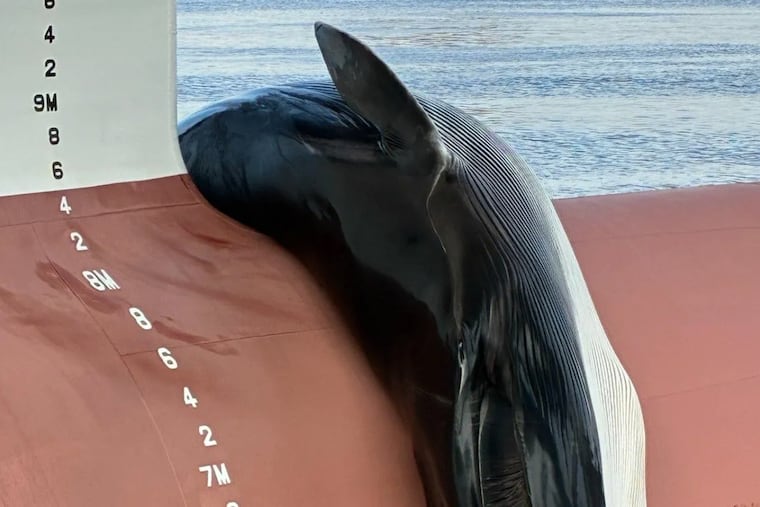
A 25- to 30-foot fin whale was discovered on the bow of a ship Sunday night at a marine terminal in Gloucester City, N.J., though the necropsy process has been much slower.
Fin whales are the second-largest whale species on earth and endangered, according to the National Oceanic and Atmospheric Administration.
The Marine Mammal Stranding Center took the lead in the New Jersey investigation, limiting public comments to its social media posts. By Wednesday, the Stranding Center said it had a necropsy plan in place for the 12- to 13-ton whale, but staff couldn’t move forward with it until they had a suitable burial location secured.
NOAA’s law enforcement arm, which is tasked with enforcing about 40 different marine laws, has opened an investigation into the whale death despite the incomplete necropsy. A spokesperson could not expand on what drove the decision, citing the pending investigation.
Stranding Center data, dating back to 2002, shows that whale strandings peaked in New Jersey in 2023, with a total of 14 cases. The following year saw a drop in strandings with a total of nine cases reported. Last year, strandings in New Jersey dropped to four.