Top court orders disclosures in N.J. cops’ use of facial recognition technology
New Jersey’s top court on Wednesday ordered prosecutors to more fully explain how they used the technology in a Jersey City murder case.
As police increasingly rely on a controversial investigative tool called facial recognition technology to identify crime suspects, New Jersey’s top court gave defense attorneys a win Wednesday, ordering prosecutors to more fully explain how they used the technology in a Jersey City murder case.
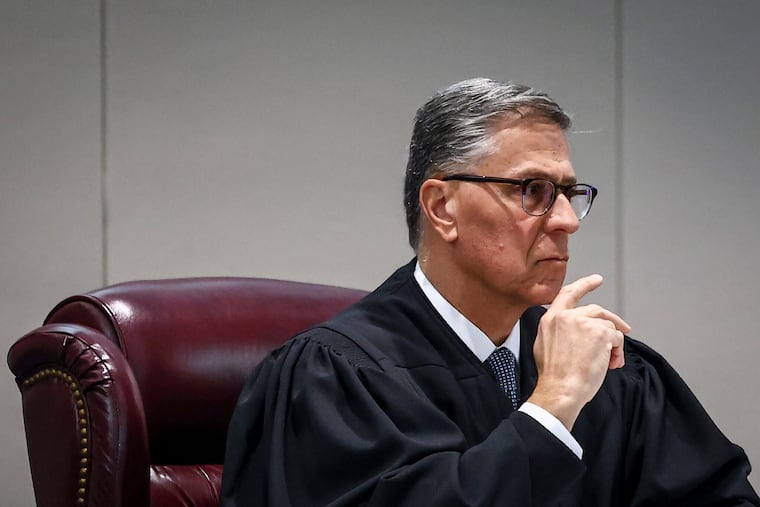
New Jersey Supreme Court Justice Douglas Fasciale, in a unanimous ruling, wrote that prosecutors were wrong to deny Tybear Miles’ discovery demand for details on which facial recognition software investigators relied on to arrest him in the June 2021 shooting death of Ahmad McPherson and how exactly they used it.
The technology is controversial because misidentifications have resulted in at least eight wrongful arrests nationally, with research showing it most often fails at identifying people of color, women, children, and elderly people. It also has gone largely unregulated both in New Jersey and nationally, alarming civil rights advocates.
Wednesday’s ruling builds upon a 2023 state appellate decision that required prosecutors to hand over 13 items related to the facial recognition software police used to charge Francisco Arteaga in a West New York armed robbery case.
Fasciale rejected any “mechanical application” of the Arteaga decision to other cases involving facial recognition technology, saying judges must decide such challenges based on case specifics.
Still, he said, fairness demands that defendants be able to scrutinize which tools police used to criminally charge them, both to challenge the tools’ reliability and to determine how police identified them as a suspect, examine whether the investigation was thorough, and demonstrate the possibility of another culprit.
“Although we reject a rigid checklist for [facial recognition technology] discovery, we note that such basic information will, in most cases, constitute the minimum necessary to safeguard a defendant’s right to a fair trial,” Fasciale wrote.
Attorney Dillon Reisman, who had argued before the court on behalf of the ACLU of New Jersey, called the decision “a really big win against the use of secret, opaque technology by law enforcement.”
“It’s a really positive sign that our court takes really seriously that new technologies are subject to constitutional safeguards,” Reisman said.
Tamar Lerer, deputy of the New Jersey Office of the Public Defender’s forensic science unit, had argued the case in court, too, and also applauded the ruling.
“Facial recognition technology may be novel, but the ability of people accused of crimes to find out how and why they were investigated is not,” Lerer said.
In Miles’ case, none of the crime’s eyewitnesses identified him as the shooter or even placed him at the scene, according to the ruling.
Instead, police identified him as a suspect after showing a confidential informant footage from surveillance cameras of six Black men seen nearby. That informant, who was not at the scene and did not see the slaying, identified Miles on the footage by his nickname (“Fat Daddy”) and Instagram handle, according to the ruling. Miles’ sister and ex-girlfriend also identified him as one of the men caught on camera.
Police then ran two facial recognition technology searches using Miles’ Instagram profile picture, according to the ruling. One search returned 10 possible matches and listed Miles as the eighth-likeliest match, while another search also produced 10 possible matches, the first five of which pictured Miles, the decision says.
After defense attorneys demanded more details about the facial recognition technology investigators used, a trial judge ordered prosecutors to turn over the same 13 items the appellate panel in Arteaga’s case specified. Prosecutors appealed, a state appellate court denied their motion, and the Supreme Court agreed to consider the case.
Fasciale upheld most of the lower court’s rulings, ordering prosecutors to hand over “basic information,” including the name and manufacturer of the software police used to search for suspects and its performance metrics, including error rates. He also directed prosecutors to provide “straightforward items” related to how investigators used the technology, including the original photograph police used as the “probe photograph,” edited copies of that probe photograph, and the photographs the technology identified as matches.
He reversed one particular part of the lower court’s rulings, though, rejecting the defense’s request for proprietary information, including the software’s source code. Miles’ attorneys had not proved a need for that information, Fasciale said. But if they do as the case progresses, the court can reconsider that request then, he added.
Lerer cheered that part of the ruling, too, saying it recognizes that “commercial concerns must yield to constitutional rights.”
Reisman noted that New Jersey still has not regulated facial recognition technology more than four years since the attorney general’s office solicited public input as a first step toward shaping statewide policy on its use by law enforcement.
Former Attorney General Gurbir Grewal in 2020 barred agencies from using one specific facial recognition technology app, Clearview AI, but little is known about how many of the state’s 500-some law enforcement agencies use the technology and how.
Dan Prochilo, a spokesperson for Attorney General Jen Davenport, called facial recognition technology “a valuable tool for investigating and solving crimes.”
“We welcome today’s Supreme Court ruling, which thoughtfully accounts for constitutional rights while confirming that defendants are not automatically entitled to unnecessarily burdensome, proprietary information that would short-circuit vital, well-conducted investigations and prosecutions that make New Jerseyans safer every day,” Prochilo said.
In Miles’ case, officers used a facial recognition system that is part of a multiagency initiative to crack down on illegal drugs in New Jersey and New York. That effort, known as a high intensity drug trafficking area task force, involves officers from federal, state, county, and local agencies in New Jersey and New York.
Those multiple jurisdictions and diffused investigations have made it tough for people arrested through the task force’s efforts to understand how they became criminal defendants, Reisman said.
“We still don’t even really know what government agency is ultimately responsible for the facial recognition system,” he said. “We don’t know anything about it, and because of that, we can’t even hold it accountable.”
This story originally appeared on New Jersey Monitor.